


‘No Arctic sovereignty without Inuit security,’ Tunraluk says
Nunavut Tunngavik Inc. president opens Arctic Security and Sovereignty Summit with hopeful keynote
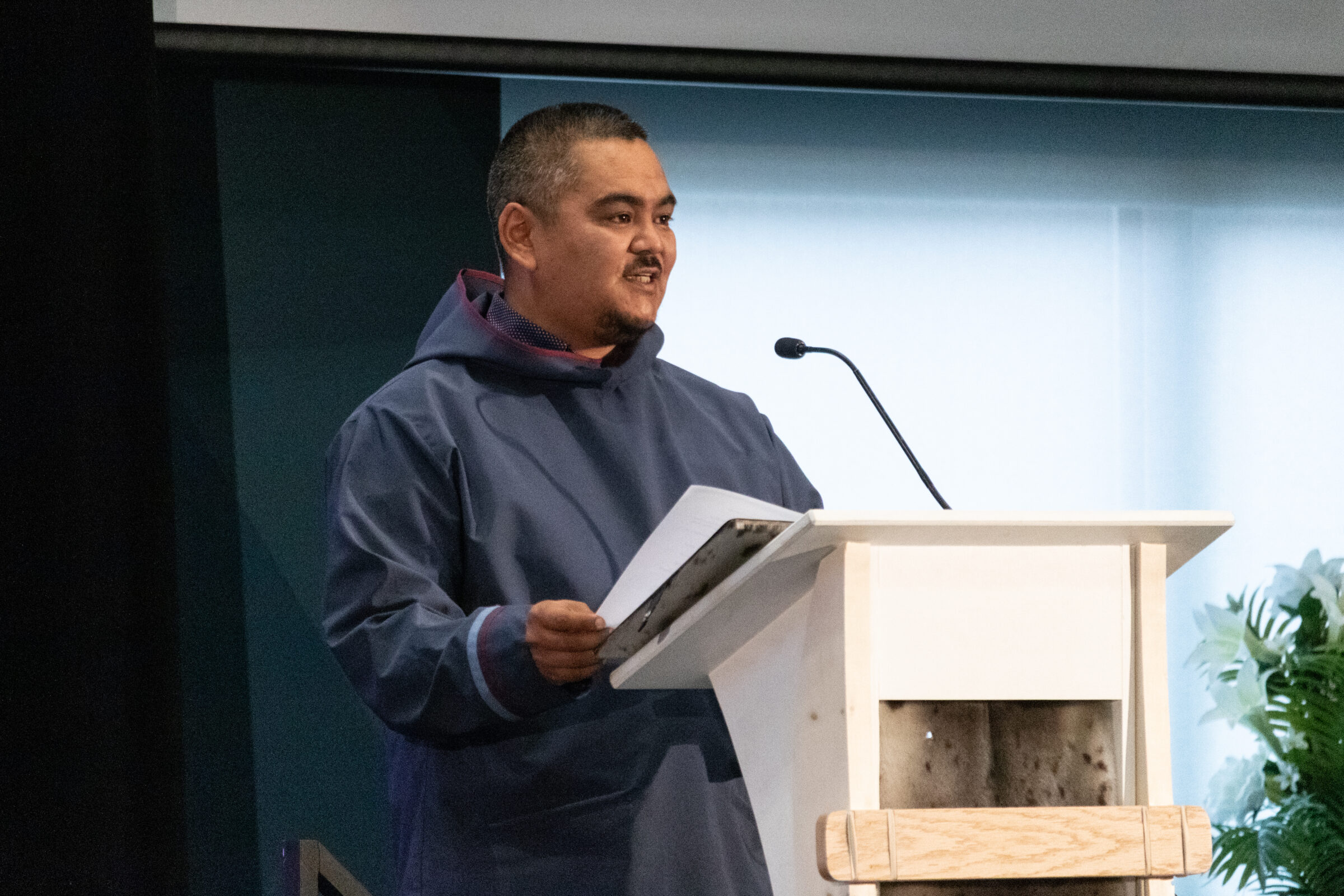
Nunavut Tunngavik Inc. president Jeremy Tunraluk delivers the opening keynote address Thursday of the Arctic Sovereignty and Security Summit in Iqaluit. (Photo by Jeff Pelletier)

For Nunavut Tunngavik Inc. president Jeremy Tunraluk, Arctic sovereignty and security can only happen if Nunavut communities are supported and Inuit culture can thrive.
“Our message is clear: there can be no Arctic sovereignty without Inuit security,” Tunraluk said Thursday in a keynote speech opening the Nunavut Arctic Sovereignty and Security Summit in Iqaluit.
The conference, held at the Aqsarniit hotel, is bringing together hundreds of government, military and business leaders for a series of talks covering security, infrastructure and Inuit leadership.
Tunraluk tied security and sovereignty to the well-being of Inuit communities.
“If our communities lack roads, runways, clean water or reliable communications, they are not secure,” he said.
“If homes are overcrowded and crumbling, if food is to be flown in from the south while [our] hunters are disempowered by policy, climate change and shipping impacts, then sovereignty just becomes a word.”
Canada, he said, needs to invest in community infrastructure, including “nation-building” projects for which he and Nunavut Premier P.J. Akeeagok have joined forces in calling for them to be built.
In particular, Tunraluk said the Grays Bay road and port — a proposed 230-kilometre all-season road and deepsea port that would link Nunavut to the south — would help Canada assert its sovereignty over the Northwest Passage.
But he emphasized that Inuit consultation is “not enough.”
“We must lead,” he said.
Tunraluk looked at the past, specifically the High Arctic relocations of the 1950s, when Inuit were not included in major decisions on sovereignty.
Those days are over, he said.
“There can be no Arctic policy without Nunavut Inuit at the centre,” he said.
“Let this be a gathering of action, not only for words. Let us commit to building homes, commit to protecting our language, stewarding our waters, and empowering our youth for Inuit by Inuit, in Nunavut for all time.”
Tunraluk included many other calls to action, including language preservation. He called Inuktut not just a language, but a worldview.
His speech was met with a standing ovation by the delegates in the room.
It was also followed by panel discussion, which echoed and added on to what he said.
Larry Audlaluk of Grise Fiord was relocated to the High Arctic in 1953 when he was about three years old. He talked about his family’s relocation from Inukjuak, in Nunavik, and how today his community struggles with a lack of infrastructure investments and expensive goods.

“I am happy that we survived, but it was very, very costly, and living in the High Arctic, we still are struggling with [the] high cost of living,” he said.
Jennifer Kilabuk of Iqaluit, who spoke alongside Audlaluk as a youth panelist, shared a similar call for better investment in communities.
“What can Canada do to support Inuit security and sovereignty?” Kilabuk said
“You can invest in essential infrastructure, housing, airports, ports, clean energy, reliable communications. You can fund innovative programs, land camps, youth initiatives, guardianship, language and culture, and healing. You could include Inuit in all decisions about climate, development and defence.”
She concluded, “Canada cannot claim Arctic sovereignty while ignoring the needs of Inuit here.”
The summit continues Thursday and Friday with panels and speeches from business leaders and politicians, including Akeeagok, Sen. Nancy Karetak-Lindell and former prime minister Stephen Harper.
There is no security when absolutely everything is run by people with no skills or education.
It’s the elephant in every room in Nunavut. But our clueless leadership refuses to address it.
Yes I agree , each town or hamlet is runned by conglomerate family structure within government and industries in nunavut. Very hard for an average inuk to secure jobs and especially tendered contracts as these conglomerates favour each other without thinking of others. Every community in this territory is biased for any proposals for good things for its own people. Saddening to be a business owner trying to secure local jobs for all walks of life and everyine is so against it because of such conflict of interests within all government and kocal organizations. Thats why our territory is at least 20 years behind with the rest of our country. Things wont change iether until all baby boomers are out and our millenials take over for good.
Grays Bay road and port continues to be pushed along by the PM, NTI our MP. It’s the perfect embodiment of business using the government to subsidize mining interest under the guise of arctic sovereignty and national security.
The road and port is not by any town within the Kitikmeot. As a result employment levels won’t be any better than that of B2Gold or AEM. Nor will actual community / local spending be any better. At-least in Rankin Inlet there’s evidence of local spend, off-shift going into Rankin, local business development and hotels, etc. That’s the benefit of having a community near the actual economic development.
For leaders like the President of NTI, the MP, etc. to tout this as some economic opportunity should spend some more time in Western NU.
B2Gold has dumped over a billion dollars in 2 years, Sabina, hundreds of millions before that. AEM dumping similar dollars into Hope Bay and I dare say the Kitikmeot communities are worse off than they were 10 years ago. More poverty, more reliance of food programs and income supplementation, zero and I mean zero community infrastructure upgrades or new developments outside a HC and School. Look at Cam Bay, the hub, where AEM and B2Gold have “offices”, there’s been nothing. Truly nothing, a new Hamlet building in 2015 a new Dev Corp office. Actually nothing for the community because nothing goes through Cam Bay or any Kitikmeot community for either of those developments. Stats don’t show us doing better as people either.
So what does that GDP development or increase in economic activity do? So far evidently not much, because most of it leaves NU. Will GBRP be different? No, not likely, the evidence of how beneficial for the Kitikmeot billions of dollars of investment into the two current mines exists right In front of our face, or lack of evidence I should say.
The billion dollar question should be, how do we change that prior to allowing these southern development companies run rampant. Should there be infrastructure upgrade requirements for communities within the region of development? I think so.
You recognize that the key to development being beneficial to people is that it occur close to where people live. That is certainly true. In the case of Grays Bay then, the obvious solution seems to be left unsaid; build a town at Kogoktoakyok.
Reroute that road to Kugluktuk. Then call it the Copper road corridor. Everyone will be happy then because it will come north from the south and be easy access to souther hubs. For ever. And will only improve the future of the region
It’s a nation building exercise. The question is which nation?
How the Nunavut Government pushes this dead end project over all the other much needed Nunavut infrastructure needs is just mind boggling. The mining companies pay for the roads and ports with the dollars they recoup from the sale of mined goods. Why the government wants to subsidize this one over other much needed infrastructure is meaningless vote buy8ng from the western MLAs with my tax dollars. Gross pork barrel politics, which is so blatantly expensive and needless. Let’s vote this out in October folks.
You are correct that the GN shouldn’t be pouring hundreds of millions of dollars into this, but I don’t think tens of millions is unreasonable. It should be mostly private sector funded on the strength of the private sector users, with a decent chunk from the feds as well.
But what I think people in Iqaluit and Rankin Inlet don’t understand is how limited the sealift service is to the Kitikmeot. Two ships from Quebec fairly late in the season; maybe a barge from Tuktoyaktuk after the cargo is trucked across the whole Yukon (forget about the Mackenzie River). A road to Coronation Gulf should be able to reliably supplement or replace the Quebec service to put the Kitikmeot on par with the rest of the territory.
Great observations! The resource development goes to Regional Inuit Associations who are supposed to run programs and share/distribute the wealth. Run like a private company with the staying power, waste, and incompetence if government bureaucracy, it should be the biggest priority of those Inuit whose RIA signed an IIBA to demand better from their Inuit reps, ask for receipts, ask where the money is. Ask for data and evidence that shows the money is being spent wisely and to the betterment of Inuit.
Nunavut leaders and commentators are under a certain delusion. That delusion is that wildlife harvested within Nunavut represents a valid replacement to imported foods. That is why they routinely equate food imports with hunting. This does not add up.
Country foods are a critically important food supplement for Nunavut residents. That is all.
Retail sales of food items in Nunavut was around $580M last year. This represents ship loads of food (thousands of tons) being brought in, and thousands of flights a year containing hundreds of tons of perishable food cargo. This is what it takes to feed 40,000 people.
Country food production cannot come close to meeting this caloric requirement. GN’s studies show that if wildlife harvesting was maximized, it would only make a slight dent in food imports.
If we pushed further to try to feed ourselves strictly from what our land produces, we would quickly run out of animals, while many would starve in the process. It would be an unsustainable disaster. This is naturally what will happen when an on-the-land society grows 6-7 fold from around 6,000 people. It is not a good or bad thing; this is our reality.
This whole idea that amping up country food production as a means of food security or food sovereignty is an urban myth. When these ideas are promoted, it is actually being deceptive, making it seem like we have a realistic option to go traditional. We do not.
Nunavut can become more food secure and have more food sovereignty. This could mean trying to get people to eat more things that we do not eat much now (Harp Seals and cod; good luck with that). However, the big part of this is to improve the ability of people to actually afford food available at grocery stores (employment and training), and developing new efficient and cheaper transportation routes for food (roads and ports).
It all comes back to these things no matter how side-tracked you become.
“Country food” is a dated shibboleth Inuit politicians would be forced to use if they did not already believe this was the answer to food insecurity.
It’s an incredibly colonial term. From the same construction as “country wife” (look it up).
Health ? Every town in the nu territory is made of gravel. The dust is immense throughout the summer with rampant flus and other disorders related to the colds. Dirty old towns is what we inuit ate all living in. If for some reason our roads and runways get pavement , we might actually see more health conscience in everyone. The proposed road will only exploit the prestine lands before it is useless a rd to nowhere from nowhere. Away from any potential users our caribou herds will dissapear and no newness in spirit will remain for nunavut inuit. How sad. How greedy our IDOs have become and shut out their own beneficiaries .Yet they remain vigilant about how much it is going to be good for us .
Even if the Gray’s Bay road could be built at a reasonable cost, the cost of maintaining it would be off the scale. Just clear a right of way and use hovercraft, like the ones that use to cross the sea between England and France.
The Greys bay port will pretty much where the declining Dolphin Union caribou herds make land in their migration south from Victoria Island …and the stretch of this road all the way to to Contwoyto lake , the road will be adjacent alongside the post calving grounds of the DophinUnion herd and the Bathurst cariibou herd and the pipe dream is to make many spur roads leading to mineral deposits all on the post calving grounds of two declining caribou herds. How is this nation building if they destroy an untouched and sensitive ecosystem right on top of the caribou ranges ? Not to mention thousandsof musk ox live on the proposed road corridor? This rd will not connect to southern canada and only in winter on a declining caribou range to the mines winter roads. An all weather road will not connect the closest communities either way to southern hubs it is only for the mineral deposits China desperately needs and to fullfill our Inuit designated organizations dream to exploit and destroy inuit owned lands.
Please point to one single mining company that is on record as saying they will open a mine if this road is built.
In the midst of all this dysfunction, turmoil and suicides, please reassure me this isn’t yet another project driven by pork barrel politics and stupid corrupt leaders.
Please.
Take Izok lake for instence ,1 of the largest base metal deposits in our continent, and ..the main reason this road is being proposed ,not for our good but for a foriegn mining giant ,Jericho diamond mine can revive ftom all the known kimberlite deposits awaiting spur roads to the mine too, and their are other deposits like the high lake mineral deposit and the ulu gold mine all in line for this prosed road. I can go on but you asked for only one.