


Nuclear in Nunavut — Trump’s ‘game show’ gambit
Part 3 | How the demand for AI data centres could help make reactors feasible in the North
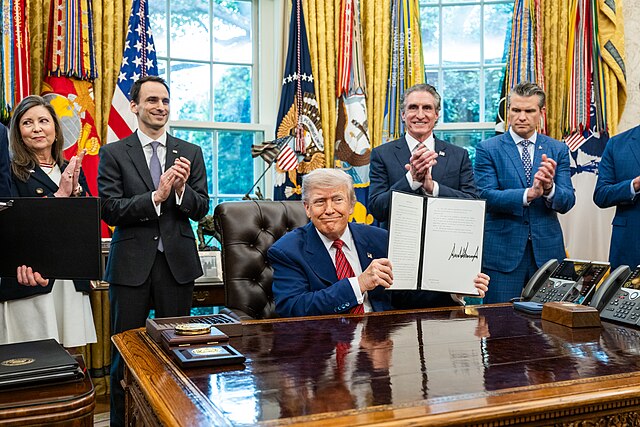
U.S. President Donald Trump signs an executive order regarding nuclear energy on May 23, 2025, in the Oval Office. (Photo by Molly Riley, courtesy of the White House)

This the third article in a four-part series exploring how advancements in nuclear technology might impact Nunavut.
The race is on in the United States.
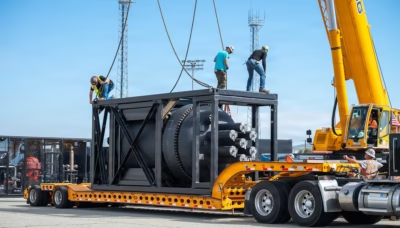
A nuclear reactor sits in a reinforced steel transport frame at March Air Reserve Base in California on Feb. 13. The reactor was airlifted from California to Utah. (Photo by Staff Sgt. Monique Bright, courtesy of the U.S. Air Force)
In May 2025, President Donald Trump gave 10 startup nuclear companies about one year to bring their advanced nuclear reactor projects to fruition. They must raise the funding themselves, but the federal government has removed the strict regulatory process and permitting normally required for nuclear research and development.
The goal is to achieve criticality — or the self-sustaining chain reaction needed to show that the technology works — by July 4, which also happens to be the nation’s 250th birthday.
“Whether you like or dislike Trump, he really has put the pedal to the metal on nuclear,” said David Novog, an engineering professor at McMaster University in Hamilton, Ont., who specializes in small nuclear reactors.
“It’s kind of an interesting thing when you have these small companies who are promising so much and then you actually say, ‘OK…. you said you’re ready to go, so here’s 365 days. Go.’”

A few of these companies have broken ground and could make the July 4 deadline, predicted Novog, but others are so far behind they almost certainly won’t.
Trump’s push is fueled by increasing demands on existing energy sources, caused partly by the proliferation of data centres used to power artificial intelligence, which require massive amounts of electricity to operate. He also wants to put a nuclear reactor on the moon.
Advanced small, or micro, nuclear reactors are made to provide anywhere from a few hundred kilowatts of energy — enough to power a small remote community — to five megawatts, suitable to provide electricity to about 3,000 homes.
But they don’t exist yet. Advanced nuclear technology remains in the conceptual stage.
The promise of small, portable autonomous nuclear reactors also has obvious potential in Canada’s remote communities.
“A northern community, well, I would hate to say it’s like the moon, but it’s a bit like the moon,” Novog said.

“It’s really far, it’s hard to get to. It has to be autonomous, it’s not like you can get people there to help in, you know, hours. It’s going to take days to get up there to fix something.”
There are about 80 advanced nuclear reactor projects under development worldwide, according to the World Nuclear Association which tracks progress in an online database.
Many believe it’s the next big thing to make nuclear cheaper and more accessible, especially in remote areas.
“It’s crazy, it’s almost like a game show, but in some weird sense I appreciate it,” said Novog of Trump’s nuclear program.
He said he believes the could be one of the likelier routes to achieving commercialization of advanced small nuclear reactors.

But there are risks to Trump’s nuclear push.
Historically, nuclear advancements have been made by nationalized companies, with government oversight and funding.
The floating nuclear reactor in Pevek, Russia, for example, was developed by Rosatom, Russia’s state nuclear agency. In Canada, there is Atomic Energy of Canada Ltd., and France and the UK both have their own nationalized nuclear energy companies.
“It’s different when you have hundreds of private sector companies, some of them with just two or three employees, making promises,” Novog said.
“It sort of runs the risk of ruining the credibility of nuclear in general, because if you make promises and you don’t keep them … you end up leaving a trail of disappointed people.”
Small nuclear reactors have been on the Canadian federal government’s radar since 2018, when it rolled out its Canadian Small Modular Reactor Roadmap — a strategy to explore its potential use across Canada.
The federal government hosted a series of workshops at the time about small modular nuclear reactors, including one in Iqaluit in May 2018, dedicated to potential off-grid northern and remote uses.
That workshop was the “beginning” of what the government anticipated as a “longer discussion” around nuclear energy use in remote areas over the next 10 to 15 years.
Participants at the workshop created lists of “positives” and “concerns” around potential nuclear generation in the North.
The reduced environmental impact and reduced reliance on imported diesel topped the list of positives.
The list of concerns was much longer, including cost barriers, safety concerns, potential impacts to wildlife, and perceived challenges to obtaining community support.
Inuit, especially those in the Kivalliq Region, have a long history with exploration companies pitching plans to potentially mine uranium on their land. This past could influence whether nuclear has a future in Nunavut.
Coming up in Part 4: Inuit and uranium, the substance that “never” goes away.
This is a rage bait article and nunatsiaq news shouldn’t be posting like this sh…t
Editors at Nunatsiaq showing their editorial weakness day in day out.
AI data centres barely factor into the article after the opening. They’re mentioned as one reason Trump wants more nuclear power, but the piece never really explains how that demand makes Nunavut reactors more feasible.
What happens in January 2029 when Trump is out of office. What are you going to write about then?
The Bathurst Caribou herd will go extinct if people start mining for Uranium and Thorium in their migratory path.
This is categorically false.