

Nunavik leaders eye banishment for bootleggers, drug traffickers
Makivvik lawyer says it’s possible but remains a complex legal issue
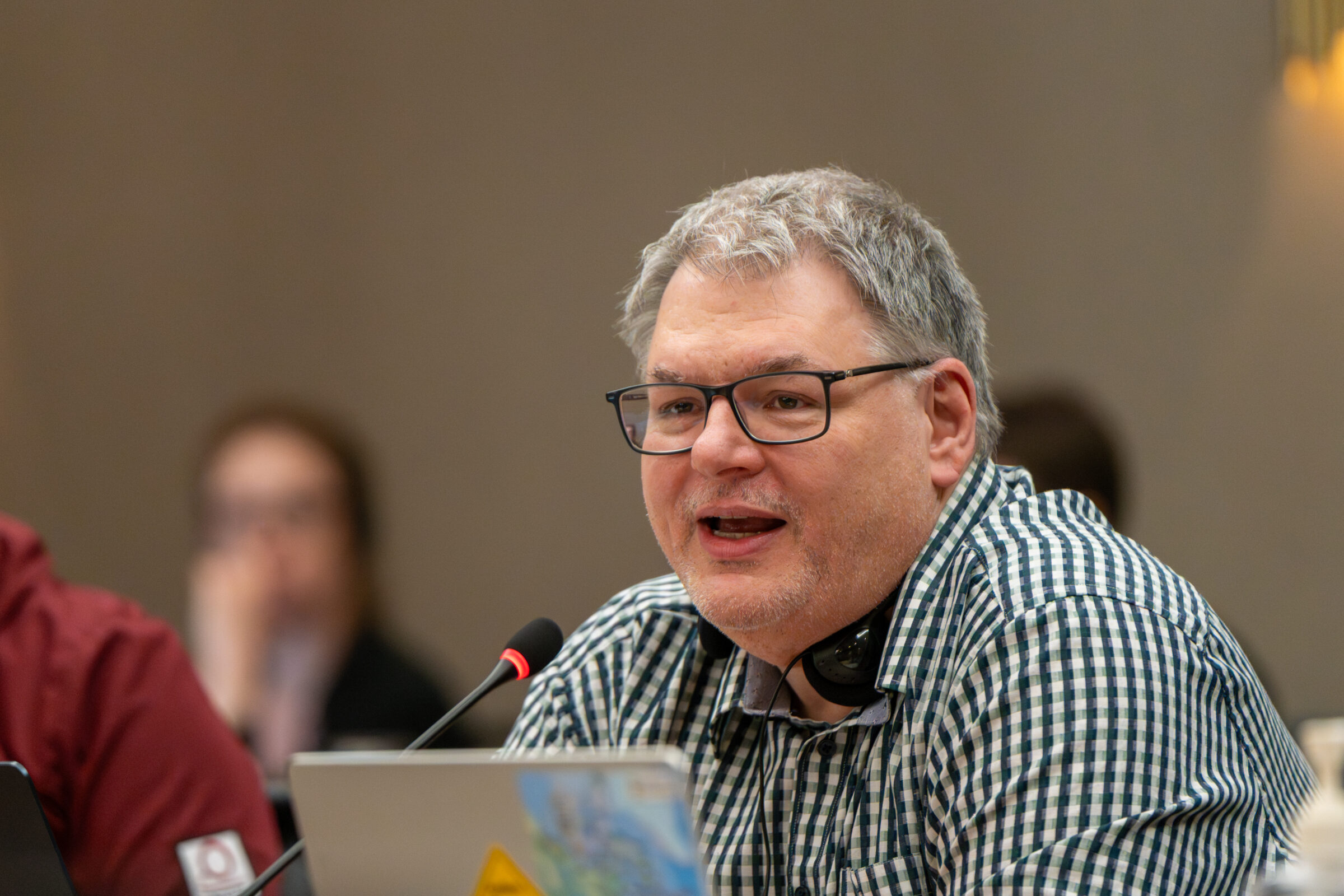
Makivvik lawyer Jean-François Arteau offers a preliminary analysis of what a banishment strategy could look like in the region, during a meeting Wednesday with leaders from Nunavik. (Photo by Cedric Gallant, special to Nunatsiaq News)
Nunavik leaders are exploring the idea of using banishment to deal with people found to be selling illegal drugs or alcohol in their communities.
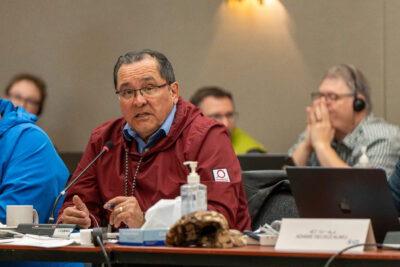
Makivvik president Pita Aatami says he does not want Nunavimmiut to remain silent when it comes to drug trafficking in the region. (Photo by Cedric Gallant, special to Nunatsiaq News)
“People are dying because of illicit drugs,” said Pita Aatami, president of Makivvik Corp., on Wednesday at the second day of the three-day Nunavik all-organizations meeting being held in Montreal.
Makivvik lawyer Jean-François Arteau gave three options as to how banishment could be implemented to remove drug traffickers and bootleggers from Nunavik. Discussions are still preliminary, and Makivvik plans to continue working on it with Nunavik organizations.
Arteau said practices used in the criminal justice system — such as arresting suspects and seizing evidence and proceeds of crime — carry limitations in remote communities such as lengthy court processes made worse by a lack of support for circuit courts to function properly.
The James Bay and Northern Quebec Agreement does not allow for the creation of a banishment policy. However, in a written report Arteau provided to the leaders he said more “muscular measures” could still be found to “reduce suffering caused by intoxication-related violence.”
He said banishment is used by some First Nations communities in the West through bylaws that are approved by band councils.
“If they can do that, we too as Inuit, we can do that,” said Aatami.
“We are not trying to scare Inuit; we want this illegal activity to stop, because they are only thinking about money at the price of life.”

Nunavik Housing Bureau president Sammy Duncan expressed concerns Wednesday about how a banishment strategy would affect Inuit beneficiaries in Nunavik. (Photo by Cedric Gallant, special to Nunatsiaq New)
Arteau proposed using what he called a “multi-prong” approach to implementing a policy of banishment.
The first option is through employers, he said.
Because southerners working in Nunavik are housed through their contracts, a Nunavik employment policy could prohibit drug or alcohol use, possession and trafficking. Discipline for infractions could include termination and removal from Nunavik through the loss of employer-provided housing.

A second option is through the landholding corporations, which can control occupancy and residency on Inuit-owned land through anti-drug and alcohol-trafficking policies.
A more cautious approach could be applied to beneficiaries caught trafficking by using support measures, Arteau said.
“It is very touchy because they are our fellow Inuit,” said Sammy Duncan, president of the Nunavik Housing Bureau, regarding banishment of beneficiaries.
“They have children, they have parents; if we ever have to evict them, are we going to kick out the whole family?”
A third option proposed by Arteau would involve co-ordinated action between Makivvik, the landholding corporations, northern villages and Kativik Regional Government.
That would combine the authority of an employment policy to evict someone from their house with stronger regulatory rules for municipalities and more rigorous transportation rules enforced by airlines.
There would be some obstacles in implementing a banishment framework in Nunavik, he said, including the Canadian Charter of Rights and Freedoms.
“Every citizen of Canada has the right to enter, remain in and leave Canada,” Arteau said.
Aatami said that even so, “us as Inuit, when we are aware that there is illicit dealing we want to stop it. Life is more important than the Charter of Rights.”
In the hand , of some lawyer , can become , a charter of rights challenge , but i m all for it , with all the hard drugs coming in.
Huge charter challenge time. Someone just says a simple “Nope, not leaving” and then calls in the CBC to film the attempted banishment. Good luck with that.
I think this should be considered in Nunavut as will, in particular hard drugs. and maybe a graduated teer system for lesser drugs and alcohol.
With overall health and safety in mind banishment may be supported despite the charter of rights as long as the health and safety remain the paramount to the reason. Health and safety of the population is more important than the few pushers.
Won’t banishment become a continuous community musical chairs loop?
Banishment is going after the lowest-hanging fruit. While the precursor chemicals to make the drugs still arrive like clockwork from the country, we are now to love. The cartels, triads and…over 200 criminal gangs keep on expanding.
Why not go right to the top and ask the Fed’s what the heck is going on? Why every city, town across Canada and now northern and arctic hamlets must become ____-holes?
Canada has top-notch prosecutors who do take on drug manufacturing and trafficking. But they are a extremely tiny number. Meaning there is no money to take on to cut off the snake’s head. The snake has many, many, many heads.
Thus police can’t do the long investigations and even if they do, Jordan legalities set them free.
They too, like top prosecutors, are restricted to the low-hanging fruit and as spectators watching the known criminal sources continue full speed ahead, as if protected.
The money is in defending drug trafficking, keeping them out of jail.
Time to get serious. Put extreme Indigenous pressure on the Liberals as if there is no tomorrow. To hire and big-time fund prosecutors to take on the source. If not, “People are dying because of illicit drugs,”… will be taken as wanted.
Banishment is already allowed. How many people have been bullied out of their communities or jobs because of rumors?
It may be practiced, but at the moment it isn’t really “allowed”.
Wouldn’t we better off keeping these folks in their communities where it easier to watch them rather then continuing to dump them on Iqaluit, Winnipeg, and Ottawa? That is just offloading our problems onto someone else.
Yeah, and dumped to Iqaluit and that is why there are so many hard drugs now, guns, break in entries’ criminals wearing mask to attack, and killing happening due to hard drugs. The last homicide in Iqaluit around 300 area was because of hard drugs, and these kind of criminal activities never use to happen until criminals started getting banned from their home smaller communities. Instead of banning them, take them on the land to teach them and work with them on healing.
Great, more vigilante tribalism towards small fry while those running the crime-show from inside and outside the community remain immune and untouched.
The main source of violence is at the top of the food-chain.
where do the banished go? seem like a lot of them are sent to Iqaluit
Yes, they are assigned to the front of the Northmart
Banishment is part of Inuit legal traditions that was used in exceptional circumstances and if used, would be protected by s. 35 of the constitution that protects ancestral and treaty rights (the JBNQA is considered a treaty) as well as inherent Indigenous rights from the UN Declaration on Indigenous rights.
In the West some nations use their own Justice committees to deal with violations to their own laws and banishment is used in exceptional circumstances when the safety and health of the community is at risk. It’s true that it doesn’t address organized crime leaders that are elsewhere and cause much more damage but it’s not up to small communities to take up the task of investigating and prosecute these criminals, that’s up to much larger police forces. Yet, banishing a dealer will most certainly disrupt the drug trade in this community and if many communities enact such laws, it may cause significant damage to the trade while making life much better in the communities.
Inuit lost control of such measures long ago, in the war on deterioration society. Inuit can only listen to what the krg lawyer is saying. Plus it’s hypocritical that leaders speak out now about supporting something which they themselves benefit from in the drug life themselves. It’s hopeless. Its a big mess
Even not speaking Inuktitut is banishment in Nunavik their flat bread.
John Molson capital of Canada 🇨🇦
Having that kind of authority in the north will inevitability be used by morally and mentally weak “leaders” to get “retribution” on those who they see as slighting them over their role as a leader.
This situation is extremely concerning, and it shows why our government needs to take serious action. Local organizations should be very cautious about doing business with individuals or companies that have been found guilty of serious criminal offences.
For example, here in Kuujjuaq, several organizations continue to do business with Pomerleau Food Service, even though Joshua Pomerleau has a well‑documented criminal history. Many community members have raised concerns about this.
According to the Nunavik Police Force, on April 9 and April 10, 2026, local business owner Joshua Pomerleau, owner of Atsaniq Café and Kuujjuaq Snack, was arrested on multiple firearm‑related charges, including possession of a firearm while prohibited and possession of a modified firearm. Several firearms were seized during the investigation.
In situations like this, many people believe that individuals found guilty of such offences should not be allowed to provide services to organizations, especially when public trust and community safety are involved.
Thats a good one and true too. Just consider what another big wheel fool is doing also in Kuujjuaq, even bought a fishing camp, and keeps fooling the so call brass right out of their colours. In all probability contribute to lost of life in Nunavik due to drug behaviour. Even the police shooting probably can be linked to his distribution of drugs through Nunavik life. Get that crooning idiot first, and it will solve most.
Thats how unaware people are-to life around them, and they dont care even about contaminated food, like hungover people buying at a local store in the morning of these saturated unfit sandwiches, and store doesn’t care either about resale of that unfit product. Its bad, its very bad.
Kuujjuaq is probably not the only place in the province where a criminal is supply directly a fast food service, there must be thousands. But kuujjuaq is a place where everyone knows whos who, and the history of that criminal is fresh as his sandwich and poutine, and if you never heard about the un hygienic conditions, then you are not aware or have no self care. Yes and why do businesses support such a menace to our community,
Someone in the discussion is concerned about the fact that we would have to banish families of the druggers as well. So be it, considering the pain and contributions to to killing people from drugs.
We are sick and tired of these dead beat meetings with hidden dinner and party moods pretending to reach out and solve drug and other important problems. Its a joke, its a waste of money, yet our elders sit waiting for hope that they can have somewhere decent to live out their last years like a nice updated elders home. Imagine the money spent on the meeting alone. Its a crime. It’s laughable throughout the civilized world. Saddened though.
This meeting like most meetings of Nunavik. It produces nothing but economic well being for airlines hotels rental and restaurants. They only talk but no solutions not even a suggestion to a solution. Nunavik has become a movement’s of people stressed out over travel for nothing but a miserable experience .
A plebiscite to vote for legal exile…a word banishment is too harsh on those illegal doers.. make them a political exiles… than send them to International prison… out smart the elite and don’t believe the lawyers….
Ask for a war and it shall be done in a second…lol
While on the topic of banishment. What about the lawyer? How many Inuit women has he harassed throughout his career?
Yes, beer sales to the people who can’t handle it ( times two try’s at least. Not to mention even, what the price of that drink is as it continues down the bootleggers sales path into the mouth of desperate misery of living. The police should try to track, in the arrest times, the cost of that one drunk in money spent, just to have some entertainment in the stats.
If they want to stop bootlegging, they should stop the 3 Coop’s of selling beer because the resale of beer from coop is big also.
Wow. If Nunavut banished bootleggers …which Many of us hope will change minds of others. our communities will have about 25% less people .alcohol rules in nunavut beside hard drugs.
If the north ban booze, you would have a civilized society and 100% good behaviour, based on too many go nuts with a little bit of it.
Banning people from the place would include the colonists as they brought it to North America. Be careful what you want.
First i thank you for show casing the way some people think. We’re going back to places like england again with blame to where it all came from. Give it up we’re doing that forever and what we have for it. Focus on dealing with our problem , the colonial history dont give two cents about you me or tom tootoo. Lets start fixing our problems and start with a decito be good person. I was brought ip with severe trauma, my problems may have come from that, but they are my problems. I live in peace not turt. So can you. I know for sure.
All comments in themselves have merit, well done to speak your mind. As for the widespread use of hard drugs north and south practically everywhere, it is the larger issue and problem of day, with good reason. I think of my kids and your kids, and the world they will inherit.
I’m not opposed to finding ways to get more control over these dangerous toxins but I think we tend to put the priorities on control a little too much rather than spending more time working on the causes as to why our people are using drugs and alcohol the way they do. Although some efforts have been made to improve mental health services, especially in counselling services, there is a great deal more that is needed. The impact of intergenerational trauma and colonization are huge and continue to increase in each new generation as we have all noticed. We must put more emphasis on these causes. The work that is required will need a multi-disaplinary approach with our culture and ways of being as the foundation of our work. The 2 levels of Governments will have to provide a great deal of funding so programs and services can be offered in a co-ordinated way. When this happens, real change can begin and start to make a real impact on our current challenges. When people begin to feel good enough about themselves, they will find their own ways to look after themselves and their families better. They will find within themselves the desire and strength to overcome the need for harmful substances. I’m not saying we shouldn’t try and control the substances coming into our communities. We must also work harder to offer strong mental health services all sectors of our population so that we can begin to feel empowered to begin the process of making healthier choices for ourselves and our families. As they used to say during the covid days “We are all in this together” it certainly is true in this situation as we have lost so many people to tragic events/sicknesses caused by intergeneration trauma.