


Nunavik’s ice wedges show how a warmer northern landscape is changing
“It took less than a decade to melt what took centuries to form”

The fractured landscape visible in the summer around Salluit is the result of ice wedges below the surface. Researchers at Université Laval are looking at these formations and how they’ve changed over time. (Photo by Antoine Boisson.)
HALIFAX—The top layer of century-old ice wedges in the ground around Salluit has started to melt over the past decade.
A researcher with Université Laval, Samuel Gagnon, studies these formations that characterize much of the landscape across the Canadian Arctic and subarctic.
Ice wedges are made purely of ice, as opposed to permafrost, which is frozen dirt. They’re caused by the seasonal thaw of snow in areas covered in permafrost.
Ice wedges begin to form when permafrost becomes so cold during the winter that it cracks. Later, when temperatures rise and snow at the surface melts, water seeps into these cracks and is then chilled and refrozen by the surrounding permafrost.
As this process repeats itself from year to year, more ice veins can form in the same crack, and the ice wedge grows.
In parts of the Arctic and subarctic, ice wedges help create distinctive polygon-shaped plates. Each polygon has ice wedges forming its boundaries.
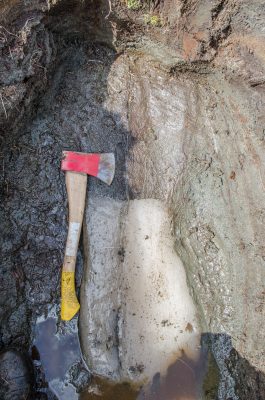
The top layer of an ice wedge outside Salluit. (Photo by Samuel Gagnon)

They can be several metres deep and more than a metre wide on the surface, Gagnon said.
In lower temperatures, new stages of an ice wedge, or upgrowth, can grow into the layer of ground that sits above the ice wedge. This ground, known as the active layer, thaws in the summer and freezes in the winter.
Following a long, hot summer, this active layer would be thicker, as more of the ground thaws.
For his work, alongside Michel Allard, a geomorphology professor at Laval, Gagnon looked at 16 sites within the Narsajuaq valley outside Salluit. He presented some of their findings on ice-wedge change in Nunavik at the ArcticNet Annual Scientific Meeting in Halifax on Dec. 3.
Ice wedges across the Arctic are centuries old. But depending on the climate, they can go into periods of dormancy.
“In the first half of the 20th Century, ice wedges were dormant because it wasn’t cool enough to cause thermal contraction,” Gagnon said.

A cooling period began in 1946 and reactivated the ice wedges as thermal contraction cracks again formed. Over this period, they also saw upgrowth of ice wedges into the active layer.
And this continued from 1946 to 1992.
What’s particularly interesting about the area around Salluit is that it only started experiencing rapid warming in the early 1990s. From 1993 to the current day, the mean annual air temperature rose from -10 C to -6 C.
And, between 1989 and 1991, ice wedges in this area were studied extensively, Gagnon said.
That allows researchers like him to compare the change in ice wedges before and after a recognized period of warming.

During Allard’s study of these ice wedges in 1991, 94 per cent showed signs of recent growth. When they went back in 2017, only 13 per cent showed this.
By 1998, the active layer had melted through upgrowth and reached what’s called the main stage of the ice wedge—the widest and oldest area of ice, Gagnon said.
Between 2006 and 2010, the top layer of those main stages had started to melt.
“It’s warmer, so the active layer becomes thicker, goes deeper and melts that top layer of ice,” said Gagnon.
“It took less than a decade to melt what took centuries to form.”
When ice wedges melt, a void is left that could have major impacts on the surface. The likely result is ground collapse, which, Gagnon said, could also create a sort of feedback loop where the ice wedge is more exposed and so degrades more rapidly.
Between 1998 and 2010, though the active layer continued to deepen in their study area, winter temperatures were also low enough to continue to cause cracking underground.
So, while the ice wedges melted from the top, they still grew in width.
After 2010, lower temperatures have led to a thinner active layer above the ice wedges, and no melting has occurred.
What they’ve observed around Narsajuaq, Gagnon said, has implications for other areas.
Just south of Salluit, it’s too warm to have thermal contractions that form and add to ice wedges. But north of here, the ground is still cracking and ice wedges are actively growing.
Salluit is on the precipice, seeing the change that temperature fluctuation brings.
“Salluit’s location gives a good indication of what will happen in the future, farther north,” said Gagnon.
Why are white people and their schools claiming to find new things and associates it with their theories which is false, they did not even bother to ask the locals with this knowledge of this territory this entire time so I say it’s nothing new this type of landscape its been here since we got here always changing with the environment since the beginning
There are plenty of “whites” who understand that the arctic has had warmer periods in the past and that it’s not something to instantly freak out about. There are also plenty of inuit who go on about global warming every time the temperature changes, just like the southern activists do. You’re not as observant as you think you are if you don’t notice this.