


Nunavut explores ending time changes
Three times zones in territory adds to ‘complexity’ to issue, says Justice Minister George Hickes
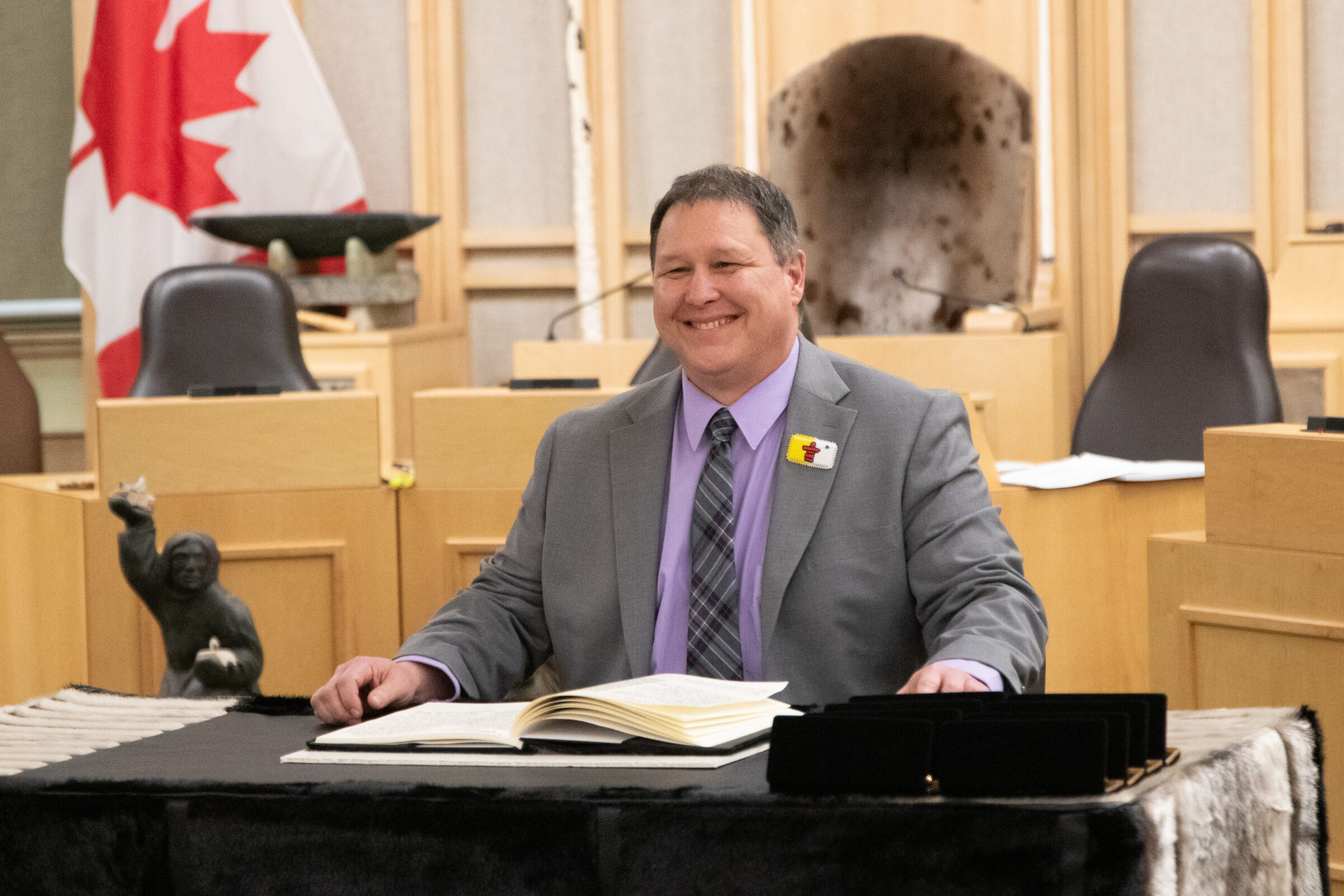
Justice Minister George Hickes, seen in a file photo, says Nunavut is looking at the possibility of ending seasonal time changes. (File photo by Jeff Pelletier)

Following similar moves by other provinces and territories, Nunavut is exploring the possibility of ending seasonal time changes.
Justice Minister George Hickes provided the update Tuesday in the legislative assembly in response to a question from Kugluktuk MLA Simon Kuliktana.
“As recently as earlier this month, my officials from Justice have been in communication with other counterparts in Northwest Territories to discuss this matter. So yes, it is something that’s in front of me,” Hickes said.
This response is different from one he provided in question period on March 19, when he said the Government of Nunavut was “not currently taking any action” on the question of time changes.
But as other jurisdictions across Canada are saying goodbye to the tradition, first introduced by the Canadian government in 1918 as a way to increase production during the First World War, Nunavut is paying attention.
“As our neighbours become more aligned with this practice, I think it’s something that we very seriously need to consider,” Hickes said Tuesday, adding he is “not a huge fan” of needing to change his clocks twice a year.
N.W.T. Premier R.J. Simpson announced in April his government will end seasonal time changes.

That announcement followed the Government of Alberta’s decision in March it would stick to year-round Mountain Daylight Time.
British Columbia also recently switched to year-round Pacific Daylight Time, putting it in line with Yukon, which follows Mountain Standard Time. Saskatchewan also does not change its clocks. It follows a year-round Central Standard Time.
Nunavut’s three time zones add “complexity” to the issue, Hickes said, adding there would be public consultation before any changes are made and new legislation would be required for implementation.
Nunavut communities are spread across the Mountain, Central and Eastern time zones. A notable exception is Coral Harbour, which observes Eastern Standard Time year-round.
Please. Yes. End the stupid time changes. They are extra stupid in a place where the sunset and sunrise times change very rapidly anyway. It makes the extremes with the darkness and daylight so much more hard on our minds and bodies. Whatever purpose those time changes are supposed to serve down south really do not apply here. Don’t even bother with daylight time. The scientific community seems to agree the whole process does more harm than good.
Why not one single time zone for the who territory? 🙂
They tried that stupid idea in 1999. It was quickly abandoned.
Because geography is a real thing. Iqaluit is about 47 degrees of longitude east of Kugluktuk. That means sunrise, noon, and sunset in Kugluktuk is just a tad over 3 hours later (there’s only about 4 degrees difference in latitude, so we can put that aside). Sunrise in Iqaluit on March 21 is around 6:30 am. Work starts at 8:30 am. If you want a single time zone based in Iqaluit, that means people in Kugluktuk are going in to work an hour before sunrise.
That’s the reason the one time zone thing in was supposed to use the Central time zone, but the complaining from the Qikiqtani was so much we all ended up in Eastern Time, which outraged those of us in the west because flying to Yellowknife meant a two hour difference.
Keep daylight savings. It’s awesome when we get that extra time in the evening each spring.
You’re having a laugh, right? Half of us live in 24h sunlight. Who are we lying to about “saving some sun”?
Remember when the WHOLE Territory was under Central time back in the day, LOL that was really a joke back then when you think about it.
China uses Beijing time and in Xinjiang they start work later and shops open later. No problem.
Paul Okalik did move Nunavut to a single time zone in 1999, and the territory later returned to multiple zones after strong opposition from residents and communities. For many people, especially across remote regions with different daily rhythms, hunting patterns, school schedules, and ties to neighbouring provinces, time policy isn’t just administrative — it affects daily life directly.
A lot of the criticism at the time centered on exactly what you’re pointing to: whether decisions were being made for bureaucratic convenience versus community realities. Northern governance decisions can feel especially personal because the impacts land hardest on smaller and more vulnerable communities.
Comparisons to places like Manitoba don’t always translate cleanly to Nunavut’s geography and culture – Mr Hickes…take note.
The Territory’s scale, isolation, Inuit communities that you never grew up in, and reliance on air travel and inter-community coordination make governance unusually complicated. The fool before you, who wasted resources figuring that failed calculus out at our expense…will offer you the same fate and eventual notoriety. Think of your early legacy and early retirement, which is likely on the horizon, offering you your best dream outside of Nunavut when the call comes…but until such time that you are allowed to govern us – do not mess with my time
Thanks — ChatGPT
Was it the list of threes or the “It’s not just X, it’s Y” sentence?
There are people in my community that I have literally not seen in years because they only come out at night.
I do not think these ghost residents of our community have a sharp appreciation of time. They are firmly on the night shift, that being whatever time of day it is when everyone else is not around to deal with their antics.
They do not mark the time they need to go to school, college, or show up for work, or any of the other ordinary day to day tasks or activities that a functioning adult would do to be counted as a member of society.
I do not think they have a sharp appreciation of anything past their short list of personal vices. We can safely assume this because the worst things that ever occur in our community happen when they are awake and active and the rest of us are trying to get some sleep.
Society tries to adapt to these folks. Things are often scheduled in the afternoons in the hopes that more of them will be up after sleeping through the entire morning. We even have flex school hours and side door programs in Nunavut for those that start this lifestyle early.
However, many of the positive interventions that are designed and delivered to help these folks become members of society never reach them because they are sleeping when these things are available and being done.
It is actually a sad thing to see our community at the crack of dawn, so silent and still, when people should be starting to going out hunting right away and things like this.
A Nunavut Justice Minister might want to spend a tad more time thinking about the issues around our ghost “night shift” population than what type of standardized time we follow.
I think many of the readers are mis-reading this article.
Nowhere does it suggest that Nunavut should all be on one time zone, as it was for a brief period in 1999, which was unsuccessful.
Nunavut currently has 3 time zones and, in each, the time changes seasonally between Daylight Savings Time and Standard Time. This article says that Nunavut is considering ending seasonal time changes. It would make sense that whatever time zone Edmonton in on, the Kitikmeot be on the same. And whatever time zone Winnipeg is on, Kivalliq do the same. And whatever zone Ottawa is on, Qikiqtani Region do the same. There would still be 3 time zones in Nunavut.
Cool story George, remember when you said the new terminal in Rankin would be open in April?
That didn’t happen either…
Ending the spring/fall time change: Excellent. Do it now.
Changing to a single time zone: That is stupid, was tried, and is still stupid.
Coppermine and Victoria island should become apart of the Northwest Territories.
Instead of Daylight saving time we could introduce Daylight saving operation hours. Instead of changing clock, we change working hours from 9am to 5 pm to 8 am to 4 pm etc. Just about the entire North Asia has abandoned this thingie. Only Europe is on this DST.