


Nunavut tightens hunting limits for Bluenose East caribou herd
Move comes “in response to a continuing decline in the population, which has led to a conservation concern”
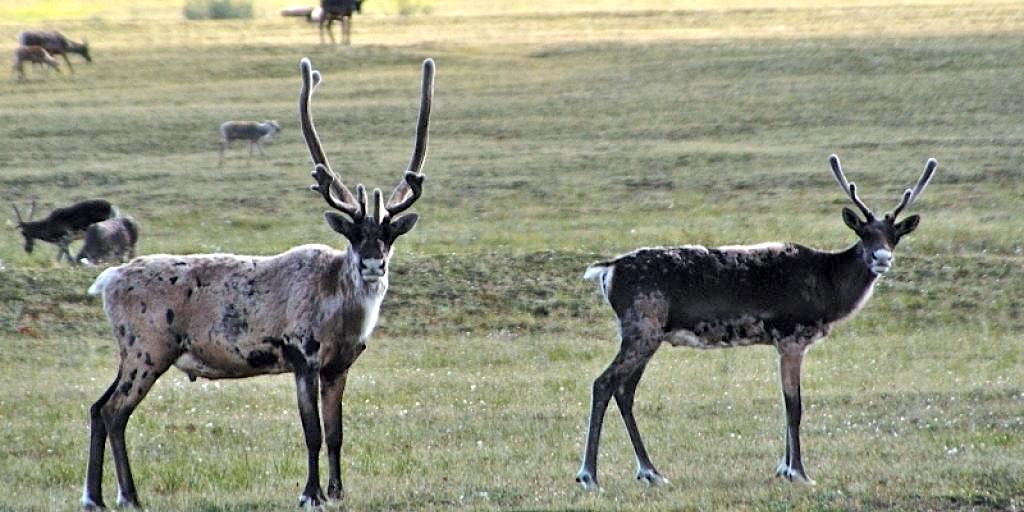
The Bluenose East caribou herd is one of several barren-ground caribou herds under the purview of the (Photo courtesy of the GNWT)

The Government of Nunavut says that it is reducing the annual hunting limit for the Kitikmeot region’s Bluenose East caribou herd.
The new total allowable harvest, or TAH, means only 170 caribou can be hunted from the herd, down from 340, Nunavut’s Environment Department said on Sept. 18.
The TAH is being cut “in response to a continuing decline in the population, which has led to a conservation concern,” said the department.
The GN also said that only one female caribou can be harvested for every male caribou, an approach designed to keep the herd’s breeding population stable.
The Kitikmeot Regional Wildlife Board will determine the allocation of the quota and keep the Kugluktuk Hunters and Trappers Organization informed, the GN said.
Hunters will need a tag from their HTO before heading out to hunt. Tags will also be available for harvested caribou, the GN said.
The Bluenose East herd ranges over a large territory straddling the Nunavut–Northwest Territories boundary and is hunted for food by Inuit from Kugluktuk and by Dene and Métis from the N.W.T.

In 2016, in response to the herd’s population drop, the GN announced a community-based caribou plan for Kugluktuk that included a harvest limit of 340 caribou, with no sex specified.
The Kugluktuk HTO also agreed then to voluntarily put various limits on hunting activities, such as no organized community hunts, no sale or purchase of caribou meat under the HTO’s country food distribution program, and no sports or commercial harvest of Bluenose East caribou.

This graphic from the Government of the N.W.T. offers a visual look at the population decline of the Bluenose East herd. (Image courtesy of the GNWT)
Even with no harvest at all, the Bluenose East herd’s population was projected by the Government of the N.W.T to drop to about 11,000 animals in 2021. That’s a little more than half its size of roughly 19,000 in 2018.
An earlier GNWT survey found the population of the Bluenose East herd had declined to between 35,000 and 40,000 caribou in 2015, from about 104,000 in 2000.
That prompted the governments of the N.W.T and Nunavut to work on a new agreement to better manage the Bluenose East and Bathurst caribou herds.

“It’s important because these are cross-border caribou herds,” said Nunavut Premier Joe Savikataaq in May 2019 after a meeting in Kugluktuk.
Earlier this month, the GN also limited the hunting of Dolphin and Union caribou in western Nunavut.
Those tasked, inform, go on air. Talk to unilingual folk as well who may help you, We need to stop the decline.
The media is telling us the conditions in our jails are now worse given the pandemic. Truth is they are no different than before, nothing has changed. Why do they say these things? Intuitions? Just because? So annoying.