


‘Opportunity for everybody’ in defence network for Arctic, military official says
$2.7B plan will see expanded military presence across all 3 territories

Canadian military is building five hubs and two nodes to support their presence in the Arctic. (Photo by Master Corporal Antoine Brochu, Canadian Armed Forces Combat Camera)

A $2.7-billion defence network planned for Canada’s Arctic is starting to come into focus, but finer details are in the planning stages, says Commodore Matthew Coates.

Commodore Matthew Coates says the operational support hubs will help “sustain” the Canadian military in the Arctic. (Photo courtesy of Department of National Defence)
Coates leads a roughly 25-member team working on the development of seven northern operational support hubs and nodes.
These sites will provide accommodation, warehouses and storage to help “sustain” the Canadian military in the Arctic, following recent announcements that the federal government will inject billions of dollars to bolster Arctic defence.
Coates spoke to Nunatsiaq News about what this expanded military presence in the North might look like.
The Canadian Armed Forces currently has four operational support hubs — all of them overseas — in Germany, Kuwait, Jamaica and Senegal. But in 2024, the federal government announced three new northern hubs as part of its $81.1-billion defence policy.
Back then, the idea was to create three hubs — in Iqaluit, Inuvik and Yellowknife — for $2.7 billion.
But earlier this month, Prime Minister Mark Carney announced an expansion of the program.
Two more hubs were added to the proposed network — in Whitehorse and Resolute Bay — as well as two “nodes” in Cambridge Bay and Rankin Inlet. Nodes are smaller versions of hubs.
The idea behind the additions is to cover as much of the different Arctic as possible, Coates said.
“Ultimately, just by looking at the geography itself, I think it becomes fairly intuitive how we’re trying to establish the logistical sustainment for the entire region,” he said.
But while adding more infrastructure to the plan, Carney didn’t announce any more funding for the four additional projects. The military is spreading out its initial $2.7-billion allocation for the three original hubs to all seven sites.
Carney also announced a separate $32-billion funding package for upgrades to four existing forward operating locations in Yellowknife, Inuvik, Iqaluit and Goose Bay, locations operated by the Royal Canadian Air Force.

“We think it’s feasible,” Coates said of the amount of funding earmarked for the hubs and nodes.
“Each location is going to be slightly different. What makes up a node or a hub in any one location will be different and depending on what may exist in a location.”
Also, the armed forces operational support hubs team will be able to piggyback on the air force’s $32-billion package by sharing some infrastructure and equipment.
“We can work together as perhaps two entities but within the department, to make sure that we’re coherent, and we can be economical on our efforts,” Coates said.
It’s estimated that each hub or node will take two to 10 years to establish.
The timelines would depend on the facility’s size and whether the Defence Department would build the infrastructure from scratch, lease existing buildings or jointly operate out of spaces used by other government departments.
Each hub or node will also likely come with military or civilian personnel that will “oversee” the infrastructure, Coates said, adding that it might mean jobs for the local workforce.
“Whether it’s through the the building of infrastructure or taking care of infrastructure, there’s lots of opportunity here for everybody,” he said.

Former national defence minister Bill Blair announces the locations of three Northern operational support hubs on March 6, 2025 in Iqaluit (File photo by Arty Sarkisian)
Over the years, many military experts have expressed alarm at how much Canada underfunds Arctic defence, with some going as far as to say the region is completely undefended against potential threats.
And Carney has shared this sentiment.
“For too long, instead of re-enforcing your strength, we have relied too heavily on your dedication alone to keep Canadians secure. Well, no more,” Carney said while addressing service members Thursday in Halifax.
Researcher Ken Coates expressed criticism last year about the government’s operational support hub announcement. Now, he’s changed his view.
“From being a skeptic last year, I’m actually sort of more of an optimist now,” he told Nunatsiaq News earlier in March.
“We’re going to see development.”
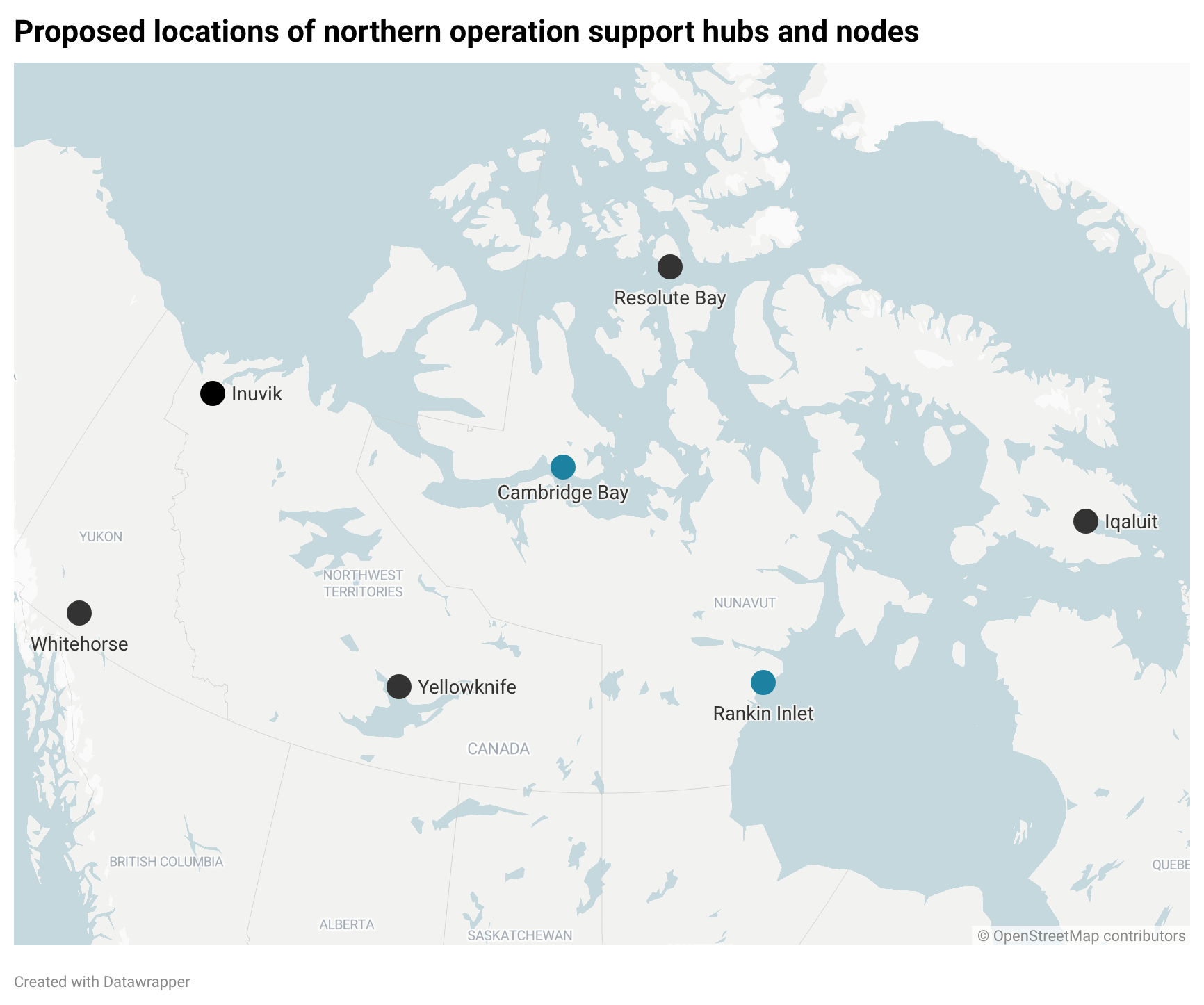
The federal government plans to build five operational support hubs in Inuvik, Iqaluit, Resolute Bay, Whitehorse and Yellowknife along with smaller “nodes” in Cambridge Bay and Rankin Inlet. (Map by Nunatsiaq News)
Are going to get some hand grenades and full auto machine guns ?
Good , Because I will need more bullets , army and navy nrimg it on nunavut , ww have the man power walking the streets ready for action ,
I see a whole lot of Nunavut Numbered companies coming in the future. NTI and other Inuit Orgs should already have action plans on handling this coming boom but I know they dont. Too busy writing voting vouchers.
Our inuit orgs ,should have a plan but do not ..yet. put this stuff for our MLA to table in the right place .
The truth is, there will not be “Opportunity for Everybody”.
If Rankin, Iqaluit, and Resolute are anything like Cambridge Bay, everyone who can work, is already working.
If you add more local employment, it will be like a large wave covering a boulder on the shore; it will make little or no difference.
We regularly see Temporary Foreign Workers brought up to keep our stores open, and trades people from all across western Canada keeping our essential services and buildings running.
Our unemployed, who are numerous, are unprepared for any new opportunity. They do not possess the desire and/or life skills to take on a job.
If there ever was a time to get stone cold serious about life skills training, upgrading, and ongoing job supports in Nunavut, the time is now. That is the only hope for the military to get any decent sized local workforce.
If not, we will see the military do what they have always done – draw people in from the most disadvantaged places in Canada where there are some people that want to work (the Maritimes and parts of the Prairies), and recruit from there.
I am an expert hunter, can navigate safely on the land and or sea. I signed up for a Canadian Ranger, signed up to be volunteer fire fighter, signed up to be volunteer coast guard auxiliary, I have applied for jobs.
All my applications denied because 20 years ago as a young man I had anger issues and ended up with a criminal record.
I am eligible for a pardon, but have to way to pay a lawyer to get it done.
Does this defence network include those of us with a criminal record? That successfully navigate the land and sea and provide for our families only by hunting and fishing?