


Orcas are moving north and staying longer, researchers say
Changes are having an impact on fragile Arctic eco-system
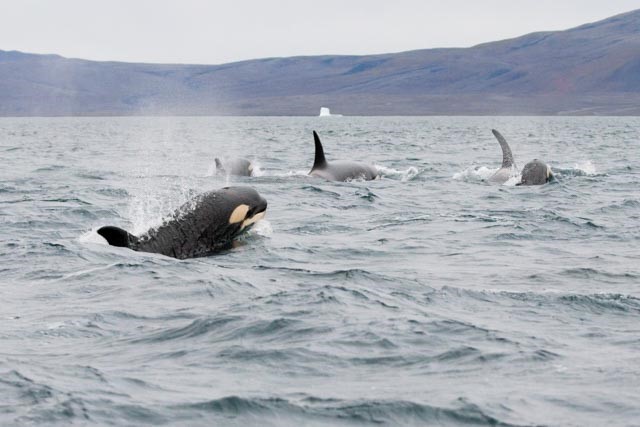
A pod of killer whales feeds off the shore of Pond Inlet in 2018. (Photo courtesy of Maha Ghazal/DFO)

Thousands of belugas are in peril as more killer whales are moving into northern waters and staying longer, scientists and Inuit observers say.
“What I hear from Inuit, other than just that killer whales are increasing in number, they’re increasing the amount of time that they remain in the region,” said Cory Matthews, research scientist with the federal Department of Fisheries and Oceans, in a phone interview.
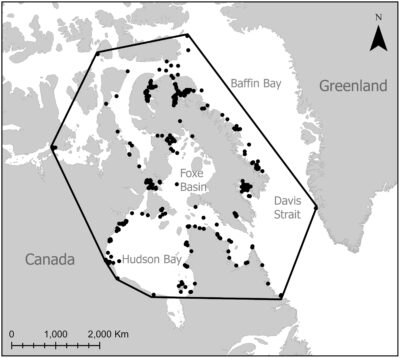
A June 2025 research article charts the locations of killer whale sightings in the eastern Canadian Arctic from 2002-2023. The black line shows the study area used to delineate sea ice data. (Map courtesy of Frontiersin.org)
“Killer whales are noted to be arriving earlier, staying later, and appearing in new areas.”
In fact, killer whales, also known as orcas, are spending nearly twice as much time in the region, ballooning from 26 days in 2002 to 48 days in 2023, Matthews said.
These rapid changes seem to be closely linked to a decline in sea ice related to climate change.
As ice caps shrink, so too does the icy habitat in which beluga, narwhal, and bowhead whales have long evolved to thrive in. Meanwhile, more southerly creatures are finding those warmer waters more inviting.

The effects that more orcas might have in this dwindling ecosystem remain largely unknown — but what is clear is that prey species are fleeing, Matthews said.
The habitat can be dangerous to the predators as well.
For example, when belugas zip into river estuaries pursued by ravenous pods of killer whales, the orcas can find themselves cut off from the open ocean by freshly formed sea ice, Matthews said, leading them to starvation.
Narwhal are similarly imperiled. Matthews pointed to one research study from 2020 in the journal Global Change Biology that calculated approximately 165 orca are capable of consuming as many as 1,000 narwhal in little more than one month.
Bowhead whales are behaving oddly too, reports Lenny Aqigiaq Panigayak of Taloyoak.
He and his seal-hunting team found two beached bowhead whales on separate occasions near the Gulf of Boothia, about 100 kilometres overland from the hamlet, the first in fall 2019 and the second in spring 2020.

One carcass was lying above the high tide mark.
“For two whales to be close by each other, it’s not a coincidence,” Panigayak said.
“It seems like they’re being killed by killer whales. The reason why I think it’s killer whales is because bowheads don’t normally die on the shore.”
It could be because bowhead whales are retreating north, following the receding area where sea ice meets open water.
“The bowhead’s defensive habitat underneath the sea ice is shrinking,” Matthews said.

Seals are on the orcas’ menu as well, but Arctic walrus tend to be avoiding the killer whales’ stomachs — and the reason may be cultural. While orcas are known to consume Pacific walrus, Matthews said, Arctic killer whales have yet to learn the correct strategy needed to prey on the tusked beasts living in the Arctic.
The cumulative effect of these changes is uncertain, but Matthews highlights research that forecasts a phenomenon known as a “trophic cascade.”
According to the theory, when a top predator is dropped into an ecosystem, the ripples radiate through the food chain, leading to long-term impacts on prey populations lower on the chain.
“It’s likely a new challenge that those species are going to have to deal with,” Matthews said.
start shooting them.
at least once they found out they are prey as well, they will learn
Killer whales have chased boats in the Coronation gulf and should not be taken as playful but predatory and these animals will grow in numbers if its not controlled . In Greenland they are controlled for food security as they are top of the food chain in their waters our balugasand seals are in peril if these killer whales are not controlled . Maybe far east asia can buy all the meat if harvesting starts !!!
In Greenland they hunt them, not just cull them. Also, it is illegal to export whale meat out of Canada.
No problem ! In canada we can make lots of cat food ,dog food and other things with the killer whales and the inuit will make lots of money saving seals and baluga whales luke hunting wolves among caribou. I am all in !
You really have no idea what the reaction will be when you try to sell dog and cat food made out of one of the most charismatic animals in the world?
Orcas are at the top of the marine food chain. Orcas that feed on other marine mammals and not fish, like the Orcas in the Arctic, are even that much higher in the food chain. Every bit of contamination that exists in the food they eat gets stored in their fatty tissues, and stays there.
As a result, East Greenland Orcas are among the most contaminated marine animals on the planet. They are so chock full of things like Polychlorinated Biphenyls (PCBs), DDT (dichlorodiphenyltrichloroethane), brominated flame retardants (PBDEs, HBCDDs), as well as heavy metals like mercury, they are like a swimming, living contaminated site.
It is so bad, some scientists think this level of contamination may be affecting their breeding, and may soon result in pods not being able to reproduce.
I do not think anyone would be recommending to anyone that the meat of these animals be consumed.
Perhaps this problem may soon solve itself. If these Orcas continue to eat more marine mammals, these contaminants may continue to concentrate in their bodies and they will eventually die out.
If they are to be culled, it would probably be a good idea for a community such as Pond Inlet be equipped with a high temperature incinerator to destroy their bodies and the chemicals that exist there.
Good reading. Yes arluit are predators and have no enemies. Keep them away. Only human can fight back with them.
Native Americans is British Columbia have lived with killer whales forever and dont kill them maybe we should be asking them for advise?
*in
I’m curious if fish populations such as salmon, cod, halibut are adversely affected by the increase in the orcas.
Killer whales remember right, if harvesting is the way to go the whole pod would need to be harvested.