

Ottawa announces $1.6M for Pond Inlet therapeutic justice program
Public Safety parliamentary secretary Jacques Ramsay joins Nunavut MP and GN ministers for the announcement
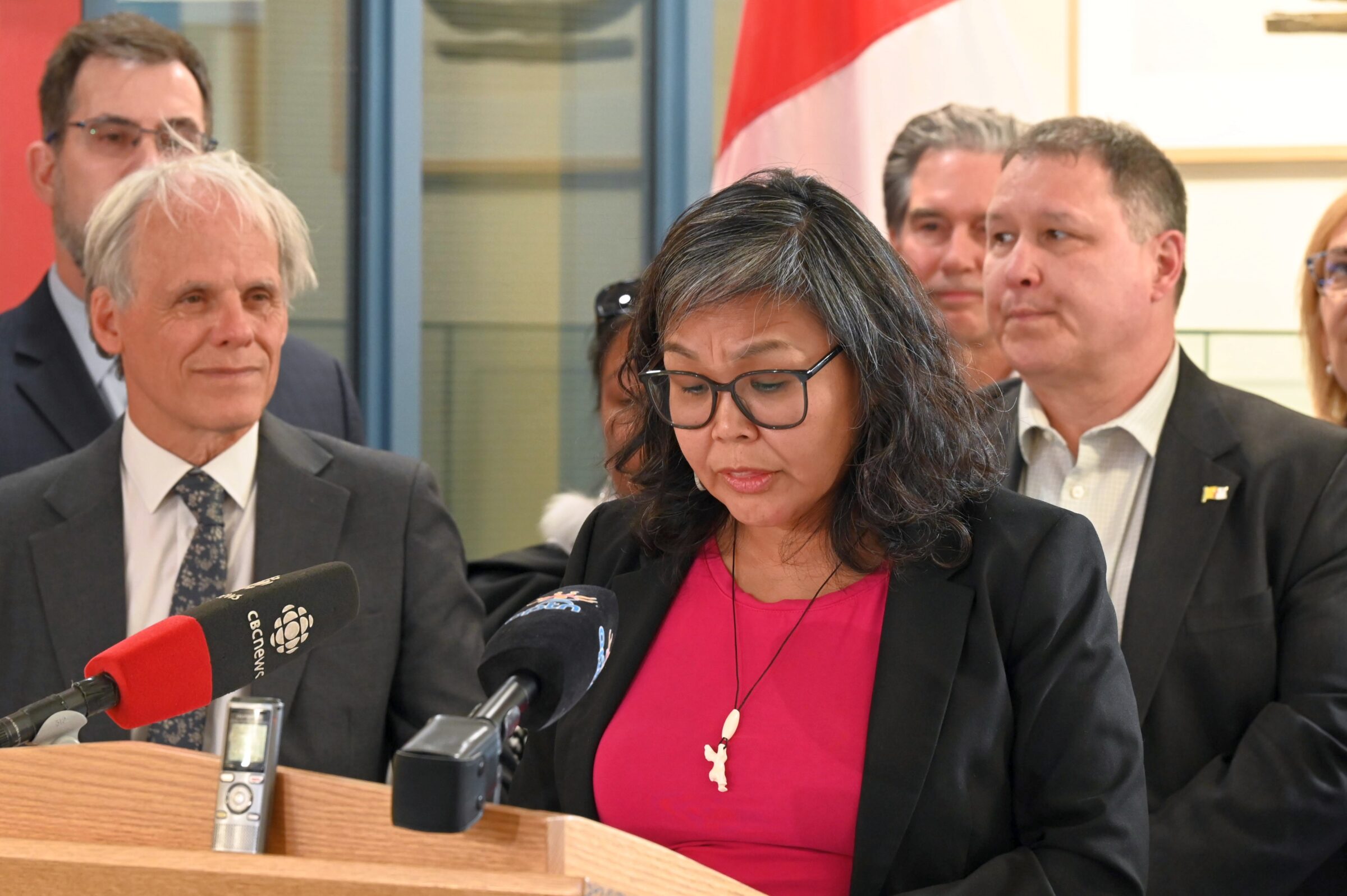
Nunavut MP Lori Idlout speaks at the Nunavut legislature announcing federal funding for a therapeutic justice program in Pond Inlet while parliamentary secretary Jacques Ramsay, left, and GN minister of justice George Hickes listen. (Photo by Mosha Folger)
This story was updated on Tuesday, June 30, 2026, at 11:45 a.m. ET.
Jacques Ramsay, the parliamentary secretary to the federal minister of public safety, was in Iqaluit with Nunavut MP Lori Idlout today for a news conference to announce $1.59 million over five years in funding to adapt and deliver a therapeutic justice program in Pond Inlet.
The program will provide an alternative to court proceedings and focus on healing, accountability and support, a Public Safety Department news release issued Friday said.
George Hickes, Nunavut’s minister of justice, said at the news conference a pilot project has already delivered the therapeutic justice program in Cambridge Bay and Arviat, where it has worked with 160 clients since 2019.
“The therapeutic justice program is designed to address some of the most pressing challenges in our justice system,” Hickes said. “The overrepresentation of Inuit in the criminal justice system. The need to reduce recidivism. The importance of strengthening mental health and trauma supports.”
The federal funding is administered through the Crime Prevention Action Fund, which is part of the National Crime Prevention Strategy.
“The goal of this fund is to support evidence-based crime prevention initiatives,” Ramsay said. “It specifically targets programs that address known risk factors associated with crime among vulnerable groups, especially children, youth and high-risk offenders.”

Hickes did not give specific details on why Pond Inlet was chosen for the program.
In September 2025, Pond Inlet’s then-MLA Karen Nutarak said there was an “escalating crisis” of suicides in the community and that the GN’s response prevented further tragedy.
“We look at the caseloads, we look at the number of calls,” Hickes said. “We look at the types of calls working with the Royal Canadian Mounted Police, and we look at where we felt it’s going to be the most impactful.”
Hickes said the program will be delivered by the GN’s Justice and Health departments.
“Mental wellness is shaped by culture, family, language, community and connection to the land,” Health Minister Janet Pitsiulaaq Brewster said at Friday’s news conference.
“Programs like this demonstrate that clinical care and Inuit knowledge are complementary not competing approaches to supporting mental wellness.”

Hickes said he would like to see the program delivered in every Nunavut community, but there are no plans in place to do that yet.
“When we’re looking at calls for service and the types of criminal activity in communities, it can fluctuate, it can change,” Hickes said.
“When we have an opportunity to roll this out to another community, those factors will be taken into consideration to choose the next one, and hopefully there is the next one. I do want to continue to build on this.”
Correction: This story has been updated to correct a quote by Health Minister Janet Pitsiulaaq Brewster.
Therapeutic justice sounds good in theory, but what happens when someone keeps reoffending? At some point, repeated chances stop being rehabilitation and start looking like a revolving door. Victims deserve justice too, and communities deserve to feel safe. If a program isn’t changing behavior after multiple attempts, there needs to be accountability and consequences—not just another referral to treatment.
MORNING COFFEE!!
Not sure why you received a down vote. You make perfect sense. Justice for victims seems to not be part of the process.
I wish this therapeutic justice program the best. I really do. However, over the last 40 years, so many of these programs have come and gone in what is now Nunavut that it would be hard to count them all. For decades, politicians have come in with feel good announcements of these programs, and yet sadly the substance abuse, the hopelessness and the violence is as epidemic today as it has ever been.
Unless you give people some hope of participating in the wage economy and a reason not to sleep all day and drink all night, I don’t think that the violence and the suicide will come down. A therapeutic justice program just isn’t designed to offer people a fulfilling job, hope for the future, and a reason to get up in the morning and go to bed sober at night. So, while I hope it helps, I’m not terribly optimistic.
“Ottawa announces $1.6M for Pond Inlet therapeutic justice program”
Why? What is not working properly that needs to be changed?
How will this $320,000 of annual spending create improvement in the lives of humans?
Many people, mostly non Indigenous, don’t understand the issues about the court system. First, these programs reduce the risks of reoffending as this is demonstrated by a series of studies done at the end of 1990’s and early 2000’s: with Indigenous justice programs the risks of recidivism are reduced by half compared to similar cases that go through the state court system. It’s true that there’s little consistency with these programs because funding is unstable and the politicians hesitate to fund them because of reelection concerns since people like tough justice instead of efficient justice.
The other challenge is the court system itself that doesn’t want to see its power eroded and whether it’s the Crown or the judiciary, they are reluctant to support these programs and few cases are referred to them so that people who administer the programs get discouraged and find other challenges. When Nunavut came into being, it was considered to channel more summary cases to lay Justices of the Peace but that didn’t materialize and the Nunavut Court of Justice filled most of the gap dealing with summary conviction offences. I salute Mittimatalik for its new program and hope they can get stable funding so that the program has the opportunity to show its effectiveness, provided the NCJ and the Crown collaborate.
A society and direct programs that promote and provide for well-being and recovery are wonderful. Those are fundamental good features of civilization, community and humanity. Suggesting that as a unique strategy or only fitting for certain individuals based on identity is something that contributes to the decline of individuals and society
Yes, S. Same thing I tried to post but guess using words: political desire jailing for speech, equality, criminal becomes victim, Gladue principles, UNDRIP’s Indigenous therapeutic jurisprudence, Canada’s sovereignty erased, social workers/ elders as judge, and jury… are not allowable so my commentary post is sent to the eyes of darkness. I’m reduced to posting in rocks-sparks, keywords, lol.
It’s good to know that some programs showed progress at one time, but that was 30 years ago.
Unfortunately, we don’t have any data on recidivism rates in Nunavut today as the GN seems incapable or unwilling to provide them (I lean toward the later).
Now that we have two territorial Healing Facilities It would be interesting and insightful to see if or how their programing has effected recidivism in the territory.
My guess, is very little if at all. But that’s just a guess. The data is there, the only reason I can imagine we aren’t seeing the progress is because there is very little to see.
Poor Lorie, reduced to nothing more than megaphone for Carney and his Liberal clowns.
Too bad Peppy le Pew wasn’t PM, he would have done nothing, just catch phase his way instead of developing policies! So most Canadians voted liberal therefore got in as government. How can most people be clowns?
Nah, this is a huge upgrade for Lori.
Nunavut voted for NDP, not liberals
Maybe if lawyers stopped recommending treatment so their “client” can get out of jail earlier or avoid jail. Maybe treatment should be reserved for people who honestly want to change their life for the better.
Wowzers CBC says 1.5 and NN has it at 1.6 and who is reporting correctly anyway?,
I can say waste of funds no one in the community is talking of a leader today’s future and we know why as well sad SAD yes stand up on your Nunavut