


Territorial leadership forum is foundation of the consensus government system
Arctic Matters: Political system in place only in Nunavut and N.W.T. depends on goodwill and respect of MLAs
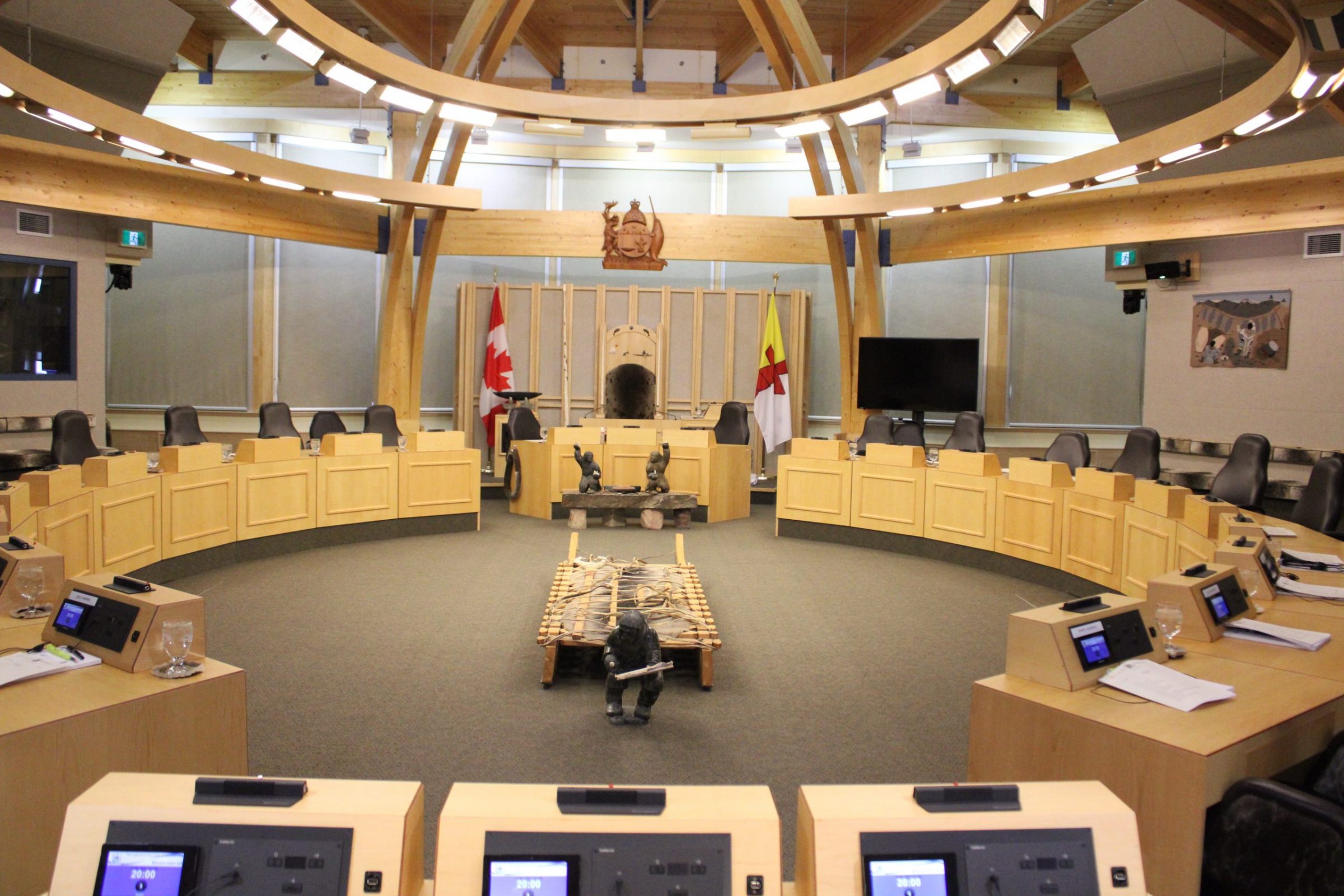
Nunavut gets its consensus form of government from the Northwest Territories, where the tradition was enshrined before Nunavut became its own territory. (File photo by David Venn)

Dennis Patterson
Now that the seventh Nunavut election is over, with its rather dismal and declining average voter turnout of less than 50 per cent, the next important event — which will define the success of the new government — will be the territorial leadership forum.
The forum, scheduled for Nov. 18, is the expression of what is unique about Nunavut and the Northwest Territories’ systems of consensus government.
Under those systems, elected MLAs voting by secret ballot in a public forum first determine among themselves who should be Speaker, presiding over the legislative assembly.
Next, they select who should lead as premier, and then who should serve on the executive council, the body which is granted the awesome authority by the assembly to oversee day-to-day operations of the territorial government.
Some would say Nunavut’s consensus government is run like a typical municipality. But the territorial government with its budget of more than $3 billion is much bigger than the largest Nunavut municipality, and has a much broader range of responsibilities.
While it could be said that the consensus system of government is simply like the municipal model, I believe the added complexity of political parties was avoided because the N.W.T., with its seven language groups and ethnic origins, was already a complex and diverse geopolitical group of legislators.

Advocates for the consensus system asked: Why add another layer of complexity — southern-style political parties — to this already complex, diverse and widely scattered population?
But in my opinion, the main reason for the consensus system evolving in the N.W.T. and Nunavut, unique among other territorial and provincial legislatures, is that it is a reflection of the traditional collective approach to decision-making of Indigenous Peoples of the North.
Rather than the aggressive, adversarial system of parliamentary governance, with government and opposition dividing the assembly, decisions in the consensus system are instead made as a result of everyone’s input — sometimes involving overly long discussions, but without a majority forcing its will upon a minority within the assembly.
And let’s recognize that the consensus system which was inherited from the N.W.T. has successfully dealt with some major issues in the past.
It was the system of government that was deeply involved in the first settlement of major comprehensive northern land claims for the Inuvialuit, and Inuit of Nunavut.
It was also the system that presided over the peaceful and democratic process which led to the settlement of boundaries and division of the N.W.T. and creation of Nunavut in 1999.

Observers of consensus governments remark upon its civility. Members treat each other with respect and courtesy, in contrast to the heckling and shouting often seen in the party system.
And standing committees in the consensus system are stronger because they are not dominated by the government party, but instead the government must respect the opinions and decisions of committees.
Some say the consensus system is unaccountable, that voters should know who the next territorial leader will be when they vote. Or that the consensus system is like a friendly club where no one challenges the government.
But remember, it was the consensus system in Nunavut that abruptly removed then-premier Paul Quassa following a non-confidence motion in the fifth assembly in June 2018.
And the next government of Nunavut also unexpectedly faced a motion of censure in November 2022 over complaints of poor performance by cabinet ministers in answering MLAs’ questions. And in November 2024, Premier P.J. Akeeagok barely survived a non-confidence motion by two votes (10 to 8).

To further enhance accountability, previous assemblies have adopted mid-term reviews, a process where cabinet ministers are required to justify their continued presence on the executive council.
The consensus system depends on goodwill and respect — virtues I believe were unfortunately in short supply at times in the previous sixth assembly.
The Hon. Dennis Patterson represented Nunavut in the Senate from 2008 to 2023. He was premier of the Northwest Territories from 1987 to 1991 and played a key role in the Nunavut land claim agreement.
The residents of NU and the NWT are blessed beyond all measure in the forms of Governance that have evolved or been inherited in the two territories. I for one do not believe that political parities have a place in local government. What has the party system done for municipal governance in the USofA especially under the current administration? For years and years Canadian local government has been lauded as the purest form of government. Why? Because every vote matters! The same argument is true for the 2 territory’s consensus governments. Every vote matters! The only problem with the two levels of government is the appalling level of voter apathy. And Dennis, do you know where it’s even worse? The election of people to lead and guide many of the birth right organizations. The low turnouts for any election are truly pitiful. My goodness, geese do a better job of collectively selecting the leaders of the flock. And the other point is the general electorate (voters and not) should take wisdom from the author of Hebrews 13:17.
Thank you Dennis for always caring.
Should Nunavut shift to a party system?
There’s no simple yes or no. Here’s a clear way to think about it, based on what your story highlights:
Reasons for keeping consensus government
1. Cultural alignment
Consensus is rooted in Inuit and northern Indigenous approaches to decision-making:
deliberation, collective responsibility, and avoiding adversarial conflict.
This is something political parties cannot replicate.
2. Strength of standing committees
In party systems, committees often become rubber stamps for the governing party.
In Nunavut, they can be genuinely powerful and independent.
3. Flexibility and responsiveness
Premiers and ministers can be removed without triggering an election.
Your story notes real examples: Quassa (2018), the 2022 censure, and the 2024 narrow non-confidence vote.
This demonstrates accountability without the gridlock often seen in party politics.
4. Reduced political polarization
Nunavut avoids wedge politics, party fundraising pressures, and south-style campaign machinery.
Reasons people argue for political parties
1. Accountability and transparency during elections
Voters never know who will be premier until after the election.
Parties could create clearer mandates and platforms.
2. Clearer policy direction
Consensus systems often lead to broad, compromise-driven visions rather than bold, decisive reform.
Parties can create sharper priorities.
3. Voter engagement
Turnout below 50% suggests many voters feel disconnected.
Some believe parties might increase interest and clarity—but this is not guaranteed.
Your narrative strongly argues that Nunavut’s system reflects Indigenous political culture, handles diversity without adding complexity, and has historically succeeded at monumental tasks like land claims and the peaceful division of the Northwest Territories.
The criticisms you mention—lack of accountability, the “friendly club” dynamic, slow decision-making—are real, but none are unique to consensus.
Party systems have their own dysfunctions: partisanship, obstruction, polarization, and leadership contests dominated by non-voters.
So: Should Nunavut switch?
Based on the values and evidence you raise, no — at least not yet.
Instead, Nunavut may benefit from:
• Stronger mid-term ministerial reviews
• Clearer mandate letters and public commitments
• Better public communication and civic education about how consensus works
• More tools for MLAs to hold cabinet to account
• Electoral reforms that fit consensus (e.g., run-off votes, civic engagement programs)
The goal should be to improve consensus, not replace it, SO
Dennis, my problem is that I never know what I’m voting for when I step into that box. Usually, I will just be voting for a nice guy ( or gal). I’m not voting for a governing agenda that’s for sure. Consensus government is high school election politics. It will always be that. You can try to put lip stick on a pig, but it will remain as such. And I think that we did have farm animals in Apex long ago.
And you are the problem NUNAVUT has, where are you’re standards? vote for someone that is honest, wants to make a difference, not the guy that smiles, and never says a word!! Ayaq!