


The Arctic’s winter of 2019-20 ran hot and cold
Overall, temperatures were higher than normal from Dec. 1 to Feb. 29

This graphic prepared by climate scientist Zach Labe shows Arctic air temperatures ranked by month over the satellite era, from 1978 to February 2020. (Image courtesy of Zach Labe)

The weather over the past three months has generally been warmer than average in Nunavut and Nunavik, according to temperatures in these Arctic regions from Dec. 1 to Feb. 29.
Of course, there have been exceptions. On Wednesday, Feb. 4, in the western Nunavut hub of Cambridge Bay, it was -41 C with a wind chill of -59 C. This week’s cold was so extreme that it made people’s snow pants creak as they walked, enveloped the town in an eerie ice fog and created ice buildups on rooftop vent pipes.
Environment Canada’s recent outlook for March says the cold is forecast to stay in place in Nunavut.
However, the meteorological winter (December to February) is still considered to have ended.
And this past winter was a warm one this year in most of Canada, and throughout most of Nunavik and Nunavut, said Dalhousie University weather watcher Patrick Duplessis.
Duplessis found weather records show that average temperatures over the past three months were higher than those in the same months for the period from 1981 to 2010 in the following Nunavut and Nunavik communities:
• Kuujjuaraapik: +3.5
• Rankin Inlet: +2.2
• Iqaluit: +1.4
• Kuujjuaq: +1.7
• Clyde River: +1.1
• Cambridge Bay: +0.8
• Alert: +0.6
• Resolute: +.06

The three-month temperature anomalies, or variations from the normal, were positive even though during February some communities’ temperatures were lower than at the same time in 1981 to 2010, Duplessis found, and those lower averages are listed here:
• Iqaluit: -1.7
• Cambridge Bay: -1
• Kuujjuaq: -0.6
• Resolute: -0.2
• Rankin Inlet: -0.1
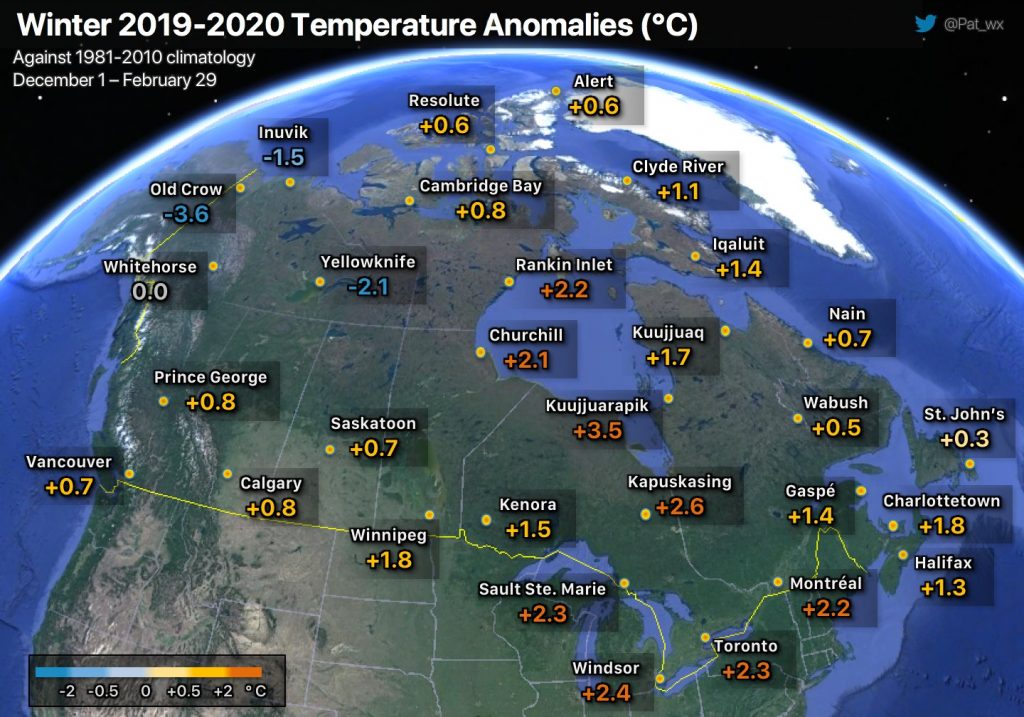
Here you can see a mapping of the winter’s 2020 temperature anomalies. (Image courtesy of Patrick Duplessis)
In Iqaluit, municipal services were suspended twice in February due to the extreme cold.

City of Iqaluit Trucked Services (trucked water, sewer and garbage) are suspended until further notice due to severe cold weather. Crews are expected to start early tomorrow morning to catch up.
— City of Iqaluit (@CityofIqaluit) February 20, 2020
Even so, some northern communities nevertheless hung on to their warmth, which they started to rack up in the fall of 2019, as their averages in February show:
• Kuujjuaraapik: +2.8
• Clyde River: +1.1
• Alert: +.04
As for January, this month was warmer for many places in Nunavut and Nunavik than in 1981 to 2010:

• Kuujjuaraapik: +5.3
• Rankin Inlet: +4.6
• Gjoa Haven: +3.6
• Kuujjuaq: +2.4
• Kugluktuk: +1.6
• Iqaluit: +0.4
New daily record highs for Rankin Inlet were set on Jan. 30 of -5 C (previously -13.9 C in 2000) and Jan 31 of 4.7 C (previously -10.9 C in 1992), with 42 years of weather data on record.
Overall, 2020 surpassed 2016 for the warmest January on record for the globe, according to the National Oceanic and Atmospheric Administration, although Fairbanks, Alaska, experienced its second-coldest winter in 44 years.
Unusual northern weather patterns had climatologists and meteorologists on the other side of the Atlantic amazed: although Arctic Finland was cold and had record snowfalls, the heat was on in southern Finland, where there was no measurable snow at all this winter and birds started to nest months ahead of schedule.
“One of the striking features this year in Helsinki has been the high number of very warm, spring-like days, when the maximum temperature has surpassed 5 C,” Mika Rantanen, a researcher at the Finnish Meteorological Institute, noted on Twitter.
Stockholm also experienced its warmest winter ever recorded, and in Moscow the average winter temperature of 0.2 C was 6.3 C higher than the average from 1981 to 2010.
Meanwhile, the Arctic sea ice extent is now at the 12th lowest on record, according to data from the Japan Aerospace Exploration Agency. That is about 1.2 million square kilometres less the 1980s average. The sea ice maximum is usually reached in mid-March.
(0) Comments