


The defence of Greenland – Part 1: Force X
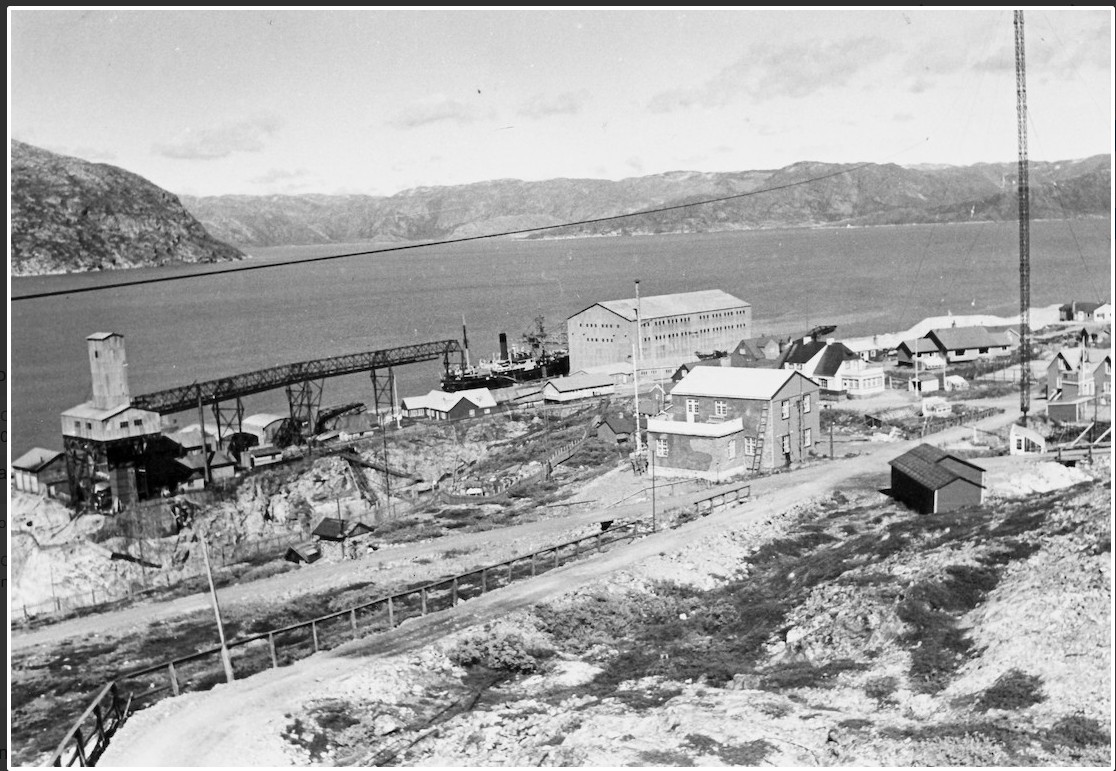
The cryolite mine at Ivigtut, Greenland, as it appeared in 1948. (Photo by Vagn Hansen, courtesy of Arktisk Institut no. 22326)
This article is the first of a four-part series on the defence of Greenland. Part 2 will appear on June 6, 2026.
U.S. President Donald Trump has, on more than one occasion, made it clear that he wants the United States to own Greenland.
The U.S. once had over a dozen military installations there. Today it has one. This series explains how America’s involvement in the defence of Greenland came about.
On April 9, 1940, Denmark fell to the invading forces of Nazi Germany. But it was an unusual capitulation. The Danish government under then-prime minister Thorvald Stauning remained in power – sort of – and the parliament continued to function.
The royal family did not flee the country, as monarchs in some other countries did. But it was clear that Germany was calling the shots in Copenhagen.
Britain had been officially at war with Germany for seven months and was naturally concerned over Germany’s successes so close to home. But it had another concern, one that it shared with Canada, which had joined the war a week after Britain.
Greenland was a Danish colony, and Canada and Britain were concerned about the future of Greenland, which was dependent on Denmark for annual supplies. There was considerable German submarine activity in the North Atlantic. Greenland, with its long fiords and thinly populated coast, could potentially be used for enemy submarine bases.
But Greenland was also strategically important for both Canada and Britain because it was home to the world’s only cryolite mine, at Ivigtut, in a 12-mile-long fiord in the island’s southwest.
Not unlike quartz in appearance, cryolite is a soft, malleable mineral with a waxy texture, an eerie milky translucence and low melting point. It had been known to local Inuit for centuries and was used for weighting their fishing lines and washing hides.
When Inuit began trading with the Danes, they began to grind cryolite into a fine powder and mix it with their tobacco; by 1856 some local snuff mixtures were almost half cryolite by weight.
Known to scientists only since 1798, cryolite’s geographic source was only discovered seven years later. It was commercially mined in Greenland beginning in 1854 by Kryolit Mine og Handels Selskabet. It was nicknamed Greenland’s “white gold.”
Mining took place through the winter using labour from Denmark — Greenlanders were not employed in the mine — and shipped to Denmark and eventually to the U.S. in the short summer shipping season.
Cryolite was an important mineral used in the production of aluminum and to build airplanes, necessary for Britain and Canada’s war effort.

The mine at Ivigtut was the only known source of cryolite in the world. Refineries in Denmark and at the Pennsylvania Salt Manufacturing Company (Penn Salt) in the U.S. processed the raw material, as did the Aluminum Company of Canada (later Alcan) at Arvida, Que.
A refinery in Norway used a synthetic material that had recently been developed, but the country was now also in Nazi hands.
The U.S. so far was neutral in the war effort but used aluminum in its own industries, including aircraft manufacturing.
The Aluminum Company of Canada needed continued access to cryolite. If Germany sabotaged the mine, it could cripple the Allied war effort. Or a German takeover of the mine could boost Germany’s manufacturing capabilities.
In 1939, about 41,000 tons of the precious commodity were shipped to Denmark and about 18,000 tons to North America.

The British government and the Aluminum Company of Canada pressed Canada, as Greenland’s nearest neighbour to the west, to take action to secure the mine.
Alcan no doubt saw a commercial advantage if the only source of cryolite were controlled by Canada. Britain wanted Canada to take the lead because it feared that action by Britain itself would antagonize the United States and violate the Monroe Doctrine, an American belief that any interference by European (and other) powers in the Western Hemisphere would be considered a threat to U.S. security.
Canada’s Department of External Affairs advised the prime minister that Canada, acting to protect Greenland and the cryolite supplies, would be more acceptable to the United States than if Britain or France were to do so.
Former Canadian prime minister Mackenzie King was initially hesitant. While wanting to help Britain in its war effort, he said that Canada was looking into how it could defend Greenland — not alone but in co-operation with British forces — without being “blamed for taking over.”
Advisers were telling him that, because Denmark was occupied by the Nazis, Greenland should be regarded as enemy territory, and Canada would be justified in occupying it and providing supplies for the Greenlanders, to which King replied that “the unemployed in Canada would criticize looking after Esquimaux in Greenland’s icy mountains… rather than Canadians at home.”
Nevertheless, at one point, Canada was considering occupying Greenland as a self-appointed “trustee” for the Danish government.
On April 14, only five days after Germany invaded Denmark, a Canadian parliamentary sub-committee chaired by the director of military operations and intelligence decided that Canada would occupy Greenland to defend the mine.
A party of about 100 men, which included twelve Royal Canadian Mounted Police officers, would leave for Greenland in early May aboard the icebreaker N.B. McLean. This secret expedition, known as Force X, had only two weeks to get ready to leave!
The details were quickly fleshed out and the plan expanded. A force of 250 would arrive in Greenland in early June and occupy the mine site and the two administrative centres, Godhavn and Godthaab, each of which was under the control of a Danish administrator, sometimes referred to as a Governor.
The RCMP vessel St. Roch, commanded by Sgt. Henry Larson, was ordered to depart from its home port in Vancouver and make its way in secret through the Northwest Passage, to be available if it were needed in Greenland.
Those were the plans. But before they were acted on, they came to a sudden halt. On May 2, the acting minister of national defence ordered the demobilization of Force X. All action was to be suspended.
What had happened?
To be continued.
Taissumani is an occasional column that recalls events of historical interest. Kenn Harper is a historian and writer who lived in the Arctic for over 50 years. He is the author of Give Me Winter, Give Me Dogs: Knud Rasmussen and the Fifth Thule Expedition, and Thou Shalt Do No Murder, among other books. Feedback? Send your comments and questions to kennharper@hotmail.com.
The US military already is in Greenland and they can build any military base and port if they want to, so the hot air coming out of the orange man seems to be about something else he wants in Greenland. It’s not security for Greenland, that’s already there and can be expanded on.
Could it be corporate interests? Deflection on the Epstein files? Something for sure.
Yes that is correct, the US already has a treaty in place with Greenland for its military security.
U.S.–Greenland relationship is the 1951 Defense of Greenland Agreement (amended in 2004 and 2012), which allows the U.S. to operate its strategic Pituffik Space Base (formerly Thule Air Base).
Allowed to build other bases as needed. For example Narsarsuaq airport and base sounds like will be taken over by the US military.
Under the Igaliku Agreement the US can not expand its current defense area beyond the Pittufik Space Base (Thule Air Base). They can only open or operate other bases, like Narsarsuaq if Denmark and Greenland both approve, which they probably will (unfortunately) but not under the conditions the US has requested.
Google “Manifest Destiny”. It was a plan to unite all of North America, including Greenland, Mexico, Canada, and the countries South of Mexico into 1 massive resource rich Country. This goes back to mid 1800s. It speaks to today and why he is trying to do what he is trying to do. This goes back generations.