


The defence of Greenland Part 4 | The Greenland Defence Agreement
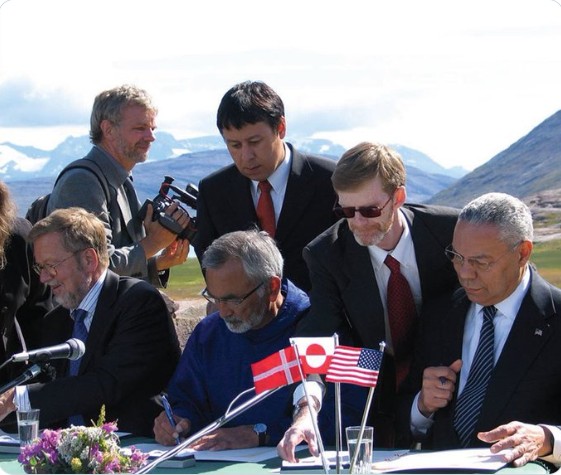
Greenlandic, Danish and American officials sign a renewal of their defence agreement in 2004 in the village of Igaliku in southern Greenland. (Photo courtesy of U.S. Consulate in Greenland)
This article concludes the Greenland defence series.
On February 12, 1941, United States President Franklin D. Roosevelt approved a proposal “to negotiate with the Danish Government in Greenland an arrangement by which that government builds an airfield, open to the American nations for the purpose of hemispheric defence.”
Then suddenly the American position changed.
Washington realized that if America, still neutral at the time, were drawn into the war, the country would need not just access to an airfield, but military bases in Greenland. Such bases would be critical for America’s war effort, planners claimed, and so the War Department wanted full control over their location, construction and operation.
As planning progressed and the scope of the project expanded, officials decided that such an undertaking could not be under the jurisdiction of local authorities in Greenland.
Then Henrik Kauffmann, Denmark’s ambassador to the U.S., played his “Greenland card.”
Wanting to ensure that “America would not occupy Greenland, but only gain a limited right to bases,” he convinced the Americans that he was a reliable negotiating partner on behalf of Denmark. The Greenland governors would be cut out of any negotiations. Kauffmann had outmaneuvered them. He would represent Denmark and the king. He had triumphed.
Kauffmann negotiated The Greenland Defense Agreement of 1941 with the Americans in secrecy. They signed it on April 9, 1941, the first anniversary of the Nazi occupation of Denmark.
Kauffmann signed “on behalf of his Majesty the King of Denmark in His capacity as sovereign of Greenland, whose authorities in Greenland have concurred herein.”
The last phrase was a stretch. The governors had been informed at the eleventh hour of what was afoot. Governor Svane concurred with the agreement “under the extreme force of circumstances,” and recommended to Brun that he do the same.
Two days later, Kauffmann sent telegrams to Denmark informing them that he had signed “An Agreement on the Defense of Greenland.”
This took Denmark – and its German occupiers – by surprise. The following day, at Germany’s request, Denmark recalled him. He was ordered to return to Copenhagen immediately.
But Kauffmann refused to go.

Denmark informed the U.S. that Kauffmann had no official mandate and no longer represented Denmark. But Kauffmann had done his homework well. By then, he had the support of the American secretary of state, who sent a note to Denmark on April 14 stating that the U.S. would continue to recognize Kauffmann as Denmark’s official representative in America.
A few days later Denmark charged him with treason, an offence punishable by life imprisonment.
But Kauffmann refused to return to Denmark.
A few days after that, the City of Copenhagen issued an arrest warrant and confiscated his property there.
Still, Kauffmann remained in Washington.

The Greenland Defense Agreement of 1941 is brief – only three pages. It began with the U.S. recognizing the sovereignty of Denmark over Greenland. The agreement gave the U.S. “the right to construct, maintain, and operate such landing fields, seaplane facilities, and radio and meteorological installations as may be necessary,” and the right to import supplies without customs duties.
Article 10 of the agreement ultimately became the most controversial one. It held that the agreement remains in effect until both parties agree to terminate it. Effectively, this meant that the U.S. would retain its rights even if Denmark later wished out of the agreement. The U.S. had a veto against termination.
The U.S. acted immediately to use the rights it had acquired. A fleet arrived at Narsarsuaq, Greenland, on July 6, 1941, to begin construction of an airport, Bluie West 1. Construction of the airport at Sondre Stromfiord, Bluie West 8, began on Oct. 20. Less than two months later it was operational, an indication of what can be done in the face of an emergency.
Germany surrendered on May 7, 1945. Immediately, Denmark sought to have the defence agreement terminated, but the U.S. would not hear of it. So, five days later, the Danish parliament ratified it.
Many in Denmark thought it gave the Americans too much power to act unilaterally in Greenland. Indeed, Article 2 of the agreement gave the Americans the right to establish facilities in Greenland without even consulting Denmark.
The 1941 Defense Agreement remained in effect for a decade. In 1951 it was replaced with a new agreement.
That agreement, the Defense Agreement of 1951, was ratified by the Danish parliament on June 8, 1951. The United States was to “assist the Government of the Kingdom of Denmark in the establishment and/or operation of such defence areas as the two Governments may agree from time to time, on the basis of NATO defence plans, to be necessary for the defence of Greenland and the rest of the North Atlantic Treaty Area.”
Thus, the U.S. cannot unilaterally establish new facilities; that requires agreement with Denmark.
But Article 5 gave the U.S. “free access to and movement between the defence areas throughout Greenland, including territorial waters, by land, sea, and air.”
The agreement can only be modified by mutual consent.
The agreement will be in effect “for the duration of the North Atlantic Treaty.”
That, in itself, should be a reason for U.S. President Donald Trump to ensure that the U.S. remains a part of NATO.
That agreement was renewed in 2004 with the so-called Igaliku Agreement, the first time Greenland acted as a co-signatory on such an agreement. It remains in effect.
Kauffmann returned to Denmark after the war ended, where he was quickly cleared of the treason charges. He was appointed a minister without portfolio in the government in 1945, represented Denmark at the founding conference of the United Nations in San Francisco, and returned to Washington in 1947 as ambassador, a post he held until he retired in 1958.
Kauffmann’s impact on the future of Greenland was enormous. In Washington he continued his diplomatic activities, often against the wishes of the Danish government, setting the groundwork to allow a continued American presence in Greenland. This has been described as his “private foreign policy.”
Kauffmann was hospitalized with prostate cancer in 1963 in Denmark. On June 5, his wife of 37 years, Charlotte, ended his life by slitting his throat in what was considered a mercy killing. She then took her own life.
Taissumani is an occasional column that recalls events of historical interest. Kenn Harper is a historian and writer who lived in the Arctic for over 50 years. He is the author of Give Me Winter, Give Me Dogs: Knud Rasmussen and the Fifth Thule Expedition, and Thou Shalt Do No Murder, among other books. Feedback? Send your comments and questions to kennharper@hotmail.com.
I just finished reading episode four of your story of American occupation of Greenland during WW II.
For years I was puzzled why the RCMP sent the St Roch from Vancouver the middle of the war across the the North East passage.
Now I have a clearer understanding of what was going on.
Thank you
We know that the free reign the Mericans have enjoyed since the demise of the British empire is coming to an end… And that a drowning body will grab on to anything within reach to save itself. The near future is going to be difficult, keep well Greenlanders, we are with you as the cookie crumbles in the lower 48 🙂
With the orange man spewing his garbage about wanting Greenland, it’s not about security as the Mericans can build any military base in Greenland if they want to, is it for deflection of certain files that are being ignored or how badly the US is being run right now?