


The Inuit-guided Moravian expedition to Ungava, Part 1
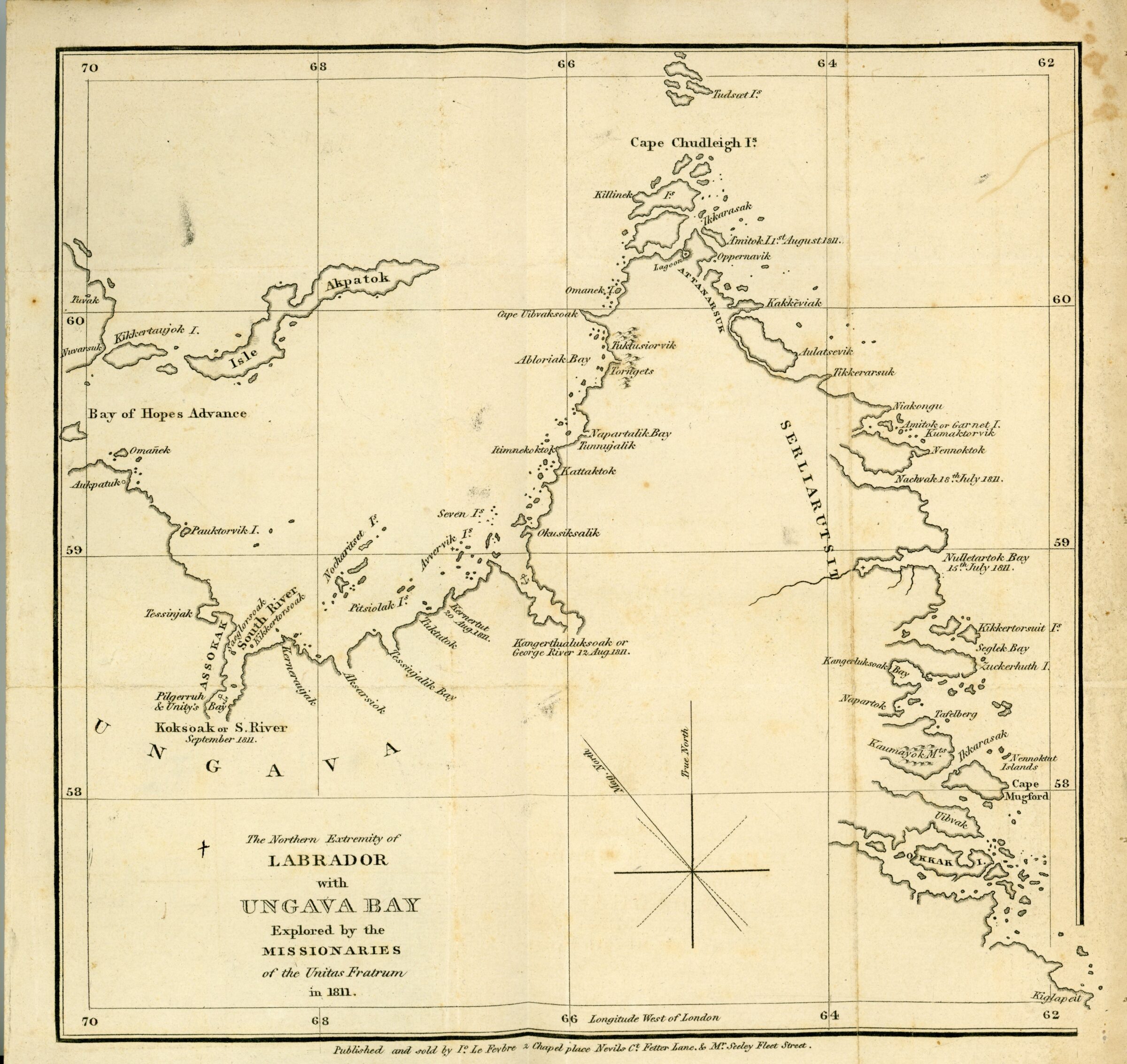
This is a map of the area travelled by Kohlmeister and Kmoch. Okkak is on the lower right. (Map from “Benjamin Kohlmeister and George Kmoch. Journal of a Voyage from Okkak, on the Coast of Labrador, to Ungava Bay” London, 1814.)
In my last column, I set the stage for the Moravian missionary voyage to Ungava Bay.
Benjamin Kohlmeister had learned much about Ungava from two Inuit traders, Arnauyak and Uttakiyok. Mission authorities in Europe had given the green light to a formal expedition to suss out the area and its possibilities as a site for a future mission.
Kohlmeister had already spent 17 years in Labrador and knew the Inuktitut language well. His translation of the Gospel of John into Inuktitut had been published in England in 1810.
He realized that an expedition to Ungava could not be conducted without major Inuit assistance. Accordingly, he travelled to Hopedale in 1910 where he recruited Jonathan, a Christian Inuk, for the task.
Indeed, Kohlmeister later wrote, “We consider him the captain of the expedition.”
Jonathan and his wife Sybilla, both between 50 and 60 years of age, had been the first Inuit baptized at Hopedale.
Jonathan was an impressive individual.

“He was a man of superior understanding and skill,” wrote Kohlmeister, “possessed of uncommon presence of mind in difficulties and dangers, and at Hopedale considered as the principal person, or chief of his nation.”
Moreover, Jonathan owned a 45-foot two-masted boat he had purchased from traders at Chateau Bay in southern Labrador. He was, said Kohlmeister, “a steady intelligent Christian Esquimaux” and considered “one of the most skilful commanders on the whole coast of Labrador.”
Jonathan recruited his own crew. They included his son Jonas with wife Agnes and five young children; his cousin Paul, “a man of very warm temper,” and his wife Mary; a young man named David who was accompanied by his mother Rachel, a “good-natured old woman” who kept everyone’s clothes in good repair; and an orphan boy, Okkiksuk, whom Jonathan had adopted.
In the fall of 1810, Kohlmeister returned to Okkak with Jonathan and his capable entourage. There Jonathan made his boat ready for the trip that would take place the following spring.
It was decided that another missionary, George Kmoch, would accompany the group. An angakkuq named Atsugarsuk spread reports about the hostility of the Inuit in Ungava.
Many of the Inuit at Okkak thought the voyage was ill-advised and that they would never see their two popular missionaries again. They would surely perish in the turbulent waters around Killinek, or Cape Chudleigh as it was known to Europeans. (Today, we know the area by the name Port Burwell.)

Jonathan responded to suggestions that the Ungava Inuit would kill him with the response, “Well, we will try, and shall know better when we get there … When I hear people talking about the danger of being killed, I think: Jesus went to death out of love for us, what great matter would it be, if we were to be put to death in His service, should that be His good pleasure concerning us.”
On June 24, 1811, the party left Okkak in Jonathan’s boat. They were accompanied by an umiak — a traditional skin boat — commanded by Thukkekina. They would use it in landing so Jonathan’s boat, with a deeper draught, did not have to go too close to shore.
They travelled north toward Killinek, stopping at several Inuit camps along the way.
Near the tip of the Labrador peninsula they met up with Uttakiyok, one of the men who had given Kohlmeister his initial knowledge about Ungava some years earlier.
Kohlmeister recalled, “Uttakiyok was one of the two Esquimaux, from whom, in the year 1800, we received the first distinct information respecting the Ungava country and its inhabitants, by which the desire… to visit the northern Esquimaux was greatly strengthened.”
Having heard that Uttakiyok was in northern Labrador, Kohlmeister had sent a message ahead that Uttakiyok should wait for his party and guide them through the treacherous strait at Killinek and south along the Ungava coast.
Uttakiyok with his two wives had waited — his name means “the one who is waiting” — and had several Ungava Inuit with him.
The missionaries said Uttakiyok was “well respected, on account of his superior sense, and skill in all Esquimaux arts.”
Despite the fact that Uttakiyok had not converted to Christianity, the missionaries’ praise of the man was lavish: “We had indeed the greatest reason to thank God, that he had sent us this man, to conduct us on our way to an unknown country, and through unfrequented seas.”
In my next column, I will continue with the story of Kohlmeister and Kmoch’s expedition to Ungava.
Taissumani is an occasional column that recalls events of historical interest. Kenn Harper is a historian and writer who lived in the Arctic for over 50 years. He is the author of Give Me Winter, Give Me Dogs: Knud Rasmussen and the Fifth Thule Expedition, and Thou Shalt Do No Murder, among other books. Feedback? Send your comments and questions to kennharper@hotmail.com.
(0) Comments