


The world is ending, and I feel fine
Climate change and AI pose existential risks, but the past has shown we can adapt
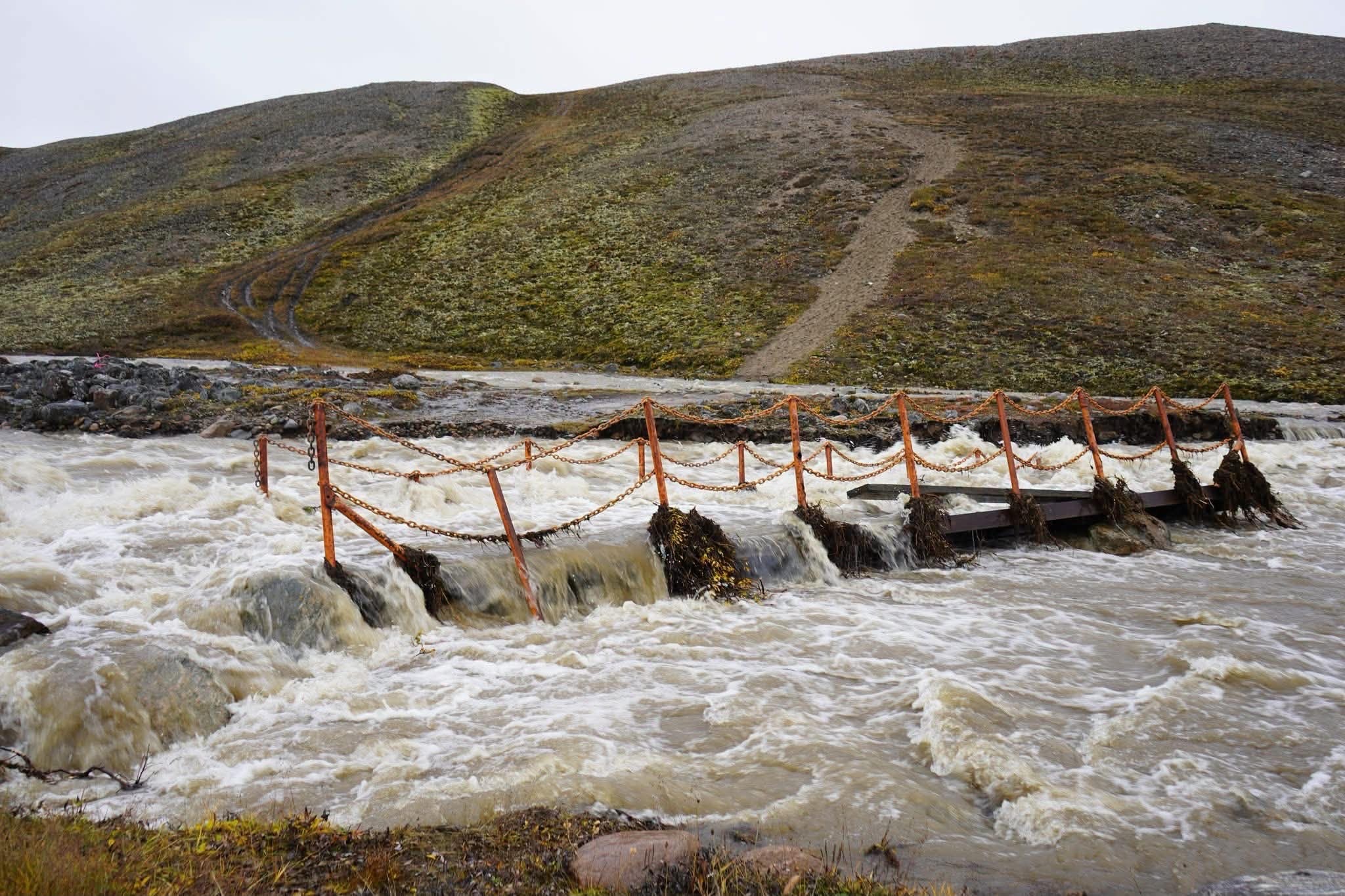
Heavy rains wash out a bridge in Pond Inlet on Sept. 5. (Photo courtesy if Andrew Tagak)
A friend told me a story this summer about a smokey day in Minnesota, where she lives. When she complained about the haze to her 13-year-old nephew, he responded: “That’s just summer.”
It wasn’t long ago that wildfire smoke was a characteristic of summer mostly limited to western North America, where conditions are drier.
But, in just a few years, that has drastically changed. Evidence of climate change is everywhere: it’s in the sea ice of the North — much less predictable now — and unbreathable air across the south. (And parts of the North.)
When we think about and imagine the collapse of civilization, the conversation usually revolves around the world becoming uninhabitable due to climate change.
Nunatsiaq News reporter Miriam Lafontaine recently wrote about one recent study that predicts Arctic winters will be, on average, 10 degrees warmer by 2100. A change like that could bring Iqaluit’s mean daily temperature in January from -26 C to -16 C.
For comparison, Iqaluit’s average daily temperature increased by one degree between 1991 and 2020.
Even more recently, artificial intelligence has emerged as a potential threat, with leaders in the field warning AI could kill us all by the end of the decade.

Of course predicting the end of the world — and being wrong about it — is a constant throughout history.
We braced ourselves for Y2K, in anticipation that computers wouldn’t understand the calendar flipping from 1999 to 2000. Before that, we thought global petroleum reserves would wane with demand still soaring. Before that, during the Cold War, the threat was nuclear.
In 1947, after the first nuclear weapons were developed, the Bulletin of the Atomic Scientists created the Doomsday Clock to assess risks to humanity. It was originally set to seven minutes to “midnight,” or the end of the world.
Today, it sits at 85 seconds to midnight.
Is the end of the world nigh? Nobody knows — not even ChatGPT. But it did acknowledge it’s a fair question.
No single person can control climate change or any other threats to civilization but we can control our own lives. Like Iqaluit’s Derek Allerton, who collects cans every day in the hopes the Nunavut government will reinstate a beverage recycling program.

We can buy into renewable energy programs, compost, limit our consumerism, and do other small things to make our communities better.
Even if the path forward isn’t clear, I’m confident we will find ways to adapt to anything.
Except maybe an asteroid.
(0) Comments