


Tom Siddon considered Nunavut Agreement his proudest achievement
Arctic Matters | Former Conservative cabinet minister’s funeral scheduled for July 9 in B.C.
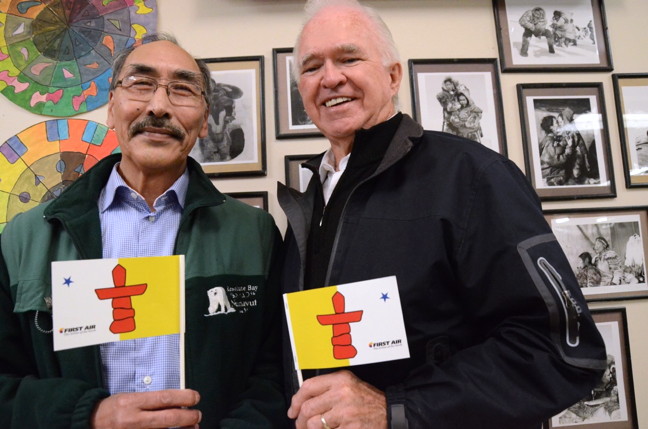
Former federal cabinet minister Tom Siddon, right, who was instrumental in encouraging the federal government to sign the Nunavut Agreement in 1993, poses with former Nunavut premier Paul Quassa in 2015. Siddon considered his involvement in the creation of Nunavut his “proudest achievement” as a federal politician, writes former senator Dennis Patterson. Siddon died in B.C. on June 28 at the age of 84. (File photo by David Murphy)

Dennis Patterson
Today, on July 9, 2026, Nunavut Day — a family and community are gathering in Penticton, B.C., to mourn a former MP from British Columbia. Tom Siddon died there June 28 at the age of 84. His family set Nunavut Day as the day of his funeral.
It is so appropriate that Siddon will be celebrated, mourned and buried far away in southern British Columbia while Nunavut residents are enjoying a holiday under the midnight sun to celebrate the 27th anniversary of their new territory.
Without Tom Siddon, there would have been no Nunavut territory to commemorate.
Of course, it was Inuit leaders who negotiated the detailed terms of the biggest and best land claims agreement in the history of North America — the Nunavut Agreement — which was finalized after 15 years of on-again, off-again negotiations in late 1991.
In a marathon negotiating session in Ottawa on a cold December day in 1991, it took until after midnight for the details of the 400-page agreement to be finally settled.
But there was one thing preventing the agreement from being accepted by the Inuit. Since the first Nunavut proposal had been prepared by Inuit Tapirisat of Canada in 1975, the Inuit of Nunavut wanted their own new territory to be carved out of the Northwest Territories and put in place with the exact same boundaries as the land claim agreement.

Without a commitment to having our own territorial government in our Inuit homeland, Inuit leaders Paul Quassa and Tagak Curley told Canada: we cannot recommend the signing of the Nunavut Agreement to Inuit beneficiaries.
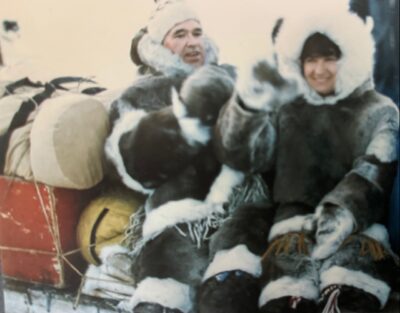
Tom Siddon and his wife Patricia leave to go sleep in an igloo in Igloolik on April 30, 1993. Siddon, a former federal cabinet minister who helped convince the government to approve the Nunavut Agreement, died June 28 in British Columbia. (Photo courtesy of the Siddon family)
But by the time midnight came and went, there was no commitment yet from Canada to create Nunavut.
Siddon was the federal minister of northern affairs, representing Canada at those negotiations. He was an admirer of the Inuit of Nunavut.
When he and his wife Pat went to Igloolik to sign the agreement in principle in 1990, he wanted so much to learn about the Inuit way of life that he asked for he and his wife to spend the night on the land, sleeping in an igloo in -20 C weather.
He wanted the years of negotiations for a land claim in Nunavut to be a success. So he woke up then-prime minister Brian Mulroney in the early hours of the morning and persuaded him to agree make the commitment to create Nunavut. The promise was then written in the early hours of the morning in Article 4 of the Nunavut Agreement, which I helped draft.

But that was not the end of the story. Next, there had to be a vote in the fall of 1992 to ratify the agreement — a healthy
85 per cent of Inuit beneficiaries voted for the deal. Then on May 25, 1993, Mulroney formally signed the agreement in Iqaluit’s Inuksuk High School in a room full of students waving Canadian flags, excited to watch history being made.
But that was still not the end of it.
Two major new laws to settle the land claim and create a new territory had to be passed. The federal government’s promises had to be kept before the looming fall election.
In the summer of 1993, Mulroney’s Progressive Conservative government was on its last legs — in the fourth year of its second term, very low in the polls with a prime minister so unpopular he was to resign and call for the selection of a new party leader and prime minister only one month after signing the Nunavut Agreement in Iqaluit.

The new prime minister, Kim Campbell, then led the Progressive Conservative party to a historic defeat, leaving it with only two seats in the House of Commons after the October 1993 election.
So with the next election and a change of government looming, we knew there was not much time to pass legislation to finalize the land claim and the creation of Nunavut.
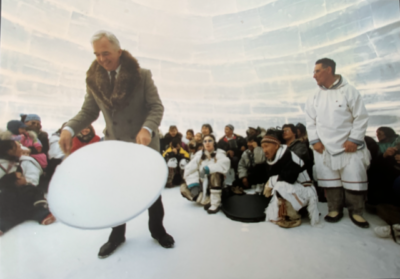
Tom Siddon, left, tries his hand a drum dancing inside a large traditional qaggiq that was built in Igloolik to celebrate the agreement in principle for the new land claim agreement on April 30, 1990. (Photo courtesy of the Siddon family)
Again it was Tom Siddon who steered those two bills through Parliament in record time. From the formal signing on May 25, 1993, to passage of the two bills and royal assent on July 9, 1993, it took less than two months — an unheard-of speed to pass such important laws. On top of that, the two bills passed with the unanimous support of all parties in the House of Commons and the Senate.
Siddon regarded the Nunavut Agreement and the creation of Nunavut as his proudest achievement in his 15 years in federal politics. He yearned to be invited back to Nunavut. But inexplicably and unjustifiably, he was not invited to the inaugural celebrations of the creation of the new territory on April 1, 1999, nor was he invited to Nunavut Tunngavik Inc. celebrations in 2023, for the 30th anniversary of the signing of the land claim.
But Tom Siddon and his wife Pat were invited back to Iqaluit for Nunavut Day in 2015 by then-education minister Paul Quassa. Siddon brought fresh fruit from B.C.’s Okanagan Region and a carving done by Igloolik carver Jake Kadlun of a man cutting snow blocks for an igloo — a gift given to him in 1990 for helping to negotiate the Nunavut Agreement.
Siddon said, “It’s time to bring the carving back home,” saying it was symbolic of the building of the new territory.
Today, as we celebrate Nunavut Day, let us thank Tom Siddon — a great Canadian who believed in Inuit, and was of crucial help in their goal to change the map of Canada and create an Inuit homeland.
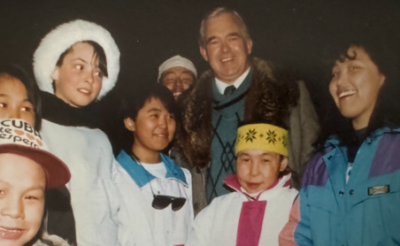
Tom Siddon poses with Inuit children at a ceremony for the signing of the agreement in principle that led to the Nunavut Agreement at Ataguttaaluk School in Igloolik in April 1990. (Photo courtesy of the Siddon family)
Rather odd but I hear that in Labrador funerals are sometimes being scheduled for months after a death has occured, usually it is in mid summer that the burial takes place. My opine but I find it a bit too much doing such things for convinence.