

Community workshop builds replicas of decades-old Inuit kayak
Plans to use vessels for youth expedition in June
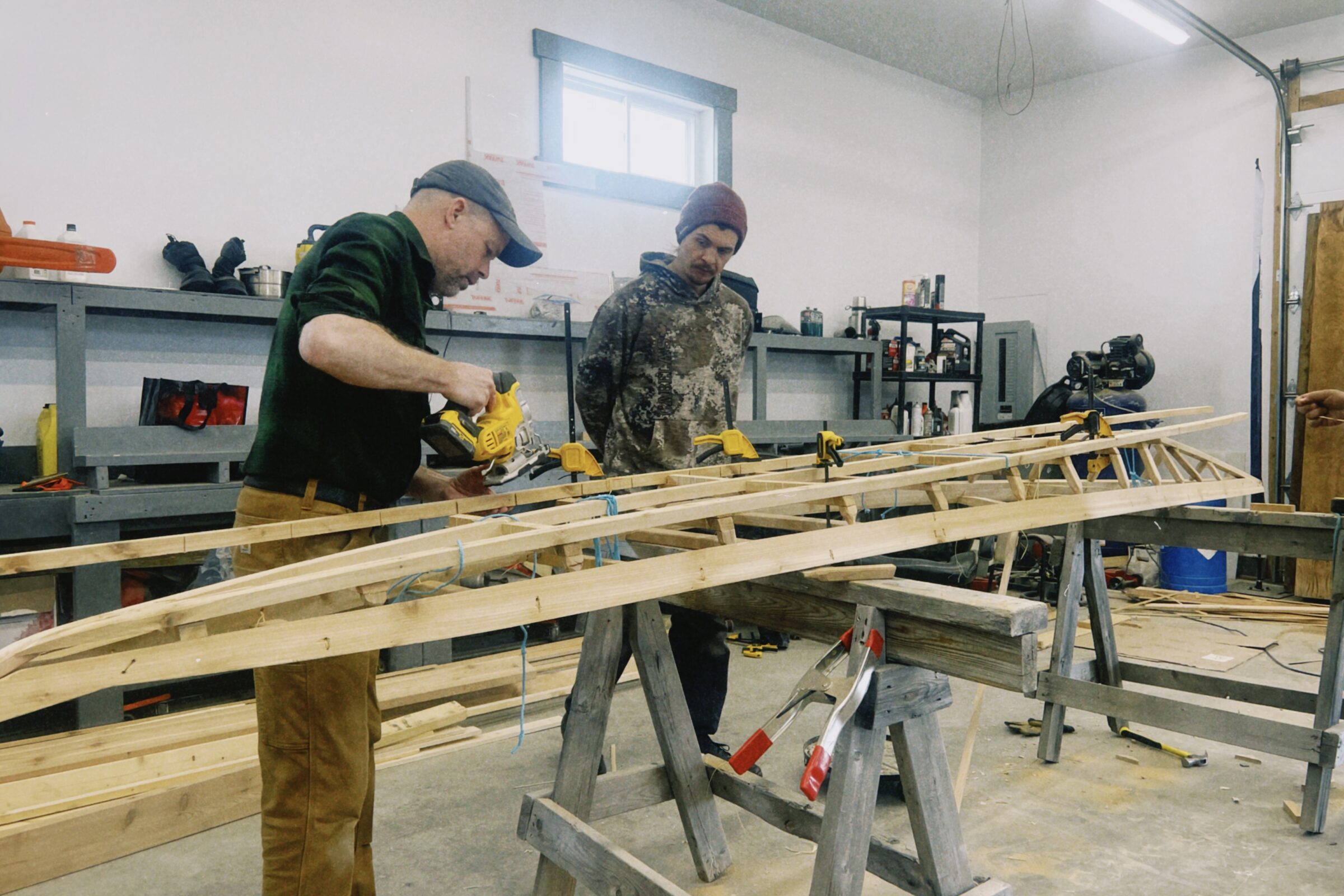
Researcher Harvey Golden, left, and builder Robert Comeau work on a kayak frame that will be used for a youth expedition in June. The workshop is a collaboration between Nurrait — Jeunes Karibus, Qajakkut Society and Nunavik Parks. (Photo by Dominique Gené)
Two kayaks that replicate a 60-year-old model built by an elder are being reconstructed at a community workshop in Kuujjuaq.
The event, scheduled to run April 20 to May 1, was originally designed for eight participants aged 17 to 30. However, due to strong interest, the organizers have opened it to all Inuit, said Alice Roy, a psychosocial worker with Nurrait — Jeunes Karibus, which offers on-the-land programs for youth.
“This workshop is a place where people can gather, talk about kayaks but also where these organizations can be in contact with the community,” Roy said.
In 1968, the Canadian Museum of History commissioned Tuumasikallak, an elder from Kangirsuk, to create a kayak.
Its construction was documented by Bernard Saladin D’Anglure, a renowned anthropologist who died in February 2025. That documentation is being used to build the replicas using a woodworking process called joinery, said Harvey Golden, an independent researcher leading the workshop, in an interview.
“It represents one of the caribou-hunting kayaks that they used way up the Payne River in the old days,” he said.
The workshop is a collaboration between Nurrait, Nunavik Parks and Qajakkut Society, a group of traditional kayak builders in Iqaluit.
Golden and society members Robert Comeau, Izaac Wilman and Aasivak Arnaquq-Baril are leading the project.
The kayaks are not entirely authentic, as the participants are replacing caribou skin, which traditionally covers the frame, with nylon, Golden said.
“The ‘replica’ term is capturing the shape and the size of the kayak and also the methods of joinery,” he said.
Kayaks were also built to fit the specific body dimensions of the hunter, Comeau said. Traditionally, a hunter’s hip fit against the sides of the cockpit, against which their knees were slightly bent, locking the paddler in place.
“The kayak is an extension of your body. So, you want it to have the best possible contact points when you’re sitting,” he said. “You have to be able to throw a harpoon. You have to be able to roll and manoeuvre.”
“I’ve heard stories about it being incredibly bad luck to paddle someone else’s kayak,” he said.
Corentin Chaillon, a conservation specialist with Nunavik Parks, which has helped fund the workshop, said this collaboration aligns with the organization’s mission.
“We protect natural heritage but it’s also part of our mission to protect cultural heritage,” Chaillon said in French in an interview.
The project will wrap up at the workshop with a feast that’s open to the public Friday at 3:30 p.m.
The plan is to use the kayaks for a 10-day expedition organized by Nurrait.
This is very cool.