


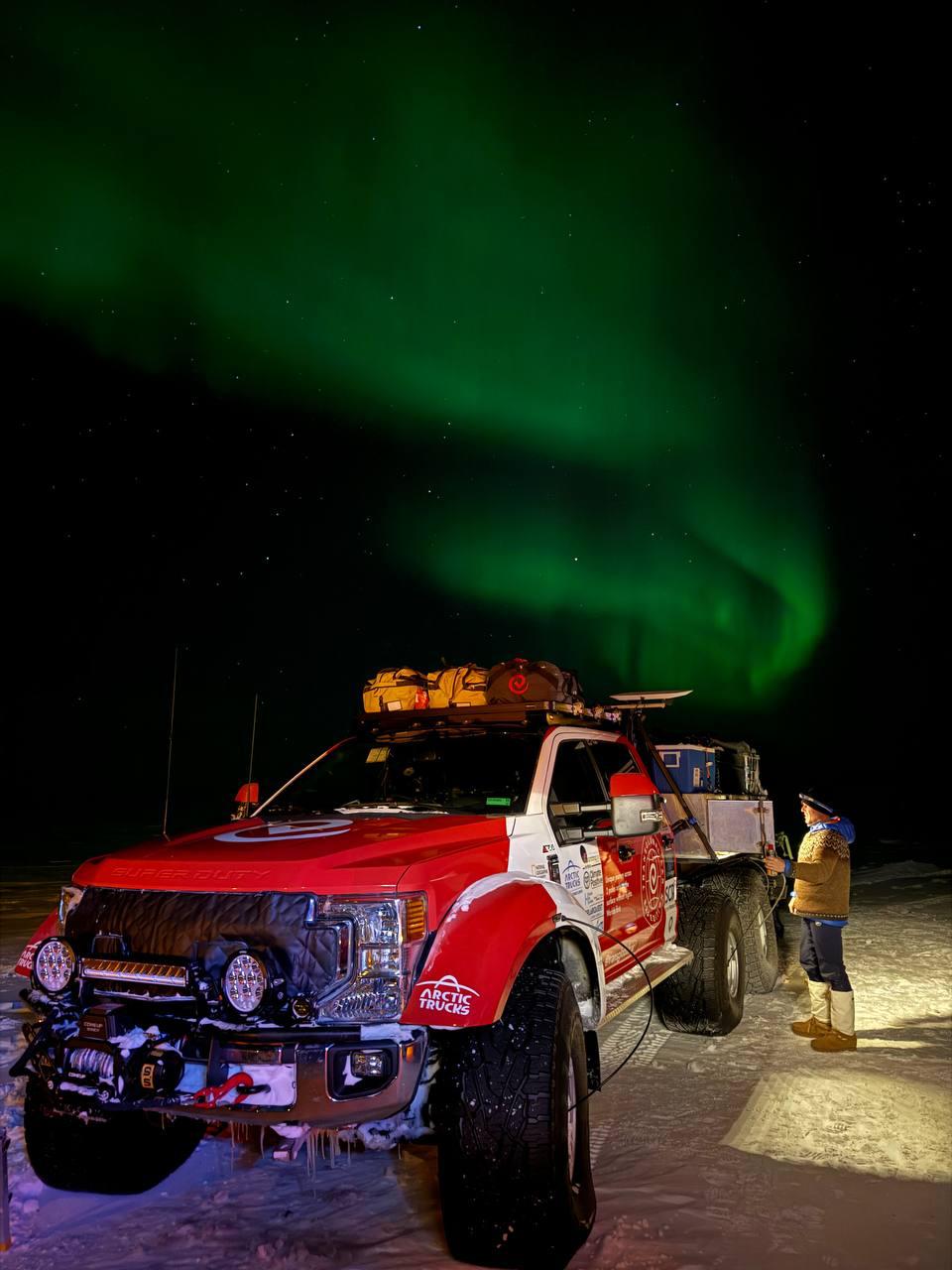
Hlynur Sigurdsson of Iceland checks the central tire inflation system on an Arctic Truck on Monday evening the Transglobal Car Expedition. (Photo courtesy Transglobal Car Expedition)
Head north: Expedition continues slow trek to the North Pole
Team of explorers is off to circumnavigate the world after spending 2 years learning from past expeditions and gaining local knowledge
A stop in Cambridge Bay is part of the second stage for a group of explorers continuing their attempt at a pole-to-pole trip around the world.
The team of eight was about 210 kilometres from Cambridge Bay as they continued across the frozen Arctic Ocean south of Qikiqtaryuaq, formerly known as Fishers Island, when one member, Andrew Comrie-Picard, spoke with Nunatsiaq News on Tuesday.
With winds low and the temperature -32 C, he said they expected to reach Cambridge Bay by midday Wednesday. They’ll likely stay for a day, he said, depending on the weather.
“It’s a fairly narrow window, even though the winter seems long,” said Comrie-Picard. “We have to get moving north and be as far north as we can as the light allows. We only move in the light, because we want to be able to see what we’re doing.
“Basically, we are chasing the rising sun,” he said. “We have to move north as quickly as we can in order to get to the North Pole as quickly as we can and get back down [to Greenland] as quickly as we can.”
The hard part is estimating how long it will take to reach the North Pole from Canada’s northern border.
“It’s over old pack ice, which is very slow going. Some days, you might make 20 kilometres a day, but some days you make hundreds of metres.

“For instance, right now we have a good-sized crack in the ice and snow that sits on top of it, so we have to have good visibility.”
In the end, the weather rules, he said. The expedition is led by retired Russian businessman and professional mountaineer Vasily Shakhnovsky.

Transglobal Car Expedition team members prepare to cross a large and recent pressure ridge with a crack in the ice on Tuesday. (Photo courtesy Transglobal Car Expedition)
The eight team members on the trip include scientists, explorers and adventurers from Canada, Russia and other European countries. About 18 other members aren’t on this trip but are providing support from their home countries.
The first stage of the trip involved driving from New York to Yellowknife in January and February. In all, it’s expected to be done in seven stages and wrap up in 2025, having covered 50,000 kilometres.
Until Cambridge Bay, the expedition will have travelled in two Ford F-350 trucks plus another carrying their gear.

After that, they will board four Yemelyas — enclosed six-wheeled amphibious vehicles specially designed for harsh Arctic conditions.
The expedition carries electromagnetic sensors constantly measuring the depth of ice in front of them.
“Right now, we’re on 1.47 metres of ice. We’re constantly monitoring that,” said Comrie-Picard.
Two years ago, the team learned “ice can change really quickly.”
During an earlier expedition in 2022, a rapid change in ice thickness led to a truck sinking into the ocean.


A Transglobal Car Expedition ice truck, designed in Iceland and built in the U.S. sits on the frozen Arctic Ocean. (Photo courtesy Transglobal Car Expedition)
That truck sank 11 metres to the ocean floor near the Tasmanian Islands in the Franklin Strait. It was recovered five months later.
On that trip, trucks and the Yemelyas reached Resolute Bay, southeast of Bathurst Island. The team wanted to push further north but sent their Ford F-150s back to Cambridge Bay, retracing their route.
The ice had been more than thick enough on the trip north, but on the group’s return five days later, it was just 10 centimetres thick and in some places there was open water.
Comrie-Picard said Inuit hunters from Taloyoak were familiar with the area where the truck went down.
“They knew that area was a tricky area for ice,” he said, adding the hunters told him the unstable ice made it a great area for seal hunting.
“And that’s just, you know, the kind of local knowledge you can’t get until you’ve met those people and developed those relationships,” Comrie-Picard said.
He said that trip had an Inuit guide, but he was from Cambridge Bay and didn’t know the area like the people of Taloyoak did.
“Over the last two years, we’ve really developed those relationships to a far, far deeper degree,” Comrie-Picard said.
In another coincidence, two of the hunters from that previous trip just happened to be at the hotel the team was staying at when they reached Yellowknife last week.
The group shared laughs and talked about the ice this year.
“We were all hugs and exchanging stories,” he said.
“There’s no resource like talking to a bunch of elders that spend so much time on the land. The relationships I have been able to develop with these folks [are] really terrific.”
“Pole to Pole”? How will they drive to the South Pole? Where from?
I was under the impression that there is a ban on Russia in Canada because of their illegal attack on the Ukraine
Run the russian millionaire back to his home country.
Leave , the Vodka
Keep your depth perception in perspective. White on white can be difficult while in motion. I lived years in the upper and lower Arctic. I hope you all the best.