


In search of a plan B: What if Nunavut mining goes ‘uh-oh’
Industry accounts for almost half of territory’s gross domestic product

Nunavut needs to find alternative industries to mining, says Hudson Lester, the Nunavut general manager for N.W.T. & Nunavut Chamber of Mines. (File photo by Arty Sarkisian)

As the grand opening of the B2Gold Goose Mine was winding down on Sept. 4, roughly 50 dignitaries lined up to touch $1 million in the form of an unpolished 245-ounce gold bar about one-third the size of a loaf of bread.
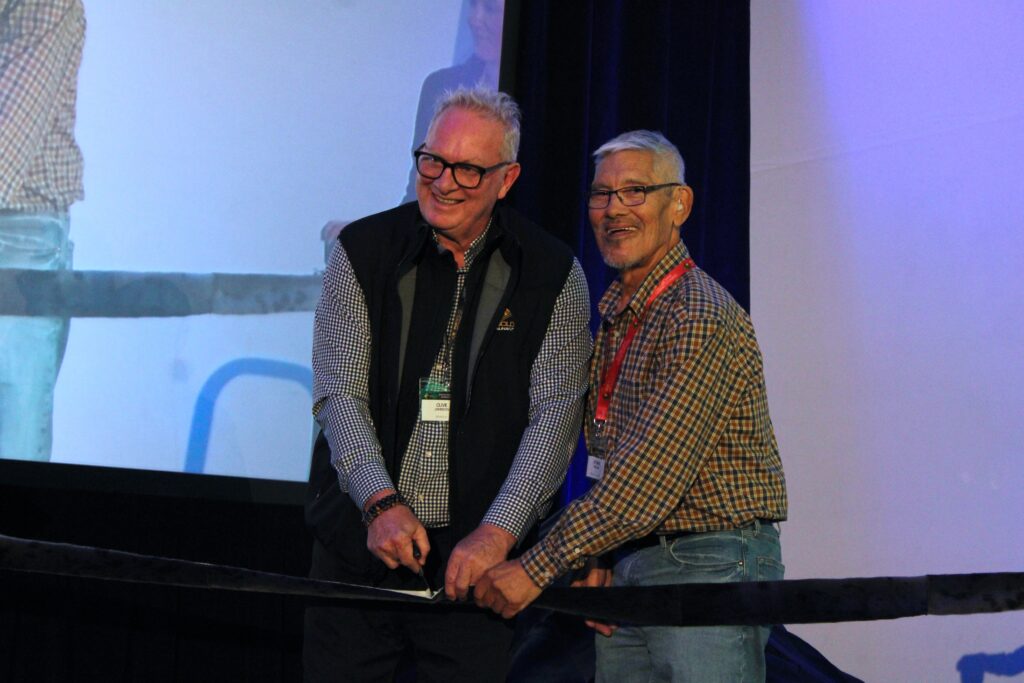
B2Gold CEO Clive Johnson and Kitikmeot Inuit Association vice-president Attima Hadlari cut the ribbon Sept. 4 during the grand opening of Goose Mine. (Photo by Arty Sarkisian)
Some took photos with it, others pretended to bite a piece of it, and almost everybody joked about wanting to steal it.
“It’s an exciting day,” said David Akeeagok, then-minister responsible for mining, who like most other officials had many words to laud the launch of the territory’s newest mine.
In 2024, the mining sector helped the territory’s economy grow by 7.5 per cent — the fastest growth in the country.
Mining already makes up almost half of Nunavut’s gross domestic product, and in 2024 it contributed $136 million in taxes and royalties to the Nunavut government and Nunavut Tunngavik Inc.
But amid all the excitement, there is a risk, said Hudson Lester, the Nunavut general manager for N.W.T. & Nunavut Chamber of Mines — what if mining goes “uh-oh”?
“We need to look for a plan B,” he said.
The territory should search for industries to “fall back on” in case mining is no longer viable, he said.
“Should I say that in my position? Probably not. But I would have that backup.”
Nunavut currently has four mines: Baffinland’s iron mine, two Agnico Eagle gold mines, and the newest B2Gold gold mine.
In some communities, mines are dominant employers — roughly 87 per cent of the employed population of Baker Lake works at Agnico Eagle’s Meadowbank site in some capacity.
But, like any mine, Meadowbank has an estimated lifespan. It’s set to shut down in 2028.

In fact, all three of Nunavut’s gold mines are expected to come to the end of their lifespans over roughly the course of a decade.
“So when Meadowbank shuts down, does Baker Lake go to being one of the poorest, most unemployed communities?” Lester said.
A similar thing happened in Rankin Inlet in 1962 after North Rankin Nickel Mine Ltd. shut down because of a sharp drop in nickel prices. The mine employed three-quarters of the 500 Inuit residents of the community that formed around the mine.
Most of them were forced to live on government welfare or move out because of the sudden closure.
Some of the potential “fallback” industries could be fishing and tourism, Lester said.
However, fishing has little room to expand, because companies cannot catch more fish than allowed by the quota from the federal Department of Fisheries and Oceans, said Baffin Fisheries interim CEO Glenn Grandy.
As for tourism, Travel Nunavut chairperson Ed Romanowski says it’s a “fantasy” that leisure travel might be able to cover for Nunavut’s dominant industry.
There is another option, Lester said.
Nunavut could tap into a different kind of mining that’s becoming increasingly in demand — uranium.

Remains of an old nickel mine are still visible in Rankin Inlet. The mine operated from 1957 to 1962. (Photo by Arty Sarkisian)
The territory’s Kivalliq Region has one of the world’s largest deposits of uranium. If it was mined, it could completely change the world market, he said.
There have been attempts to bring projects related to the radioactive material to Nunavut in the past, including by ATHA Energy Corp. and Forum Energy Metals, but none have succeeded so far.
Many Nunavummiut are suspicious of uranium, often calling it the “death rock,” Lester said.
“I think some of those perceptions now is what a lot of those mining companies are trying to overcome and teach more of the positive sides of it,” he said.
“So there is work to do, but it might be possible.”
thats why specialty jobs carpenter electrician mechanic and cook training are needed more then heavy equipment
JA , your right we have the useless Arctic college with classrooms in every community, but no they do not want to focus on trades training like our high schools. They want to produce scholars, total waste of money.
In Rankin Arctic College has long underperfomed, noticeably deteriorating over the years, probably due to an incredibly underqualified Dean who, thankfully, moved on recently.
Rankin does have what appears to be a well run trade school however, which seems to be doing alright if you don’t pay attention to the incredible drop out rate, which I don’t think that can be blamed on the College.
The idea that the College is over focused on producing scholars is a strange one, what makes you say that?
Nunavut needs Inuit trained for trade jobs. But it also needs “scholars” — Inuit with the education to become doctors, nurses, architects, accountants, biologists, lawyers, etc.
2 years at NS will do the job 😆
No it won’t. To get certification in professions you need a university degree, sometimes more than one.
I don’t admire sarcasm; nonetheless, ‘mit’ was definitely doing sarcasm
Schools need to start shops training, first with carpentry, as early as Grade 3 or 4. First because that imparts lifetime interest, skill and employability anywhere. Second because of the urgent need to keep youth out of trouble—assuming the shops are actually open evenings and weekends. Third, so Inuit fill all or most trades jobs in Nunavut. And if it’s a question of money, isn’t that the kind of thing the Nunavut Trust is for?
Need to defund NS aka glorified summer camp.
NS isn’t even southern high school equivalent. NS should be revamp to essentially offer an actual Southern high school equivalent and then kids go into essentially community college equivalent programing.
NS currently is as you say basically a daycare.
Iqaluit could be different but the majority of Nunavut high school education is that of middle school or elementary elsewhere. You have so many high school kids that can’t read or write due to not being able to hold them back. And because we lack proper streams for those who can perform they get grouped in with everyone and you have to cater to the lowest common denominator in your classroom and not only that these kids cause infinite distractions for those that do want to learn. Everyone loses in the current system.
It’s quite clear kids get pumped through so no feeling are hurt and DEAs can toute they’re bringing up graduation rates.
You pass a kid who can’t do basic math, rear or write and pump them through to grade 12. What does that even say to them? Says you don’t actually need to try in life we will make sure you get through! The current system is a pipeline into the welfare system.
Thanks, ttts; eloquently and accurately stated
90% of the money in Nunavut comes from federal transfers. Why destroy the land for a part of the other 10%? Mining is bad for the land, animals, workers, and families. Shut it down.
Yea for sure, let’s all just be on welfare, poor and never self sufficient. Why create wealth? Who needs it, we have Lori to complain for more money.
The logic there is that any dollar generated for the economy is priceless: that’s nonsense. Mining is short-sighted, high-interest economic investing. The long term costs far exceed the initial income. Turning down an option for unhealthy income is not a poverty mindset, it is wisdom and a view for enduring health, not killing the golden goose. The materials are finite and irreplaceable, and the damage done to the earth, animals, and families will outlast any temporary financial gains. We need a stronger economy, but not one which is so bad for us. None of this irresponsible drill baby drill, dig baby dig mindset.
From whence the minerals for your motors, computers, electrical components, nails, brackets, jewelry, knives, appliances, vehicles, gear, door knobs, tools, and steel beams, M. Common sense?
Of course we need to mine materials from the ground, but the trade off of mining in Nunavut—as with almost any/all human activity in the far north—has far too high a cost than what it is worth in the long run. If federal transfers are 90% of the economy, keep that as the means of propping up life in the North; don’t add an incredibly destructive industry into the mix for a pale (and short lived) financial impact. Mine where there are roads, B.
Plan B shut downt the mines. Before Nunavut, the mines that opened up in and around where B2Gold, Hope Bay and various others have caused many wildlife to decrease. Nowadays people are relying on caribou tag. Not only south of Cambridge Bay also ones near Keewatin region. Sorry but this is an elders; thought..
They want the government to pay them to go hunting. What’s the difference?
There’s a lot of room to expand the benefits nunavut captures from fisheries. A huge share of the quota still goes to southern companies from Atlantic Canada. And even the Nunavut-owned companies mostly operate out of Atlantic Canada.
Then there’s the small-scale inshore fisheries which have the potential to expand in some communities.
There’s more than just mining out there…
Mines generate far more wealth than already overstretched fisheries could.
There are indeed many ways to increase the returns on Nunavut’s fish quotas but the fishery will never produce anywhere near the jobs and revenues that come with a mine.