


Nuclear in Nunavut — Inuit and the element that ‘never ends’
Part 4 | ‘How do you explain to an elder something you can’t see, taste or smell?’
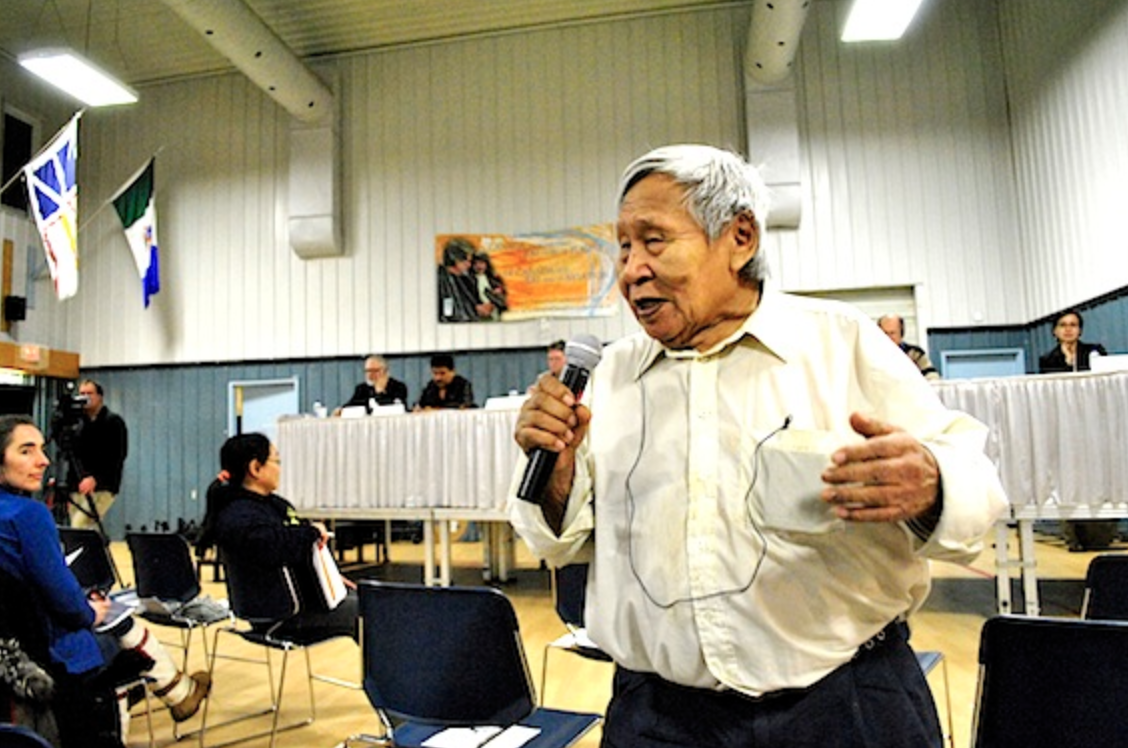
Iqaluit elder Celestin Erkidjuk speaks March 17, 2011, at a public forum in Iqaluit, the first of three forums organized by the Government of Nunavut to help the GN form a policy on uranium development in Nunavut. Though Erkidjuk spoke fondly of the days when he worked as a miner in Rankin Inlet, the forum exposed stark divisions among Nunavut residents over uranium mining. (File photo by Jim Bell)

This is the fourth article in a four-part series exploring how advancements in nuclear technology might impact Nunavut.
To get a sense of what Inuit think of uranium, many Inuit will point to the Inuktitut word for it.
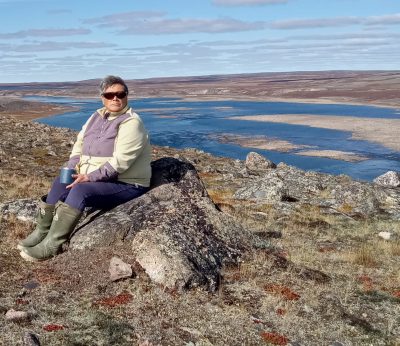
Joan Scottie is the author of a 2022 book on colonialism, uranium mining and Inuit resistance in her community of Baker Lake. (Photo courtesy of Joan Scottie)
“We call it nungusuittuq, which is the product that never ends,” said James Eetoolook, president of Kitikmeot Inuit Association.
It’s not clear who came up with the term, but it’s been the subject of debate over the years.
Some have criticized the word as too negative, said Baker Lake elder Joan Scottie, who wrote a letter to Nunatsiaq News in 2007 about the development of Inuktitut words for nuclear terms.
She recalled a territorial government delegate proposing “nungu-qattaqtuq” instead, meaning “it gets used up.”
Scottie wrote the book on Inuit and uranium, literally, when she published I Will Live for Both of Us in 2022. It tells the story of her community’s fight against exploration companies that came to the Kivalliq Region over recent decades, looking to explore for uranium around Baker Lake.
While Scottie was not available to speak to Nunatsiaq News, her writings describe the challenges of coming up with Inuktitut words for technical concepts.
Uranium has a very long half-life, meaning it can take thousands of years to decay. It provides nuclear power — but it’s also deadly.
“Take radiation, for example,” Scottie said in her book. “How do you explain to an elder something you can’t see, taste or smell?”
In 1989, as part of the push for uranium exploration, a group of federal politicians, businesspeople and nuclear regulators travelled to Baker Lake to explain to local Inuit the potential risks and benefits of uranium mining.
Language was a clear hurdle.

At one point, according to a transcript of the meeting, a participant requested an official to sign a paper promising it would be translated into Inuktitut.
“Will I sign a piece of paper? That’s a tricky one,” answered Bernie Zgola, who at the time worked for Canada’s nationalized nuclear energy company Atomic Energy of Canada Ltd.
“I will do my very best to have something translated. Now the question is exactly how much we can translate and how much time we have to do it.”
Fast forward to 2011, and the conversation around uranium was still getting lost in translation.
That year, Inuit Uqausinginnik Taiguusiliuqtiit, the territorial government’s language authority, hosted a uranium terminology workshop at the request of the Nunavut Impact Review Board.
The meeting appeared to be a response to demands from the Baker Lake hunters and trappers association, which wrote the board asking it to halt a proposal for uranium exploration near the hamlet “until a vocabulary can be developed that allows the draft guidelines to be translated into the Baker Lake dialect of Inuktitut.”
The review board responded that such a request would create an “indefinite” delay of proceedings.
It’s not clear what has changed since then.
Nunatsiaq News emailed Inuit Uqausinginnik Taiguusiliuqtiit to ask about the issue but did not receive a response. Nunatsiaq News also tried to contact the Office of the Language Commissioner of Nunavut but did not receive a response.
Generally, the likelihood that any Nunavut community would take the lead to bring in nuclear power is low, say people in the nuclear and mining industries.
But the federal government is set to spend billions to bolster Canada’s Arctic defence. Part of this work is a $40-million project to assess the potential of using a nuclear microreactor to power northern defence installations, the federal government announced on April 29.
David Novog, an engineering professor at McMaster University in Hamilton, Ont., who specializes in small nuclear reactors, says it’s a unique situation in Canada that dual-use military spending — meaning it benefits the military and the local civilian population — is part of the country’s NATO commitment.
“Military or dual-use technologies that support energy for isolated places like a military base are pretty high on the agenda,” he said.
“That may be a lever that gets some reactors built. And then, of course, once it’s built a few times, then a northern community can be pretty sure that this is going to work because we built one over here, you know, and it’s not even that far away.”
Nunatsiaq News emailed Nunavut’s three regional Inuit associations to ask their leadership about their thoughts on nuclear power.
Only Eetoolook, with the Kitikmeot Inuit Association, responded.
He said KIA does not have a position on nuclear energy but credited the Nunavut Impact Review Board for raising awareness of its potential opportunities and risks.
“We are burning fossil fuel right now and it’s not friendly to the environment and the atmosphere,” Eetoolook said.
“[Nuclear] is probably coming down the road. So I think we have to learn.”
“How do you explain to an elder something you can’t see, taste or smell?”
Like oxygen? Bacteria? Virus? There are many concepts that one can’t see with the naked eye, sense being touched, smell, hear, or taste, yet people are able to understand perfectly well.
“the product that never ends” is much more accurate than, “it gets used up”, even if it comes with a negative connotation. That “territorial government delegate” probably didn’t understand nuclear energy at all.
Even though the radioactive life of uranium pretty much never ends, nuclear energy is an important way forward.
Canada operates 17 reactors across 4 active power plants: Darlington, Pickering, Bruce, and Point Lepreau. These reactors produce enough power for somewhere around 10 million homes continuously.
Darlington has been operating for over 30 years.
Pickering has been operating for over 40 years.
Bruce has been operating for almost 50 years.
Point Lepreau has been operating over 40 years.
All of these reactors operating for all this time, plus another station in Quebec that operated for 30 years, and all of the high-level waste ever created by these reactors (roughly 3.4 million bundles) is about 70,000 cubic feet.
70,000 cubic feet sounds like a lot, but it would not even fill up an Olympic sized swimming pool. For 40+ years of powering 10 million homes, I think Canada can find the space, about equivalent to the size of the Iqaluit Aquatic Centre, for spent uranium storage.