


Nunavut needs auditor general’s help on drinking water
Improvements are desperately needed, money is flowing; news of an auditor general’s report is welcome
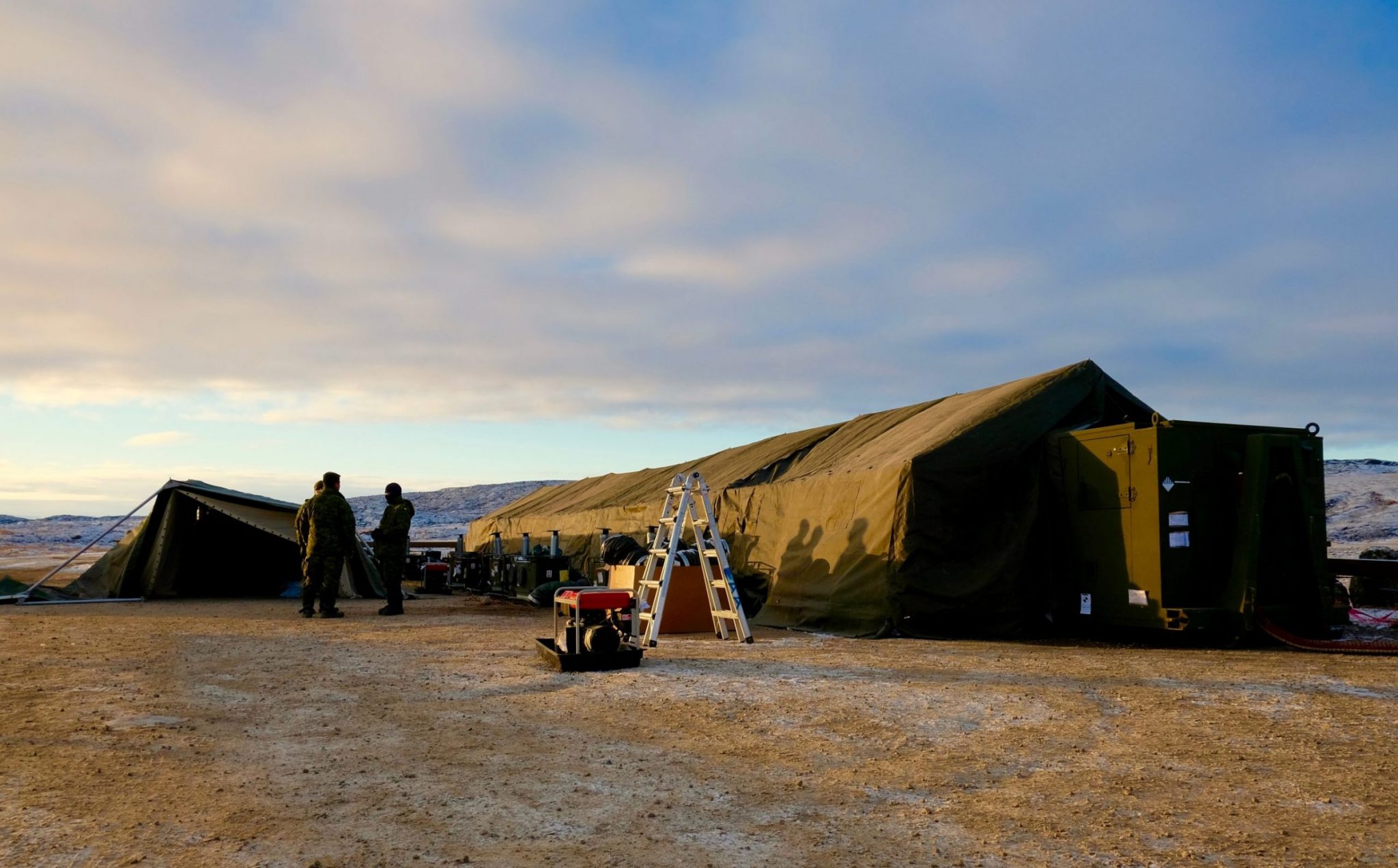
Canadian Armed Forces personnel work in Iqaluit in 2021 for Operation Lentus. The operation used specialized water purification equipment after the city’s water supply was contaminated with diesel fuel. Canada’s auditor general plans to examine the management of Nunavut’s drinking water. (File photo by Mélanie Ritchot)

News that Canada’s auditor general is going to take a look at Nunavut’s drinking water should be welcome news to all Nunavummiut. To all Canadians, in fact.
Across the territory, there’s a lot that doesn’t seem to be going right with the supply of drinking water. At the same time, governments are pumping a lot of money into improvements to water and sewage infrastructure.
Nunavummiut learned this week the auditor general is going to do an audit of the management of Nunavut’s drinking water, expected to be published next year.
A little advice from the auditor general should help identify what changes need to be made as well as shine a light on the way public money is being spent.
Canada’s auditor general Karen Hogan is the independent officer of Parliament responsible for conducting audits and studies of federal and territorial public institutions.
You might recognize her name from such audits as this year’s review of the Family Services Department’s handling of children in care and last year’s Public Housing in Nunavut report that pointed to a lack of transparency in the territory’s plan to build 3,000 homes between 2022 and 2030.
Provinces have their own auditors general, but because Nunavut doesn’t have one, the federal official is responsible for reviewing territorial institutions and offering advice to the legislative assembly.
Governments sometimes bristle at auditor general reports because they frequently point out the shortcomings of governments or public institutions.
In recent years, there has been a litany of water problems in Nunavut. (The details are laid out in a story by reporter Nehaa Bimal about the upcoming auditor general’s report on page 7 of this week’s paper).
Water woes have been experienced by people in Arctic Bay, Baker Lake, Coral Harbour, Gjoa Haven, Iqaluit, Kugaaruk, Naujaat, Pangnirtung, Pond Inlet, and Sanikiluaq.
In 2024, a Nunatsiaq News story reported only eight of Nunavut’s 25 water treatment plants had passed their most recent public health inspections without health or safety deficiencies.
Adverse conditions in Nunavut’s drinking water have ranged from short-term boil water advisories because of the risk of contamination due broken infrastructure to do not consume orders to states of emergency.
In some cases — such seawater getting into Kugaaruk’s water treatment plant or diesel fuel contaminating Iqaluit’s supply — the military has been called in to distribute bottled water or to use its specialized equipment normally used in disaster areas to purify water.
When you need the military to step in and provide clean drinking water in communities of 1,300 or 8,700, there’s a serious problem.
The federal government is spending a lot of money to improve Nunavut’s water infrastructure. The biggest, highest-profile project is the $214 million in funding then-prime minister Justin Trudeau announced to upgrade Iqaluit’s water infrastructure.
A 2023 Drinking Water Strategic Framework estimated the cost of addressing the territory’s water treatment needs at $605 million.
Everyone knows there’s a huge need to improve Nunavut’s drinking water supply. There’s a lot of money needed, and already a lot of money flowing.
That’s why the thoroughness of an auditor general’s review of the situation is good news for Nunavut.

You make a good point. It would be good to see the approved scope of the audit. Indeed, if the scope is designed to cover the following audit objectives, then it might be beneficial to Nunavut.
1. Assessment of the drinking water infrastructure gap in Nunavut communities
2. Evaluating value for money for federal capital funding that has flowed into Nunavut’s drinking water infrastructure – Effectiveness, efficiency and economy of investments made
3. Evaluation of the human, financial and operational capacity of the Government of Nunavut and community governments to deliver reliable, safe drinking water to Nunavummuit
4. Analyzing the root causes of drinking water disruptions that have been experienced by Nunavut communities in the past ten years.
Good article Corey and for the most part right on the mark. However, there is a constant theme playing itself out in Nunavut that is repeated over and over again. It is the lack of value and subsequent action taken by the Government and its Departments to implement and execute the recommendations of the Auditor General (AG). One does not have to go back far to recognize this as a major problem. Simply look at the Child and Family Services and the number of reports that have been done on that department alone in the last 6 years (including the ongoing “follow up” Report). Then take the most recent AG Report on Nunavut Housing Corporation (NHC) 2025. Your very newspaper and other media outlets reported on the fact that when questioned about the NHC, AG Reports findings and recommendations. The then Premier PJ Akeeagok said quote, “I didn’t read it”. The PM didn’t even bother reading the AG Report which at the time was addressing one of the major issues facing Nunavummiut. What message did that send to all bureaucrats who ultimately are responsible to implement recommendations?
It’s not enough to also then hold televised Committee hearings on the AG Report and have to listen to defensive comments from the Cabinet Minister or the Bureaucrats as they try and deflect or justify the findings instead of committing to and being open to the recommendations. Or lack luster questions about the findings from the Members of the Committee who seem intent on NOT getting to the bottom of the findings and ensuring a measurable and accountable processes and procedures for insuring their implementation. It’s not enough to then have the concerned department put out a press release with the same old nonsense of, “We take the findings of the AG seriously and plan to insure the implementation of the report”. Only to have it then ignored and put in File 13.
The problem and it’s a big one in Nunavut. Is that as long as the Politicians and bureaucrats and those with the power to promote change choose to continue to ignore, dismiss or downplay these AG Reports it will not matter how well they are written, how much substantive information is include or the recommendation.
So yes, absolutely the AG Review and ultimate Report on Potable Water Management in Nunavut is welcome but only if there is concrete action on the recommendations. Because otherwise, the Reports won’t be worth the time and energy invested in creating it and will simply not be worth the paper it is written on.
Municipal Services is a broad statement when it comes to providing services within a municipality. Still funded using achiac methods, not based on what it cost to provide the service and never forward thinking.
Municipalities in Nunavut have limited expertise and often running on “catchup mode”. Who has not the time, nor the expertise to foresee the problems, and on the other hand there is a whole government department called “Community Government” supposedly where the expertise are housed for municipal services.
Responsible for the health and welfare of the community lies with the municipality without adequate funding, and the government of Nunavut is well staffed with funds but limited community involvement.
What is wrong with this picture?
Here are some thoughts; if a water system has been designed by an engineering firm and proves to be deficient, stop using that engineering firm.
If an engineering firm fails to evaluate the risk of salt intrusion into a water system they design, that engineering firm should be legally liable for that error.
If a water system has been built by a construction company and proves to be deficient, stop using that construction firm.
If a construction firm fails to notice diesel fuel accumulating on the site of where they are building a water treatment plant, there should be some amount of liability that accrues to that company.
If you take a look at the Government of Nunavut Contract Reporting System online, you will find that the same bunch of companies have been doing this type of work for years and years.
It very much seems that when Nunavut water infrastructure is designed and built, contractor performance does not seem to be as big a priority as it should.
When the Government of Nunavut does not have the technical capacity to monitor and evaluate this work properly, at the very least, the people doing the work should be adhering to their specific obligations, demonstrating a duty of care, professionalism, and diligence.
The operations of the water plants are mandated to the local governments, each acting independently. As are many functions they have no hope of executing well. Nunavut maintains a territorial government, 25 local governments, 25 local housing boards, regional level governments plus the myriad of other entities (HTO’s, local boards etc) for a population of 40k people spread over three time zones. GN operations are also weakened by efforts to decentralize. Hence various department’s administration spread over the territory as well as QEC ‘HQ’ in Baker Lake and NHC ‘HQ’ in Arviat,. Let’s not forget the IPG’s, NTI etc. The Feds should examine the efficacy of Nunavut’s entire public sector delivery model for their $2B +/a transfers.