

Ottawa to spend $108M to upgrade Iqaluit’s sewage system
New funding would support 2,500 new housing units
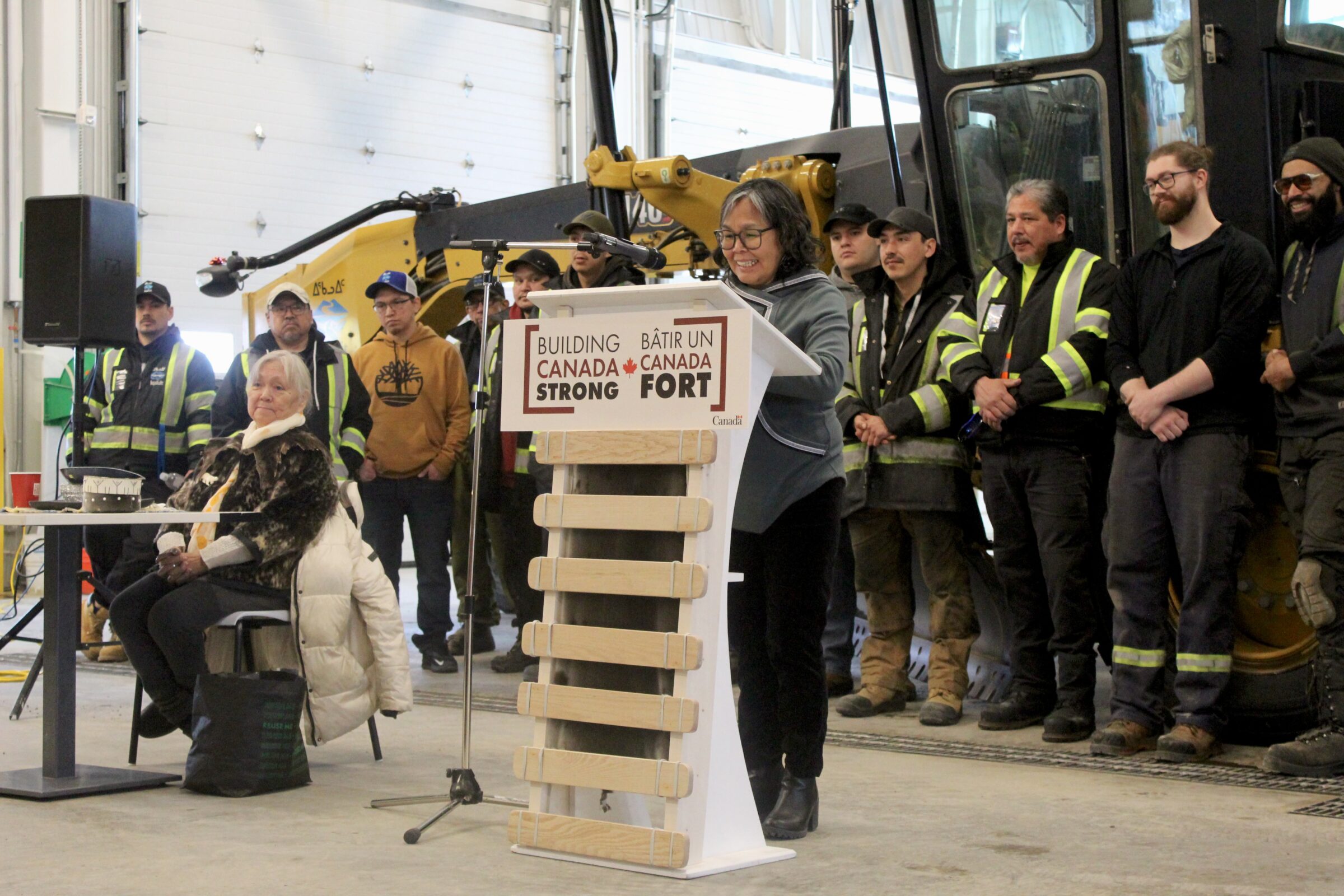
Nunavut MP Lori Idlout announces $108 million in federal funding Tuesday for infrastructure upgrades to Iqaluit’s water and sewer services. (Photo by Arty Sarkisian)

Iqaluit will get $108 million in federal funding for water and sewer upgrades which could allow the city to nearly double its current housing supply, Nunavut MP Lori Idlout says.
“That’s how impactful it can be,” she said Tuesday, after an announcement at Iqaluit’s public works garage.
“Given that we always have a shortage of housing, that is very exciting to me knowing that focusing on this infrastructure will create more opportunities for more housing to be built.”
The money will come from the $51-billion Build Communities Strong Fund, first introduced in the 2025 federal budget. It’s earmarked for hospitals, bridges, water systems and other core infrastructure.
In Iqaluit, the funding will go toward upgrades to trucked water and sewer services as well as expansions of existing infrastructure which will build Iqaluit’s capacity to grow by 2,500 housing units, Idlout said.
The work on those upgrades is set to be completed by 2031.
If built, 2,500 additional housing units would represent a 73 per cent increase in Iqaluit’s housing stock, which is listed at around 3,419 units, according to City of Iqaluit website.

The funding will add on the existing $214-million federal funding for a new Iqaluit water reservoir and the renewal of critical pipelines announced in 2022.
The Iqaluit sewage system upgrade is one of 13 projects across the country to get support from the federal fund.
“I think it will be very impactful for all of Nunavut,” Idlout said of the project.
“I know that it might sound like it’s just for Iqaluit, but with all the government offices being here I think it will make sure that we have more reliable services from the City of Iqaluit.”
Nunavut is also set to receive $155 million over 10 years for “critical public infrastructure,” which will be determined later under separate agreements between the federal and territorial governments, the federal news release said.
Let’s see how much of an impact the communities outside of Iqaluit will actually see. Sure, Iqaluit is growing rapidly, but there seems to be little to no development for the other communities.
What is NTI doing with all that housing money? Give money to the Hamlets that actually deliver water and sewer services!
NTI is not responsible for municipal services! Question is what are both is the Government of Nunavut doing for the other communities? Oh yeah taking care of the 15% of the population needs!
It’s not a popular fact in some circles but it’s a lot easier to get a better bang for every dollar in Iqaluit and the regional centres. The small communities for the most part are extremely expensive to build anything in and have little hope of being more than total economic and social basket cases.
We really need to stop bashing Iqaluit every time it gets any much needed development dollars and need to put the dollars where they can do the most good to the most people. The future lies in fewer but bigger communities and it’s time our leaders grappled with that.
“It’s not a popular fact in some circles but it’s a lot easier to get a better bang for every dollar in Ontario and the southern provinces. Nunavut’s communities for the most part are extremely expensive to build anything in and have little hope of being more than total economic and social basket cases.
We really need to stop bashing Ontario every time it gets any much needed development dollars and need to put the dollars where they can do the most good to the most people. The future lies in fewer but bigger communities and it’s time our leaders grappled with that.”
See how that works? By your own logic, the doing “the most good to the most people” would exclude Nunavut entirely, Iqaluit included. Yes, it is expensive and difficult to build in the smaller communities, and there is not much economic opportunity. But there could be, and Resolute is a pretty good example of it when given a chance. Pretty sure the Frob just posted their dinner special this week is a $235 ribeye steak, so I don’t think Iqaluit is really struggling in the same way the smaller communities that you know nothing about are.
That’s a lot of straw men you’re trying to stuff there Peter.
Of course, you know that we’re not talking about depopulating the whole territory just closing some communities and redistributing the resources to the communities with real world actual potential to grow and prosper.
The Greenlanders had to do the same. Newfoundland closed lots of outport communities. Doesn’t mean it’s not hard; wrenching even. Newfoundland hasn’t been depopulated in the process and Greenlanders are still at home in Greenland.
If you really think these small communities have economic potential then feel free to enlighten us why they haven’t developed economies after 25 years of Nunavut and where you see their economic future potentially lying.
It’s a lot cheaper and easier to build homes, schools and health centres in larger population centres. It’s easier to get staff etc. There are real reasons that people all over the planet are moving into larger population centres. Starting with a better life for their families.
@ Big BEN
It’s not a popular fact in some circles but the population of Canadas’ North is of secondary concern to the governments and why they “prop up” northern communities is to ensure the “BILLIONs (possibly Trillions) of $$ of resource wealth” in the region is “safe” for Canada’s use.
Three billion dollars a year to the GN for a population of less than 40,000 souls and Lord knows how many hundreds of millions put into the Inuit organizations is one hell of a “prop”.
Perhaps less whiny victimhood and entitlement would be more constructive?
@ Big Ben
At the risk of repeating myself –
“…..the population of Canadas’ North is of secondary concern to the governments…”
3 billion is Chump Change when weighed against the vast wealth in the region, that is destined to be even more exploited then the population..
Article 14 of the Nunavut Agreement provides for a process to establish new communities in our territory. Nobody talks or thinks about this part of our modern treaty, yet it exists as clearly as our harvesting rights, co-management boards, and need for IIBAs.
I find it fascinating how short sighted and insular Nunavut has become considering the potential positive future that is possible here.
Sudbury, Flin-Flon, Thompson, Churchill Falls, Labrador City, Wabush, Yellowknife, Whitehorse, Rouyn-Noranda and Schefferville. All examples of tax based northern and hinterland communities that got their start with resource development. Also, examples where indigenous and other Canadians enjoy initial and basic infrastructure that was paid for privately.
Our communities have all been located based on the needs of the fur trade, in some cases the churches and the RCMP, and afterwards, with a nod to efficiency of providing government services.
They are most often not ideally located for economic self sufficiency which is a key aim and dream of the Nunavut Agreement.
It is high time Nunavut breaks the mould in its thinking and looks to establishing communities where new and emerging economic opportunities exist.
No, Nunavut’s future should not be -by default- have Inuit crowding into ever growing government towns where our position as Wards of the Crown is assumed and perpetuated.
Ever time Iqaluit gets something or something done
The communities want what Iqaluit is getting but you know what
Iqaluit is a city now and sure needs many upgrades
The communities need their SAO AND THE COUNCIL AND MAYOR TO STEP UP AND WORK HARDER to get things and not just take the job for the pay
The military base upgrade will increase the local population as will the secondary businesses and services that support it. Most of the extra water/sewage capacity is for that.
Those loud sewage truck engines is loud. Causes stomach aches and stomach noises.
Iqualit began as an American airstrip for refueling in ww2. Canada purchased it and it was the DEW line after the war. Some Inuit were attracted to the infrastructure and began to live here. It’s a military installation.