


Regional Inuit not consulted over ‘significant’ changes to draft land use plan: NTI
Signatories reject latest proposal, release document detailing concerns
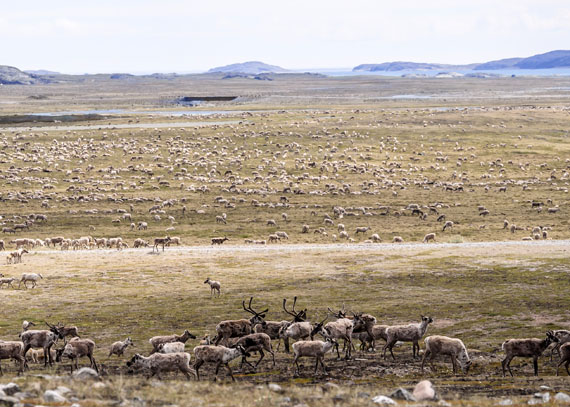
The Nunavut Land Use Plan provides regulations around development in the territory while protecting wildlife such as caribou, seen here. The plan remains in limbo as the latest draft was rejected Friday by its three signatories. (File photo)
Concerns that the Nunavut Land Use Plan could strip regional Inuit organizations of the right to manage their own lands dominate the reasons for why its latest draft was rejected.
The plan, which lays out rules for development and conservation of Nunavut land, is a cornerstone of the Nunavut Agreement. Nunavut Tunngavik Inc., the federal government, and the territorial government must all sign off on the plan for it to be implemented.
The most recent draft — the fourth in 16 years — received a rejection notice Friday. The signatories released their reasons for the decision on Monday.
Topping everyone’s list is how an “overlay,” introduced in this draft of the plan, would affect regional Inuit rights over their lands.
The overlay — regulations that apply to Inuit Owned Lands in areas that are designated as limited use — provides regional Inuit associations the ability to make exceptions to prohibitions in limited use areas, on which industrial and commercial activity is banned year-round.
A “significant departure” from the previous approach to land management, the overlay would introduce legal uncertainties and the potential for “protracted disputes” that would “seriously undermine” the ability of regional Inuit organizations to manage their own lands, NTI said in the document that outlines its reasons for rejecting the plan.
“[The overlay] occurred despite requests by NTI and the [regional Inuit associations] that the commission consult directly with them on Inuit goals and objectives for [Inuit Owned Lands],” the document said.
Representatives from Nunavut Tunngavik Inc., the GN and the federal government declined interview requests for this story.
NTI also noted the draft plan doesn’t take into account “distinct” regional Inuit goals and differences between the regions.
“The commission’s refusal to hold direct consultations with NTI and the [regional Inuit associations] was not consistent with the Nunavut Agreement,” NTI said.
As well, NTI expressed concern over the amount of land earmarked for protection. The draft plan identifies 650,000 square kilometres as proposed limited use areas, an area larger than France, the organization said.
This amount of land proposed for limited use could result in Canada achieving its goal of conserving 30 per cent of Canada’s land and oceans by 2030, which is not something NTI necessarily wants — at least not yet.
“To date, NTI and the [Government of Canada] have not yet agreed on how Inuit-led governance and stewardship over these areas will be supported and Inuit benefits realized from contributions to Canada’s conservation targets,” NTI said in the document.

The federal government and GN echoed several of NTI’s areas of concern but also took issue with the potential for some approved development projects to be stranded because they are surrounded by proposed limited use areas.
The federal government called for revisions to the plan to allow these proponents to build “linear infrastructure,” such as all-season roads, as long as they demonstrate their project “cannot be undertaken without that linear infrastructure.”
The GN also noted that areas identified as migratory bird habitat sites need to be “redefined” to allow cable projects and ports.
Other concerns identified in the draft plan include an approach to caribou management that doesn’t consider differences between herds, as well as a lack of consultation with nearby Dene groups.
The Nunavut Planning Commission recognized these concerns Monday in a news release.
“The commission acknowledges NTI’s direction regarding direct engagement with the regional Inuit associations and recognizes regional Inuit perspectives will be essential to resolving a number of the issues identified by the signatory parties,” the release said.
Whether that means revising the existing draft or starting from scratch is still to be determined, said commission spokesperson David Aglukark to Nunatsiaq News.
So is the Grays Bay Road ? I hope they start all over but this time do it right from town and put in a military base and pave the runway. Put the future in and not the past .
Didn’t all of NPC, NTI, the RIAs and the federal LNDP have input into the LUP? Are they disagreeing with themselves? Why do most of these folks have input anyhow?