


Baffinland is $1B in debt, lacks liquidity to buy fuel for this season’s sealift
Mary River iron mine might have to cease operations, company says in court filings
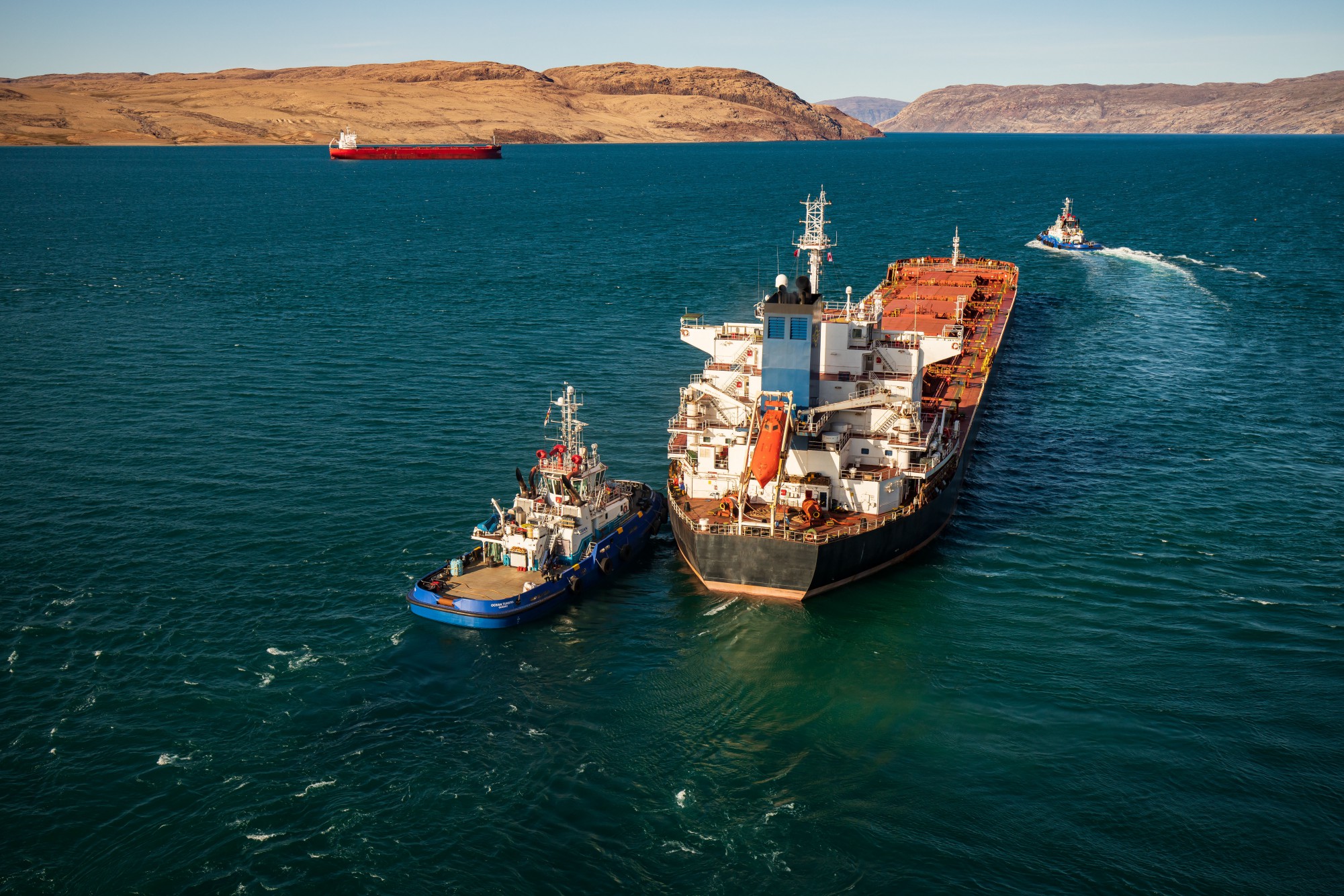
Baffinland Iron Mines Corp. is more than $1 billion in debt, court documents say. (File photo)

Baffinland Iron Mines Corp. spent more than $1.46 billion on a proposed expansion that was ultimately rejected by the federal government, and these expenditures led to the company seeking creditor protection.
Now, the company owes $1.07 billion it cannot repay, according to court documents filed May 14 with the Ontario Superior Court of Justice. The court documents list dollar amounts in USD, which Nunatsiaq News has converted to Canadian dollars.
Between 2017 and 2022, the company “entered into significant contracts” in anticipation of approval of its proposed 110-kilometre railway from Mary River iron mine, near Pond Inlet, to a port at Milne Inlet, according to the court documents.
But the federal government rejected the project, named Phase 2, at Milne Inlet after a heated, years-long public hearing.
“When the Milne railway was ultimately rejected by the regulatory authorities, these expenditures left the debtors carrying significant debt attributable to a project that could not proceed,” the court documents read.
As a result, Baffinland lacks the “liquidity” to buy fuel before this year’s sealift shipping window closes, which may force the mine to “cease operations entirely.”
Despite this, Baffinland expects no operational disruptions and day-to-day decisions are still being made by executives, “subject to court oversight,” said Baffinland spokesperson Peter Akman in an email to Nunatsiaq News.

Akman ignored questions about the company’s debt or the billion-dollar investment in its unapproved Phase 2 project.
Baffinland still intends to build a separately planned $5.7-billion railway and deepsea port project at Steensby Inlet, Akman said, which would allow the company to ship 22 million tonnes of iron ore per year.
That said, the company “does not currently have sufficient capital committed to advance the [Steensby] project,” according to the court documents.
Baffinland told the court it has attempted to address its “liquidity constraints” by renegotiating supplier contracts and laying off staff, the documents state.
The company, which is Nunavut’s largest private sector employer, laid off 10 per cent of its staff in 2024.
But despite these cost-reduction measures, Baffinland’s financial troubles still persist.

Tim Hodgson, the federal minister of energy and natural resources, was asked Tuesday during a separate news conference in Nunavut about Ottawa’s stance on Baffinland’s situation.
“[Baffinland doesn’t] have the capital to operate the mine,” Hodgson said.
“And the Steensby expansion is incredibly important to the long-term vitality of that mine and quite frankly to the entire economy of Nunavut.”
When asked, Hodgson didn’t say whether Ottawa is considering a bailout for Baffinland, but said the government is “on top” of the situation.
So, the heart of the matter is Baffinland made a very poor decision to enter into agreements for the Phase 2 expansion, before the NIRB review was completed, knowing full well that the proposed expansion was deeply unpopular and might not receive regulatory approval.
This is just another project that the liberal canadian tyrant government want to flop so they can bail out and sell it off to the Chinese or India.
Can you clarify what you mean by “tyrant”? There is no political interference, except that the regulatory process—which involves the federal government and NTI through NIRB—was not met. NIRB operates independently. At the end of the article, the federal minister of energy and natural resources was asked about the Baffinland situation, and he stated he is aware of it and on top of it. Baffinland mainly relied on financing and borrowing. This is unrelated to political interference, as you suggested. The Liberal government supports mining. Please explain how this is a liberal fault.
The Liberals set up and expanded the regulatory process so nothing gets built or developed in Canada. The other commenter was correct to slam the Liberals and Carney.
Actually no. All processes are laid out under Nunavut Agreement and NuPPAA and not controlled by the government. And this project was originally approved when? And who was PM then? Oh right.
The amount of misunderstanding and assumption in this thread is astonishing. Lots of armchair experts that can’t even google properly.
Perhaps they were told to start the process? Maybe they were assured they would be permitted to bring in the construction things needed to construct the rail road. I’m very curious on how this happens?
” Maybe they were assured they would be permitted to bring in the construction things needed to construct the rail road.”
That’s some pretty wild speculation. Do you have any evidence?
I think it’s much more likely that the company got ahead of themselves and arrogantly entered into construction agreements before the NIRB process was anywhere near complete. They were well-aware that their proposal to expand was deeply unpopular. They should have known better.
Baffinland probably did not make a poor decision in incurring costs for an expansion of their operation prior to it being approved. It was likely their only decision.
They would have needed things like power plants, trains, railway cars, and railway ties. Hundreds of millions worth of material and equipment that you do not buy through Skip the Dishes when you feel like it and get delivered to you 30 minutes later.
These are called “long lead” items for a reason.
Customers for these things have to sign off and pay to get in line to buy them. The waiting line at suppliers for things like these may be years long.
Locomotives need to be purchased 2 years in advance of when you need them. Power Plants need to be purchased 3 years in advance of when you need them.
For Arctic projects, you need to tack on an extra year of time just to get it shipped in and positioned to be available for construction.
Developers going through the regulatory process face a time crunch due to this reality.
They need the materials as soon as they can get permission to build, and probably in the case here, could not afford to wait 2-3 years with no cash flow after they have their permits in hand to start ordering this stuff then.
For what is Qikiqtani’s largest business, people need to have some idea about the realities that this business faces.
With the ongoing need for expansion of the Arctic and the inclusion of Inuit peoples in defence of Canada’s sovereignty, it seems foolish and ill thought to allow a company to bankrupt in the far north.
There must be far more to this story than meets the eye.
Tim Hodgson is familiar with FN and Inuit rights. The bigger picture on this interests me, I will dig deeper than the headlines.
Thanks for posting this.
This is true. Lead time is an important factor in any major buisiness decision. However, the decisions one makes need to be informed and well-considered. Baffinland’s decision to pursue a railway to Milne Port when they already had permission to develop a line to Steensby Inlet was a risky and foolish decision. Baffinland failed to appreciate the implications of increased shipping through a marine consevation area, on narwhal, Inuit culture, and ways of life central to Inuit culture, identity and well-being on north Baffin Island. We, in western culture, have the strange idea that $$ is the meaning of life. The reality is that while $$ is important, for many people, other considerations are of equal, if not greater importance. Had Baffinland been patient and continued its existing operations for 5 – 10 years and build up capital reserves that mighthave attracted capital for the Steensby option, it wouldn’t hsve been in this mess. Baffinland staff were amateurs, like cowboys with shovels, driven by the idea of being bigger, with their hanfs on more $$ as soon as possible. The results of this all-too-common mentality are obvious in this case. I say this as the former technical advisor, working with Mittimatalik and other affected communities on north Baffin for 3 years during a very difficult hearing process. NIRB deserves a lot of credit for making a very difficult, but well-informed decision not to recommend Baffinland’s Phase 2 Proposal.
Risk balanced with reward are unavoidable facets of human life.
If you were too worried about slipping on a sock and spraining your ankle, you would never get out of bed. If you have things you must do, you will get out of bed.
If you were not willing to accept the possibility that you might waste gas and wear and tear on your machine in a fruitless search, you would never go out hunting. If you have no niqi, you will go out hunting despite the chance you will come back empty handed.
If young men and young women were too worried about being rejected by someone they might like, our species would go extinct. If you are really attracted to someone, you will forgo your shyness.
But somehow, you think that when it comes to business, risk and reward calculations are tainted by greed. No. business is simply another arena of human endeavor where reward comes with risk.
Iron is a bulk commodity. It is valued less than many other mineable materials. In order to be profitable mining iron, you need to mine lots of it. An early revenue phase was not achieving this for this company. They were probably losing money every year doing this just to demonstrate to potential investors they could operate and had cash flow. You cannot run a company indefinitely losing money. Increasing production is make or break for them.
You focus on the risk without having a firm grasp about how critical the reward was.
Yes, balancing risk with reward is important in many situations. And when billions of $$ are at stake, a lot of research, thought and consultation is what makes sense – including listening to opposing points of view. I didn’t see much of this in the way Baffinland approached the idea of Phase 2.
And its not a matter of “greed”. Reducing decisions like this to personal attitudes and values is simplistic. Mining companies, in particular, are driven by realites that are hzrd to ignore. When the price of ore goes up and you have expansion plans in your back pocket, pushing for a desireable outcome (now!) Is what happens. Mining is risky business. If you have to pay 12% interest on borrowed money (bonds) you sre really pushed to take risks you might not otherwise take. And the idea behind capitalist ventures is to make as much $$ as fast as possible, attract capital and use that to repeat or continue the process. A lot of things suffer in the process. People’s well-being, the environment, sometimes honesty – you name it. ‘Greed’ is a simplistic way of dismissing complicated realities that few people understand. I approached Baffinland at one point with a suggestion for incremental change, increasing the volume of ore shipped over time, depending on the results of monitoring impacts on narwhal and the marine environment, with monitoring conducted by Inuit. It was dismissed without any discussion. Having started (with others) and managed a large company growing oysters on the west coast and dealing with changing technologies and means of growing, decisions about re-capitalizing a company and a product with fluctuating prices, I have some idea of what I’m talking about. Baffinland’s approach to the Phase 2 Proposal was, in my opinion, a badly handled mistake – for a long list of reasons.
Frank Tester, is saviour of Inuit haha! You view Inuit world in a romantic way, that we should be poor and not be wealthy and enjoy what non Inuit are enjoying too.
I can get you a train by 3 o’clock this afternoon. With nailpolish.
Hope them hunters are happy for a soon to be abandoned mine like the old nanisivik
Like I said mines all over the world make there millions and go bankrupt leaving big mess behind no money to remediate.
They refused it now they paying the price for them so called hunters, why not just expanded it and make boat load of money
QIA was also benefiting by developing programs for beneficiaries from IIBA royalty payments, a lot money went towards training Inuit and other social programs in the five affected communities.
We as tax payers will eventually pay for it all
I am pretty sure money was put a side for remediation which is usually required through the regulatory process
Wow! That could put hundreds of Inuit workers out of a job.
I see new mines being opened in the territory, so more jobs needed. If one mine ain’t feasible, the employees will be able to get other opportunities elsewhere.
At least the anti-mining folks, like Lori, will be happy.
In a way, this might also be one of the first casualties of the US loss in Iran… oil prices have skyrocketed since they made their mistake and now the math doesn’t math for Baffinland
Yur kidding !
Looks like Nunavut killed it’s golden goose. I hope the hunters and others that were opposing the expansion can find a way to support all those that will be out of work.
Dang.
Maybe its time for the Inuit orgs like QIA to step up work for the people. They helped make this mess and they’re the ones profiting from the royalties recovered. Enough bail out by the fed. Time to put up or shut up and clean up the mess they made. For those wishing to see the mine close, where do you think the $ to build houses from the government is coming from? If the mine dries up, so does everything else!
Is this the end of mining in nunavut? While some oversight is important, over-regulation is never a good thing. Bad for business. And believe me, potential future investors in nunavut are taking notes.
No, this is not the end of mining in Nunavut. There’s several other mining projects operating in the territory and they’re not going anywhere. In fact, they’re expanding.
This is one company that made a series of lousy business decisions.
The new mines within NU are happening in the Kitikmeot. The Kitikmeot is notorious for having little care at all for what goes on within its region. It’s by far the most passive, almost no one shows to public hearings and presentations. No one shows up to RIA’s AGM, there’s typically little to no news covering things in the Kitikmeot. I think part of that is nothing is directly attached to any communities so out of sight out of mind. Unless you are hunting around Hope Bay or Bathurst you would never even notice there was mining happening within the region.
I am not saying its a bad thing at all, I am just saying on a regional level you may see work slow in the East because of how difficult the groups there are to work with if companies realize the West is just happy to do business.
On the other side of the coin you do have to examine if there’s value in making noise. The fact that the Kitikmeot has seen zero infrastructure upgrades despite both mines pouring billions into the ground says we may be a little too passive and we’re happy to see all the value flow out of NU and have nothing lasting within our communities and we will just roll over to that.
There’s a balance to be struck, it’s likely the East is far too ani-business and the West is far too passive. Both hamstring themselves, one business leaves, the other business booms, but leaves minimal economic benefit.
The majority of the comments here reveal just how little Nunavummiut know about their own regulatory regime, mainly the NIRB. Yikes.
The government’s decision to block this project was absolutely asinine and foolish.
The government should be forced to reimburse Baffinland.
You don’t sold iron ore when no deals sign pure simple.This is not first deals go sideways.They rush too fast look cleveland cliffs about huge project in labrador consol Thomson turn huge flop due go too fast and put on hold.
Economic Experiments are always risky,, and especially coming from another none experienced company.. if the resources are important,,they will solve it by loops holes stickers… give the right candy to an investor, anything is possible…
Hey ya wanna buy a dying horse,he’s blind overweight and has a bad leg. It’s probably gonna cost you about $1500. a month in medication but he’ll recover,,,honestly..lol
Poor management made this happen