


Limit new mining claims until land-use plan approved: advocates
Fourth draft rejected in July; land continues to be staked across territory
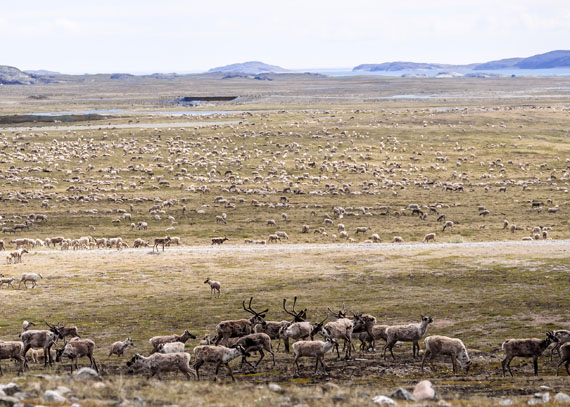
Habitat for caribou will continue to be threatened if a new Nunavut Land Use Plan is not signed by signatories, says an advocacy group. (File photo)
A Nunavut-based land use advocacy group is calling for a ban of new mining claims in areas that would have been protected under the latest draft Nunavut Land Use Plan until a new plan is formalized.
Friends of Land Use Planning put forth the idea in a July 9 news release, after the draft’s latest rejection.
A land-use plan is required as part of the 1993 Nunavut Agreement. Its purpose is to partition Inuit-Owned Lands in the territory for environmental and wildlife habitat protection, as well as economic development.
Over the past 16 years, four drafts have been submitted to — and ultimately rejected by — Nunavut Tunngavik Inc., the federal government and the Nunavut government. All three bodies must sign off on the plan for it to be implemented.
The latest draft includes proposals for areas that would be open to development, open to development on conditional terms, and “limited use” zones where development would be banned for environmental, cultural or archeological reasons.
The signatories released a document July 6 with several suggestions for revision, as well as calls for more consultation with Inuit.
Meanwhile, mineral exploration and other forms of development continue across the territory without a plan in place.
“The ramifications are already apparent. As of May 2025, more than half of Nunavut’s 52,000 square-kilometres of mining claims had been staked in the previous two years,” said the news release from Friends of Land Use Planning.
About 15,000 square-kilometres of these claims are in proposed limited-use zones, where industrial activities would be banned due to environmental concerns, the release said.
Lawyers for the advocacy group have warned that reversing existing claims in limited use areas “could be a costly legal process if the companies do not willingly relinquish their claims.”
“Ignoring those voices will only deepen conflict and increase distrust,” the news release said.
Representatives from Friends of Land Use Planning did not response to a request for comment.
Nunavut Tunngavik Inc. is still working with the federal government and the Nunavut government towards a finalized plan, NTI said in an unsigned email.

“At this time, the signatories have not made any decisions regarding interim land withdrawal measures,” the email said in response to questions about the proposal to temporarily halt new mining claims in areas proposed to be protected in the draft plan.
The federal government and territorial government did not respond to a request for comment.
So keep e everything held up for another 16 year.thats another generation that could be gainfully employed. Oh well. SA will always be there.
You have 16 more years to upgrade your education system and bring up employable populace. Good luck.
30 yrs is the length of time considered to be a generation.
The Concept of a Generation: A Timeframe Explained
The idea of a generation is more than just a vague notion of people born around the same time. It’s a way to measure human progress, family lineage, and social change. But exactly how long is a generation in years? The answer isn’t set in stone. Different fields and cultures define it differently, but most agree it falls somewhere between 20 and 30 years.
A generation generally refers to the average time between the birth of parents and the birth of their children. This period reflects biological, social, and historical factors. It helps us understand family trees, population studies, and even shifts in attitudes or technology over time.
In biology and genealogy, the generation length is often tied to reproductive age — when people typically have children. In sociology or history, it can stretch or shrink depending on societal norms or major events that shape groups of people differently.
Let us be clear. Mineral exploration is not overlayed on significant cultural or archeological sites. Even if they were, territorial and federal legislation other than land use planning would protect such sites in any such eventuality.
The big limited use areas in Nunavut relate to caribou.
According to a previous Nunatsiaq News story, the amount of proposed Limited Use area staked for mineral exploration is actually 15,000 square kilometers.
This is far less than the 52,000 square kilometers quoted by this group above, which represents total new staking for the entire territory, including all other proposed land use zones.
The rejected Land Use Plan proposed to make 22% of Nunavut completely off limits to mineral exploration, or a staggering 462,000 square kilometers. This is more area than our existing National Parks.
Therefore, mineral claims cover around 3% of what the NPC figured should be “saved” from mining.
Given how prone caribou are to moving around, this small amount hardly constitutes the conservation crisis warranting interim land withdrawals called for by this special interest group.
Dissolve the NTI. Useless organization that serves itself and not the Inuit.
Yes they are useless, let’s let the friends of the land use plan run NTI, from their cushy offices in the south wow that sounds like the GN, I have to stop.