


We’re good now, right? — The new word between ITK and Ottawa
Natan Obed’s comments signal a shift in relationship between national Inuit organization and federal government
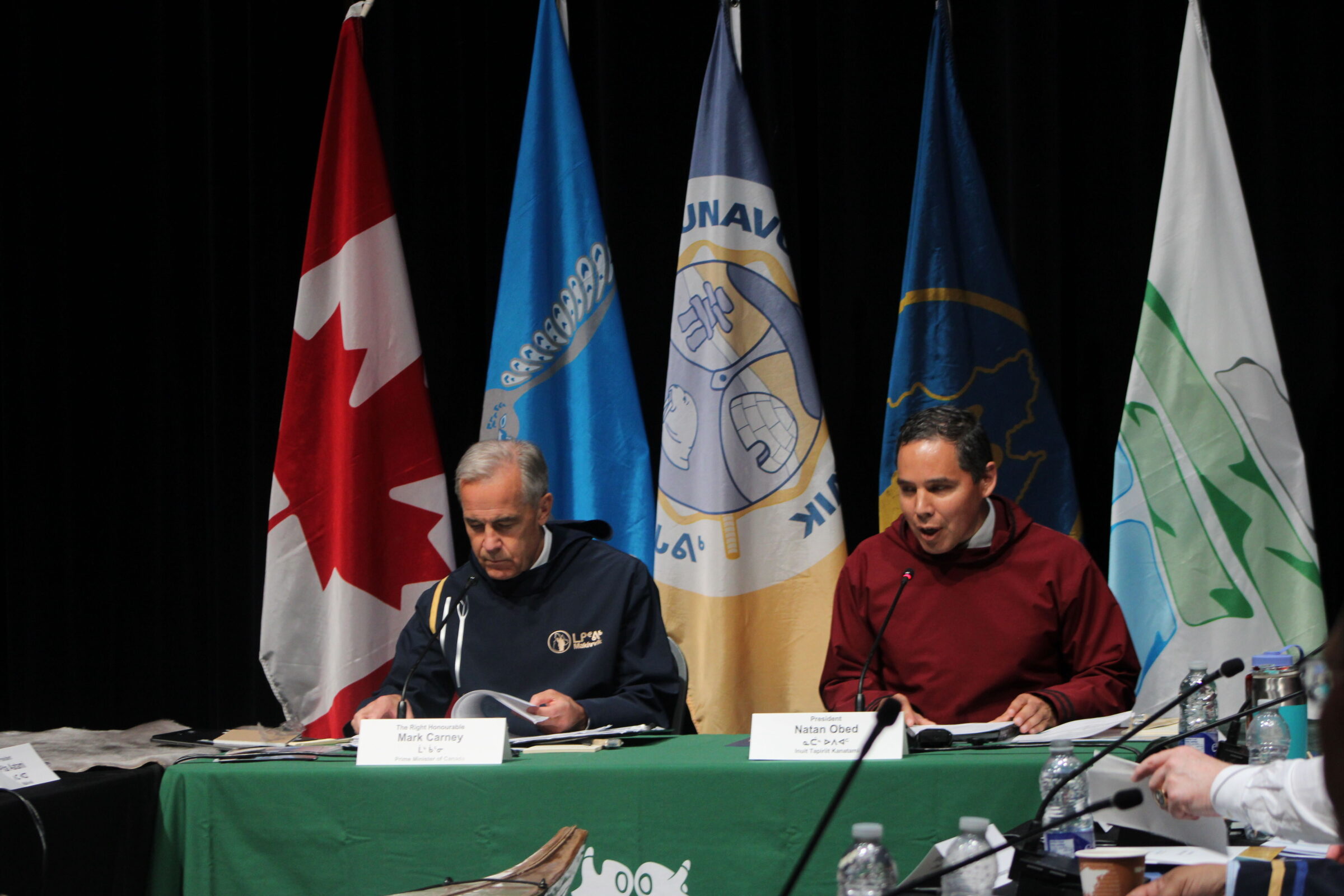
Prime Minister Mark Carney, left, and Inuit Tapiriit Kanatami president Natan Obed deliver opening remarks Tuesday before co-charing a meeting of the Inuit-Crown Partnership Committee in Kuujjuaq. (Photo by Dominique Gené)

Was it a false alarm? It sounds like Inuit Tapiriit Kanatami has patched things up with the federal government … if its relationship had actually ever been on the rocks in the first place.
A week ago, this editorial space suggested that the alarming comments ITK president Natan Obed made on June 19 at an Arctic security conference sounded like the rhetoric Quebec and Alberta separatists use: “If a partnership with Canada is not on the table, if we are not going to be respected partners, then should we not be looking for other partners as well to uphold our interests?”
At first blush, it seemed like Obed was thinking Inuit might consider breaking up with Canada, the federal government or Prime Minister Mark Carney.
But earlier this week, Obed appeared to walk back that tough talk.
On Tuesday in Kuujjuaq, at a high-profile meeting of Inuit leaders and Carney, Obed assured reporters, “We are proud Canadians. We are first Canadians and Canadians first.”
Obed said that, coincidentally, the day before Canada Day.
After the Inuit-Crown Partnership Committee meeting, he clarified his remarks.
Instead of pulling away from Canada, he said his comments were intended to signal that Inuit were looking for “good partners” who can help Inuit find “great opportunities.”
Whatever’s going on, it seems the relationship between ITK and the federal Liberal government might not be as cozy with Carney as it was with previous prime minister Justin Trudeau, who created the Inuit-Crown Partnership Committee in 2017. The committee is a mechanism for co-ordinating work between the federal government and Inuit.
When asked about Obed’s “looking for other partners” comments, Carney told reporters in Kuujjuaq he and Obed have “very good relations.”
Later, during his opening remarks to the committee, Obed said, “We stand with Canada as proud Canadians. But, as in any working relationship, there’s always room for improvement.”
But Carney, in his opening remarks before Tuesday’s closed-door meeting began, publicly summed up what he and the Inuit leaders on the committee planned to talk about. The list was full of issues that were already on the go or that had already been announced.
Ottawa is funding the construction of 750 homes in Nunavut through its Build Canada Homes program.
It has provided a “short-term” extension of the Inuit Child First Initiative while “co-developing long-term funding” for it.
Carney repeated his government’s pledge to chip in $50 million for ITK’s Inuit Nunangat University, whose main campus is scheduled to open in Arviat in 2030.
He reiterated the plan for an Inuit-led approach to eliminating tuberculosis — a file neither the government nor ITK has had much success with.
Carney’s list included a lot of great opportunities for Inuit.
It’s still not clear who the good partners ITK is looking for might be or what kind of great opportunities they might bring that aren’t already on the table with the federal government.
But it’s reassuring that, at a time when Alberta separatism risks plunging Canada into a national unity crisis, Obed’s organization remains committed to working with Canada and with the federal government — not against them.
Was it a false alarm? Or was an editorial making way too much of a few sentences taken from a much lengthier statement?
.
Honestly, that editorial did a lot of good for NN in terms of driving traffic to the site through the framing of separatism, and it certainly produced a lot of comments…
.
Hopefully we’re back to normal and just commenting on things as they are, without twisting things to act as if ITK and Obed are Inuit separatists, and not incredibly dyed in the wool staunch supporters of the Liberal party as their years of history makes plainly obvious.
.
There’s plenty to criticize ITK and Obed for, without trying to act as if they’re the second coming of Danielle Smith…
Be nice To your fellow humans. Don’t forget where we all came from. Check and learn your history be honest with yourself and accept your origin. ❤️
Is Natan Obed worried about Canada’s shift towards European totalitarian rule? And Canada’s alignment with China? When Canadian politicians are talking about jailing citizens for misinformation only defined by the government few.
Or is he saying out loud what other Indigenous leaders are currently questioning? Is it better to deal directly with cash in hand China? Does it matter if the Arctic becomes a 2 planted flag country?
Or is Natan asking people to ponder? Does the future look brighter if join Alberta, Saskatchewan, NWT, and Yukon, leaving Canada?
Will northern Quebec and Newfoundland want to follow?
All to stand on guard saying no to communist China and the EU’s social and carbon credit scores, prison lockdown on free speech, and freedom.