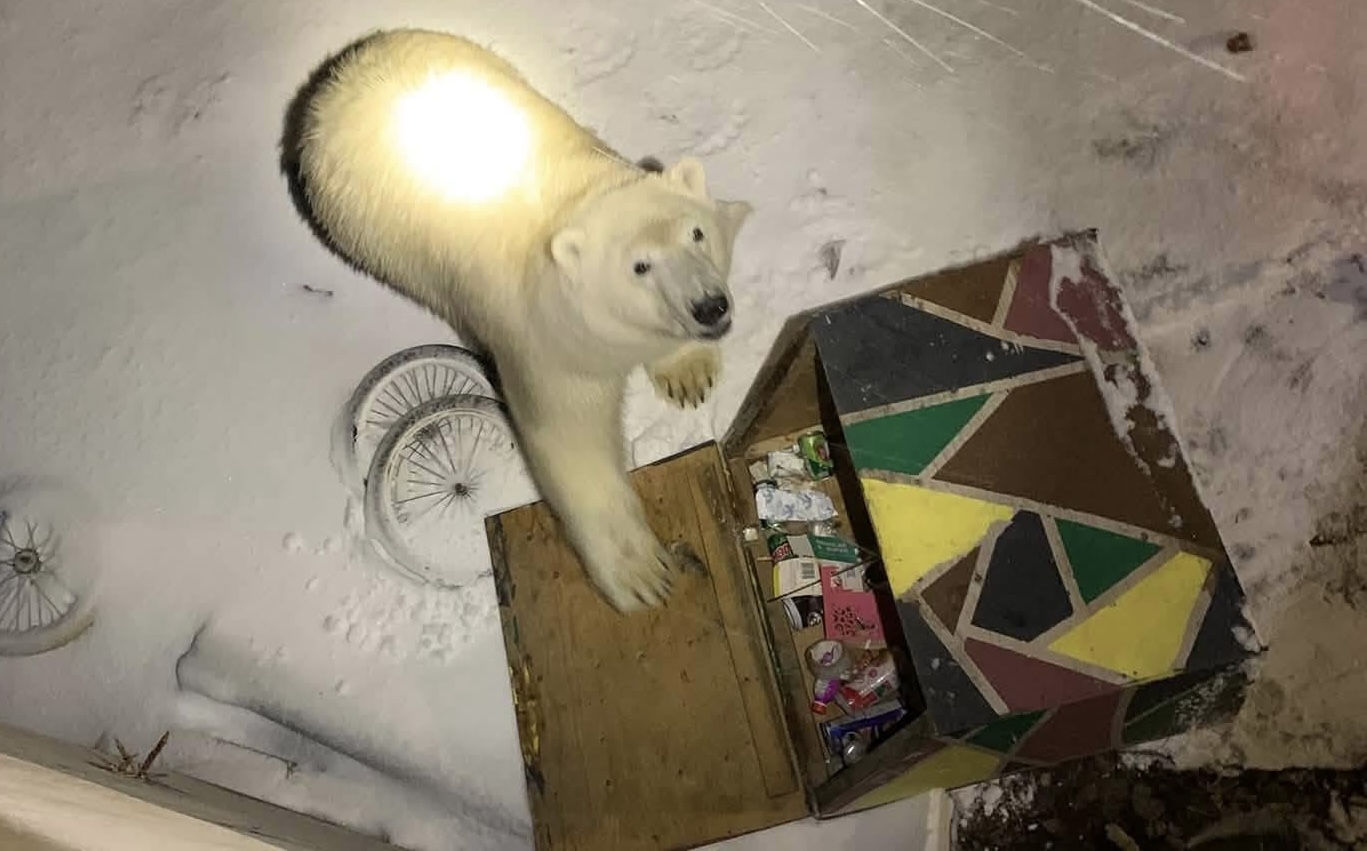
A polar bear rummages through Paul Etungat’s garbage bin in Kinngait on Nov. 4. Etungat said his mother was smoking outside just before the bear appeared at 6 a.m. They heard noises coming from the bin, then Etungat used an air horn to scare the animal away. (Photo by Paul Etungat)

On Thursday night, the stage at Inuksuk High School was set for the Iqaluit municipal election all-candidates meeting. Both mayoral candidates, Kenny Bell and Noah Uluuni Papatsie, were present, as were 11 councillor hopefuls. Read more later on nunatsiaq.com. (Photo by Dustin Patar)

Last week’s Inuit Studies Conference in Montreal featured a lot more than its packed schedule of presentations—it also offered attendees a number of diversions, including this book fair table. There was also an arts and crafts sale, performances by Nunavik Sivunitsavut and Siqiniup Qilauta, and a Labrador Inuit slipper-making workshop by Vanessa and Veronica Flowers. (Photo from 21st Inuit Studies Conference Facebook)

Nanook School in Apex is closed today. Dr. Michael Patterson, Nunavut’s chief public health officer, has recommended the closure of the territory’s schools and daycares for the next three weeks. (File photo)

The 17-kilometre road from Cambridge Bay to Ovayok Territorial Park, near the esker known in English as Mount Pelly, remains full of deep potholes after a wet summer. Some residents are calling for the holes to be filled and the road graded, something they say hasn’t been done in a few years. (Photo by Jane George)

Despite last weekend’s rain, the Kuujjuaq Sivulirtisait Youth Committee held the community’s first-ever soapbox derby on Saturday, Sept. 28. The category for 11–13-year-olds was won by Aiva Lingard, who drove the Green Thunder soapbox made by Larry Cain; Madison York came in second, driving the Little Grey go-kart made by her dad, Patrick York; and Jackie Jones (on the left) came in third, not too far behind. (Photo by Isabelle Dubois)

Prime Minister Justin Trudeau and his children step off their plane as they arrive in Iqaluit. Today Trudeau is scheduled to give remarks about climate change and environmental protection and to visit with elders. See more later at Nunatsiaq.com. (Photo by Bill Williams)

Ovide Alakannuark, one of Nunavut’s first MLAs, has died at the age of 81 after a long illness. “Mr. Alakannuark, who was a well-respected elder in the community of Kugaaruk, was a strong voice for Inuit culture, language and values throughout his career,” said Speaker Simeon Mikkungwak in a news release today. “On behalf of all members of the legislative assembly, we extend our condolences to his family and former constituents.” The flag for Kugaaruk is flying at half-mast at Nunavut’s legislative assembly in honour of his passing. (File photo)

Puvirnituq-born Lisa Koperqualuk, who is currently vice-president of international affairs for the Inuit Circumpolar Council–Canada (ICC Canada) and a life-long advocate for Inuit culture, rights and self-determination, listens to a question from the audience after delivering the first keynote address on Thursday, Oct. 3, at this year’s Inuit Studies Conference in Montreal. Education is key, she told the packed auditorium, which included many Inuit from around Inuit Nunangat. But education must respect Inuit Qaujimajatuqangit, must be taught in Inuktut, must reflect Inuit values and culture, must incorporate traditional skills and must, as its goal, empower Inuit self-determination. “Give back to Inuit what belongs to Inuit,” she said, to rousing applause. The conference wrapped up on Sunday at the Université de Québec à Montréal. See stories later on nunatsiaq.com. (Photo by Lisa Gregoire)

John Taipana and George Hapanaq stand at a friend’s cabin near Rankin Inlet after a successful caribou hunt on Sept. 15. (Photo by Noel Kaludjak)

The fifth annual Puttautiit suicide prevention, healing and grieving conference gets underway in Salluit, Nunavik. The conference, which began on Sept. 29 and wrapped up today, opened with the lighting of a qulliq, a moment of silence and a candle-lighting ceremony, as well as speeches. Musical performances followed, entertaining the 87 attendees from across Nunavik. The conference is held in a different community every year, helping delegates work through the grief and trauma caused by suicide, and giving them a means of managing it. The theme of this year’s conference is “Inuugumaniq—Promoting Life.” (Photo courtesy of Reach Out Nunavik)

Nunavik Sivunitsavut students from the 2019 intake perform for the first time on Thursday, Oct. 3, in a packed auditorium at Concordia University in downtown Montreal during opening ceremonies for the 21st annual Inuit Studies Conference. Bridget Grist, approaching the microphone on the right, served as the group’s MC, introducing songs and explaining the stories behind them for a very lively and appreciative crowd. The conference continues until Sunday, Oct. 6, at the Université de Québec à Montréal. (Photo by Lisa Gregoire)

Qajaq Robinson, right, one of four commissioners in the National Inquiry on Missing and Murdered Indigenous Women and Girls, addresses a crowded conference room of mostly women on Thursday, Oct. 3, at the 21st annual Inuit Studies Conference in Montreal. Robinson spoke about how the inquiry’s challenges included trying to fulfill a huge mandate without inflicting further harm on traumatized participants and their families. One way was to deny lawyers cross-examination of those who testified—an unprecedented move for official inquiries in Canada. “We pissed a lot of people off and said ‘No.’ But that was our prerogative,” she said. Joining her, from left, are inquiry grief support worker Looee Okalik, inquiry researcher Lisa Koperqualuk and inquiry lawyer Violet Ford-Roy. The Inuit Studies conference continues over the next four days. See stories later on Nunatsiaq.com. (Photo by Lisa Gregoire)

It’s a go for the new $40-million Nunavut Arctic College campus in Cambridge Bay. Participating in a groundbreaking ceremony Oct. 2, from left: Agnes Olowokere, the Kitikmeot region’s NAC representative; Patterk Netser, the minister responsible for the NAC; Cambridge Bay MLA Jeannie Ehaloak; Premier Joe Savikataaq and Fiona Buchan-Corey, dean at Cambridge Bay’s NAC campus. “Having a new facility to work from makes a difference, physically and emotionally,” Ehaloak said. The new building should be finished in 2020. (Photo by Jane George)

Josh Q and the Trade-offs own the stage at their sold-out show at the National Arts Centre in Ottawa on Friday, Sept. 27. The Arctic soul band did not disappoint, even when Josh Qaumariaq’s guitar string broke during the first few songs. “As you can see, I’m having a good night already,” Qaumariaq joked. “I don’t need that string. Until the second set.” The audience was filled with family and friends, including Qaumariaq’s mom and a cousin Qaumariaq hadn’t met before. “So cool to have so many people I know here,” he said. “Thanks for coming, guys.” The band played as part of Mòshkamo, Ottawa’s Indigenous arts festival, which celebrated the debut of the centre’s Indigenous Theatre. (Photo by Kahlan Miron)

Riit (centre) performs as part of Mòshkamo, an Indigenous arts festival by Ottawa’s National Arts Centre, on Saturday, Sept. 28. Riit and her partner, Alexia (right), led their audience through a night of Arctic electropop, complete with throat singing and Inuktitut lyrics. The two artists even had a throat singing competition—using their fighter names, “Riit the Rock” and “Alexia Anaconda”—and led the two halves of the audience to sing against each other after a quick lesson. Riit opened the concert with the song “Ataataga,” a word that means “my father,” which is also the title of her upcoming album. “I always open the set with that song to honour him,” she said. “He’s a huge part of the reason that I’m doing what I am today.” (Photo by Nadia Kharyati/NAC)

Welcome to the “fifth region” of Inuit Nunangat. At the Tungasuvvingat Inuit annual general meeting in Ottawa on Friday, Sept. 27, TI president Kaajuk Kablalik and executive director Jason LeBlanc said they estimate that around 40 per cent of Inuit in Canada now live in urban and southern regions. TI now serves that population with more than 20 programs, and by the end of the year will employ more than 100 people. (Photo by Jim Bell)

Brittany Hesmer and Malaya Rheaume give a presentation on Tungasuvvingat Inuit’s new regional cancer program on Friday, Sept. 27, at the organization’s annual general meeting in Ottawa. They said they’ve just completed a smoking cessation program and plan future activities related to nutrition, screening for cancer among Inuit and Inuit-specific cancer research. TI estimates that southern and urban Inuit now comprise about 40 per cent of the Inuit population in Canada. That rapid growth means TI is growing rapidly also. In 2018-19, the organization employed 83 people with revenues running to about $8.7 million. In about eight weeks, their employee roster will jump to 105 people. (Photo by Jim Bell)

Kuujjuamiut, youth and elders alike, joined in the global climate strike on Friday, Sept. 27, inspired by 16-year-old Swedish climate activist Greta Thunberg, in protest at the lack of action against climate change. (Photo by Isabelle Dubois)

Frank Reardon encountered this furry critter in Iqaluit on Sept. 8. He believes it’s Pyrrharctia isabella, commonly known as the woolly bear caterpillar. The species freezes solid during the winter months in its caterpillar form and later reanimates in the spring. Then it creates a cocoon and emerges as an isabella tiger moth. (Photo by Frank Reardon)

On a foggy Friday afternoon about 50 Iqalungmiut marched to the legislature and city hall as part of the climate strike protests being held throughout the world today. (Photo by Dustin Patar)

A participant is doused with water during the Bucket Brigade game in support of Inuksuk High School at the annual Rotary Fall Fair in Iqaluit on Saturday, Sept. 21. Children and their families packed the Arctic Winter Games Arena to line up for popcorn, cotton candy and carnival games. Proceeds from the event went to various causes. (Photo by Emma Tranter)

A boy stands on the breakwater in Iqaluit and watches as Inuit hunters, who just returned from a five-day hunting trip to an area near Loks Land Island, or Takuligjuaq, share their catch of walrus with the community on Wednesday, Sept. 25. (Photo by Dustin Patar)

Pastel-coloured houses illuminate this street in Rankin Inlet on a sunny September day. (Photo by Emma Tranter)

In a 4-2 vote, Iqaluit city council voted to increase taxi fares for all cab companies in the city from $7 to $8 during a meeting on Tuesday, Sept. 24. The new fare will officially kick in Oct. 8. More to come at Nunatsiaq.com. (Photo by Dustin Patar)