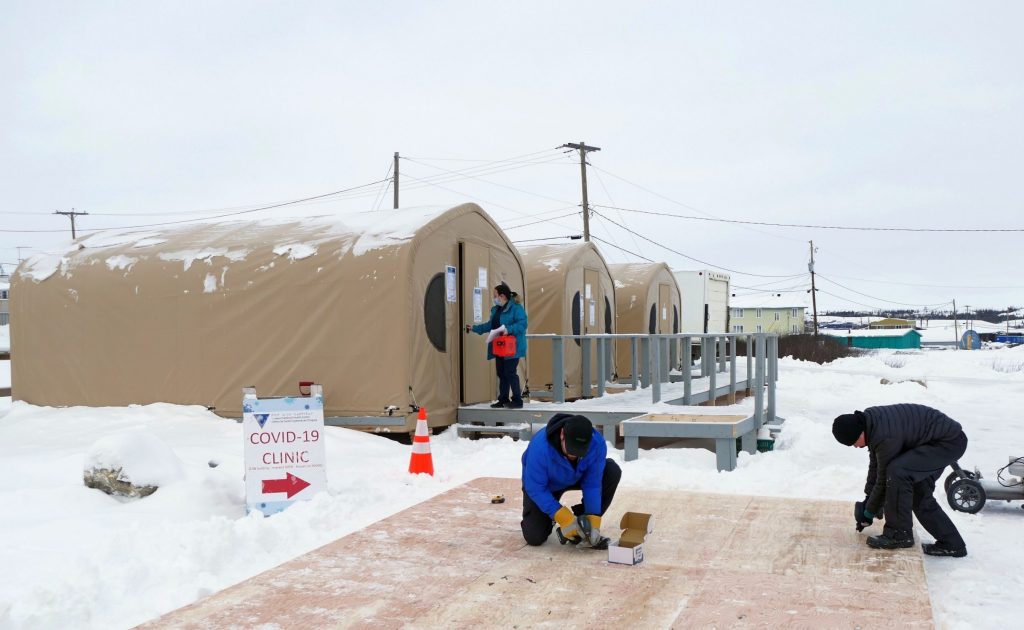
A work crew prepares a platform to set up a new tent outside of the Tulattavik health centre in Kuujjuaq on Nov. 13. The heated tents are being used by health care workers to give flu vaccinations and to administer COVID-19 tests. (Photo by Allen Gordon)
The region buckles down for the pandemic, work starts on Inukjuak’s hydro project and the main internet provider nearly hits capacity
In a year that was dominated by news of a global pandemic, Nunavik was largely spared. The region was able to keep COVID-19 out — except for a few dozen mostly isolated cases — by restricting travel and keeping schools closed for several months.
Santa Claus and his helpers distribute candies and other presents — such as hats, gloves and mitts — during a tour around Kuujjuaq on a municipal flat bed truck dubbed Rudolph on Sunday, Dec. 20. (Photo by Isabelle Dubois)
Volunteers help pack up food baskets in Kuujjuaq on Thursday, Dec. 17. Over the last decade, community organizations like Nayumivik Landing Corp., Makivik Corp. Kuujjuamiut Inc. and the Northern Village of Kuujjuaq contribute to the hampers, which were delivered to just over 700 homes in the Nunavik community this week. (Photo by Allen Gordon)
Selena Whiteley holds two fish she pulled out from her fishing hole at False
River, outside of Kuujjuaq, during the weekend of Dec. 5. (Photo by Malaya Qaunirq Chapman)
Saimmajualy Ekomiak fishes through a hole in the ice he made at False River, outside of Kuujjuaq, during the weekend of Dec. 5. (Photo by Malaya Qaunirq Chapman)
Victoria Grey looks out the window of a helicopter while anticipating her arrival at her fishing cabin at False River, outside of Kuujjuaq, during the weekend of Dec. 5. (Photo by Malaya Qaunirq Chapman)
A new bridge was installed across the river near Inukjuak on Dec. 5, as part of work on 7.5-megawatt run-of-the-river hydro project that’s expected to be complete by late 2022. The bridge will connect to an access road on the far side of the river. The power project is expected to provide nearly all the electricity required for the nearby community of 1,800, which currently relies on diesel. (Photo by Sylvain Paradis)